
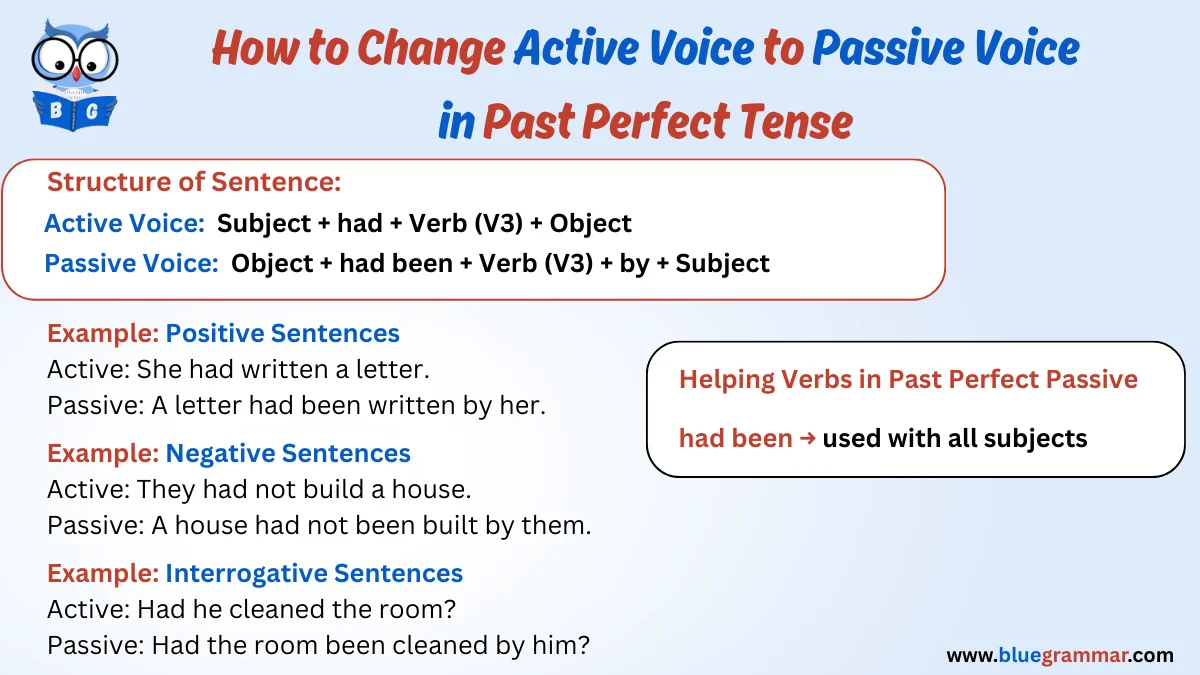
The past perfect tense is used to show that one action was fully completed before another action or moment in the past. When converting a sentence from active voice to passive voice in the past perfect tense, the focus shifts from who performed the action to what was completed earlier. The object of the active sentence becomes the subject of the passive sentence, and the verb takes the form had been + past participle (V3).
Sentence Structure of Active to Passive Voice in Past Perfect Tense
- Active Voice: Subject + had + past participle (V3) + Object
- Passive Voice: Object + had been + past participle (V3) (+ by + Subject)
Helping Verb Used
had been is used with all subjects (I, he, she, it, we, you, they) in the past perfect passive voice.
Examples of Positive Sentences
- Active: The manager had approved the proposal.
- Passive: The proposal had been approved by the manager.
- Active: She had completed the assignment.
- Passive: The assignment had been completed by her.
- Active: They had repaired the bridge.
- Passive: The bridge had been repaired by them.
Examples of Negative Sentences
- Active: The manager had not approved the proposal.
- Passive: The proposal had not been approved by the manager.
- Active: She had not completed the assignment.
- Passive: The assignment had not been completed by her.
- Active: They had not repaired the bridge.
- Passive: The bridge had not been repaired by them.
Examples of Interrogative Sentences
- Active: Had the manager approved the proposal?
- Passive: Had the proposal been approved by the manager?
- Active: Had she completed the assignment?
- Passive: Had the assignment been completed by her?
- Active: Had they repaired the bridge?
- Passive: Had the bridge been repaired by them?
Additional Examples for Practice
- Active: The company had launched the product.
- Passive: The product had been launched by the company.
- Active: The scientist had discovered a new element.
- Passive: A new element had been discovered by the scientist.
- Active: The company had not launched the product.
- Passive: The product had not been launched by the company.
- Active: The scientist had not discovered the cure.
- Passive: The cure had not been discovered by the scientist.
- Active: Had the company launched the product?
- Passive: Had the product been launched by the company?
- Active: Had the scientist discovered the cure?
- Passive: Had the cure been discovered by the scientist?
Key Points to Remember
- The past perfect passive voice uses had been + past participle (V3).
- It indicates that an action was completed before another action in the past.
- The object of the active sentence becomes the subject of the passive sentence.
- In negative sentences, place not between had and been (e.g., had not been).
- In questions, had comes at the beginning of the sentence.
- The phrase “by + subject” is optional and can be omitted when the doer is unknown, obvious, or unimportant.