
The present simple tense is used to describe regular actions, habits, general truths, and facts. When we change a sentence from active voice to passive voice in the present simple tense, the object of the active sentence becomes the subject of the passive sentence. The verb changes to past participle (V3), and we use the helping verbs is, am, or are according to the new subject.
Passive voice is commonly used when the action or object is more important than the doer, or when the doer is unknown or unimportant.
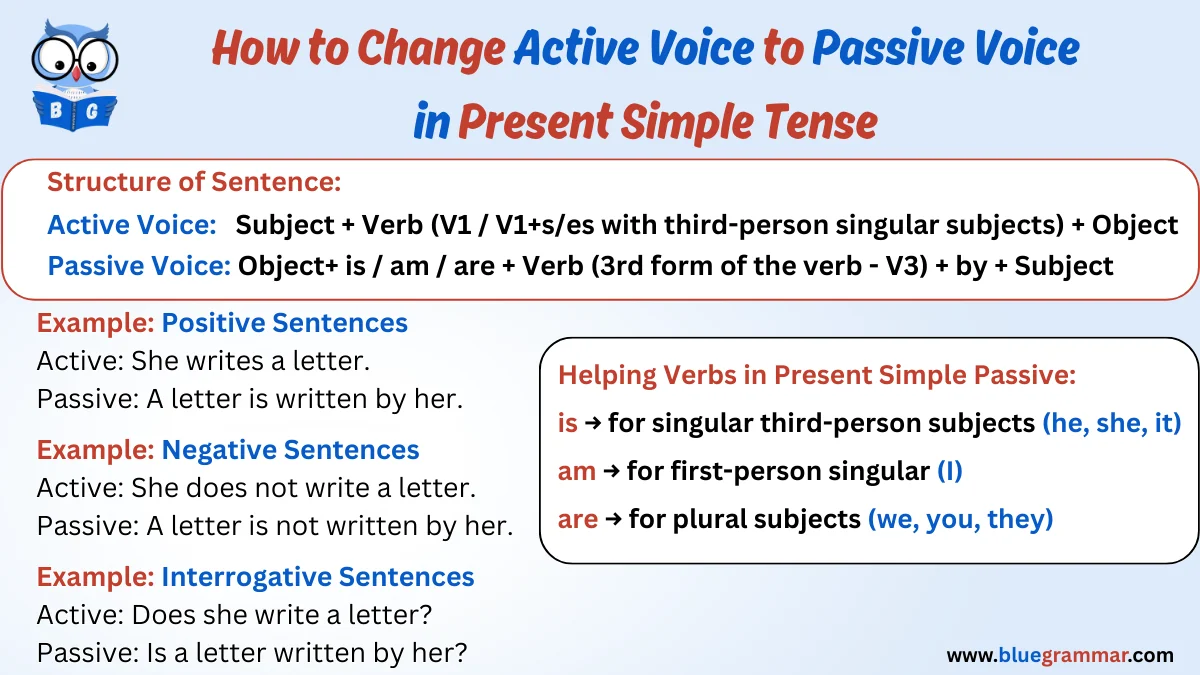
Sentence Structure
- Active Voice: Subject + Verb (V1) + Object
- Passive Voice: Object + is / am / are + Verb (V3) (+ by Subject)
Helping Verbs in Present Simple Passive:
- is → for singular third-person subjects (he, she, it)
- am → for first-person singular (I)
- are → for plural subjects (we, you, they)
Examples of Positive Sentences | Active Passive – Present Simple
- Active: She writes a letter.
- Passive: A letter is written by her.
- Active: They play football.
- Passive: Football is played by them.
- Active: I clean the room.
- Passive: The room is cleaned by me.
Examples of Negative Sentences | Active Passive – Present Simple
- Active: She does not write a letter.
- Passive: A letter is not written by her.
- Active: They do not play football.
- Passive: Football is not played by them.
- Active: I do not clean the room.
- Passive: The room is not cleaned by me.
Examples of Interrogative Sentences | Active Passive – Present Simple
- Active: Does she write a letter?
- Passive: Is a letter written by her?
- Active: Do they play football?
- Passive: Is football played by them?
- Active: Do I clean the room?
- Passive: Is the room cleaned by me?
More Examples for Better Understanding
- Active: The teacher teaches English.
- Passive: English is taught by the teacher.
- Active: The chef cooks food.
- Passive: Food is cooked by the chef.
- Active: The teacher does not teach French.
- Passive: French is not taught by the teacher.
- Active: The chef does not cook rice.
- Passive: Rice is not cooked by the chef.
- Active: Does the teacher teach English?
- Passive: Is English taught by the teacher?
- Active: Does the chef cook food?
- Passive: Is food cooked by the chef?
Key Points to Remember
- Passive voice in present simple uses is, am, or are + past participle (V3).
- The object of the active sentence becomes the subject in passive.
- “By + subject” is optional if the doer is unknown or unimportant.
- Negative sentences: put not after is/am/are.
- Questions: invert the helping verb and the subject.
- Use passive voice to emphasize the action or object, not the doer.