
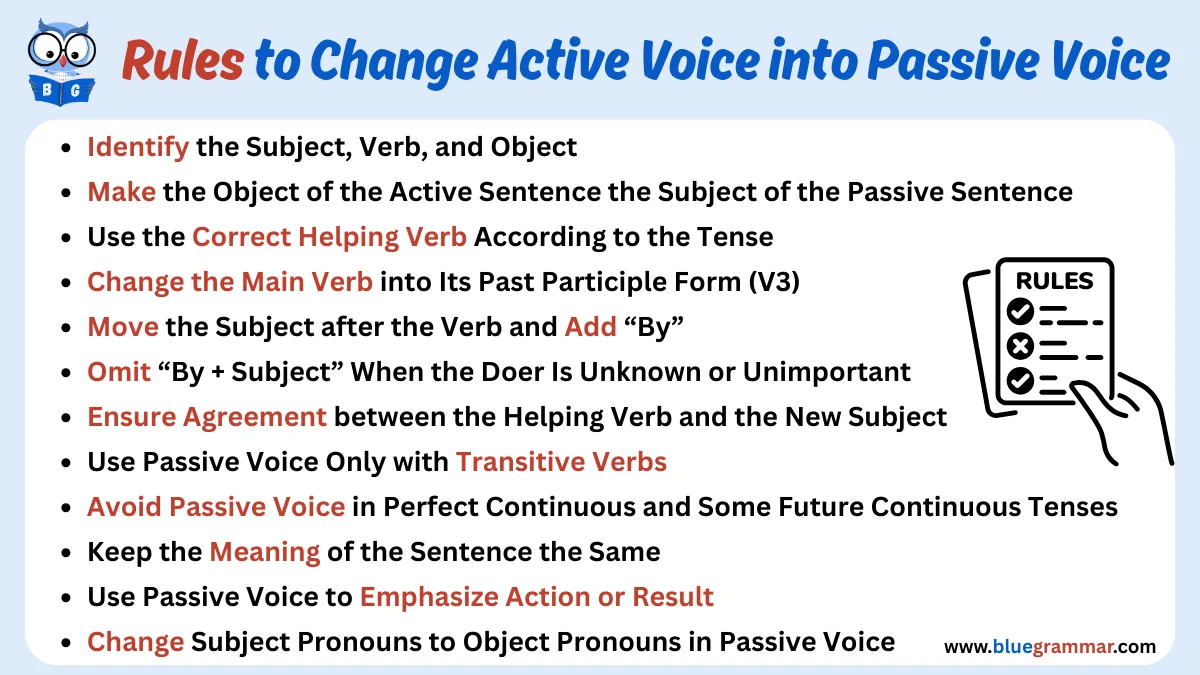
Converting sentences from active voice to passive voice is an essential skill in English grammar. It allows writers to emphasize the action or the recipient of the action rather than the subject performing it. Understanding the rules for this transformation helps ensure clarity, accuracy, and proper sentence structure. In this guide, we will explore the key rules for changing active voice into passive voice, with explanations and examples to make the process easy to follow.
1. Identify the Subject, Verb, and Object
The first and most important step in changing an active sentence into passive voice is to identify its subject, verb, and object. The subject performs the action, the verb shows the action, and the object receives the action. Without clearly identifying these parts, it is not possible to form a correct passive sentence.
- Active: She writes a letter. (Subject: She | Verb: writes | Object: a letter)
2. Make the Object of the Active Sentence the Subject of the Passive Sentence
In passive voice, the object of the active sentence becomes the subject. This shift in focus helps emphasize the action or result rather than the doer. This rule changes the structure but not the meaning of the sentence.
- Active: She writes a letter.
- Passive: A letter is written by her.
3. Use the Correct Helping Verb According to the Tense
Each tense requires a specific helping verb in passive voice. Choosing the correct helping verb is essential to maintain the tense of the original sentence. Common helping verbs include is, am, are, was, were, being, been, and will be.
- Active: She is writing a letter.
- Passive: A letter is being written by her.
4. Change the Main Verb into Its Past Participle Form (V3)
In passive voice, the main verb always appears in its past participle form, regardless of the tense. The tense is shown by the helping verb, not by the main verb itself.
- Active: They build a house.
- Passive: A house is built by them.
5. Move the Subject after the Verb and Add “By”
The subject of the active sentence is placed after the verb in the passive sentence and is usually introduced by the word “by.” This shows who performed the action.
- Active: The teacher teaches English.
- Passive: English is taught by the teacher.
6. Omit “By + Subject” When the Doer Is Unknown or Unimportant
In many passive sentences, the doer of the action is either unknown, obvious, or not important. In such cases, the “by + subject” part is omitted to keep the sentence natural and clear.
- Passive: My wallet was stolen. (The doer is unknown, so it is not mentioned.)
7. Ensure Agreement between the Helping Verb and the New Subject
The helping verb in the passive sentence must agree with the new subject in number (singular or plural). This agreement is necessary for grammatical correctness.
- Active: They clean the rooms.
- Passive: The rooms are cleaned by them.
- Active: He cleans the room.
- Passive: The room is cleaned by him.
8. Use Passive Voice Only with Transitive Verbs
Passive voice can be formed only when the active sentence contains an object. Sentences with intransitive verbs cannot be changed into passive voice because there is no object to become the subject.
- Active: She sleeps.
- Passive: Not possible (no object).
9. Avoid Passive Voice in Perfect Continuous and Some Future Continuous Tenses
Passive voice is not normally used in present perfect continuous, past perfect continuous, future continuous, and future perfect continuous tenses. These forms are grammatically awkward and generally avoided in Standard English.
- Active: She has been writing a letter.
- Passive: Not normally used.
10. Keep the Meaning of the Sentence the Same
While changing an active sentence into passive voice, the meaning must remain the same. Only the structure changes, not the message or idea of the sentence.
- Active: The chef cooked the food.
- Passive: The food was cooked by the chef.
11. Use Passive Voice to Emphasize Action or Result
Passive voice is preferred when the action or result is more important than the person who performs it. This is common in formal writing, reports, and news.
- Passive: The bridge was completed last year.
12. Passive Voice Is Common in Formal and Academic Writing
Passive constructions are often used in scientific, academic, and official writing to maintain an objective tone and avoid personal reference.
- Passive: The experiment was conducted carefully.
13. Questions and Negatives Follow the Same Passive Structure
In passive sentences, negatives are formed by adding “not” after the helping verb, and questions are formed by placing the helping verb at the beginning of the sentence.
- Passive Negative: The work is not completed.
- Passive Question: Is the work completed?
14. Change Subject Pronouns to Object Pronouns in Passive Voice
When the subject of an active sentence is a pronoun, it changes to its object form in the passive sentence and usually comes after “by.” This ensures grammatical correctness and maintains clarity.
- Active: I wrote a letter.
- Passive: A letter was written by me.
- Active: She teaches English.
- Passive: English is taught by her.
Notes
- “You” and “It” remain the same in both cases.
- The “by + object pronoun” part can be omitted if the doer is unknown or unimportant.