
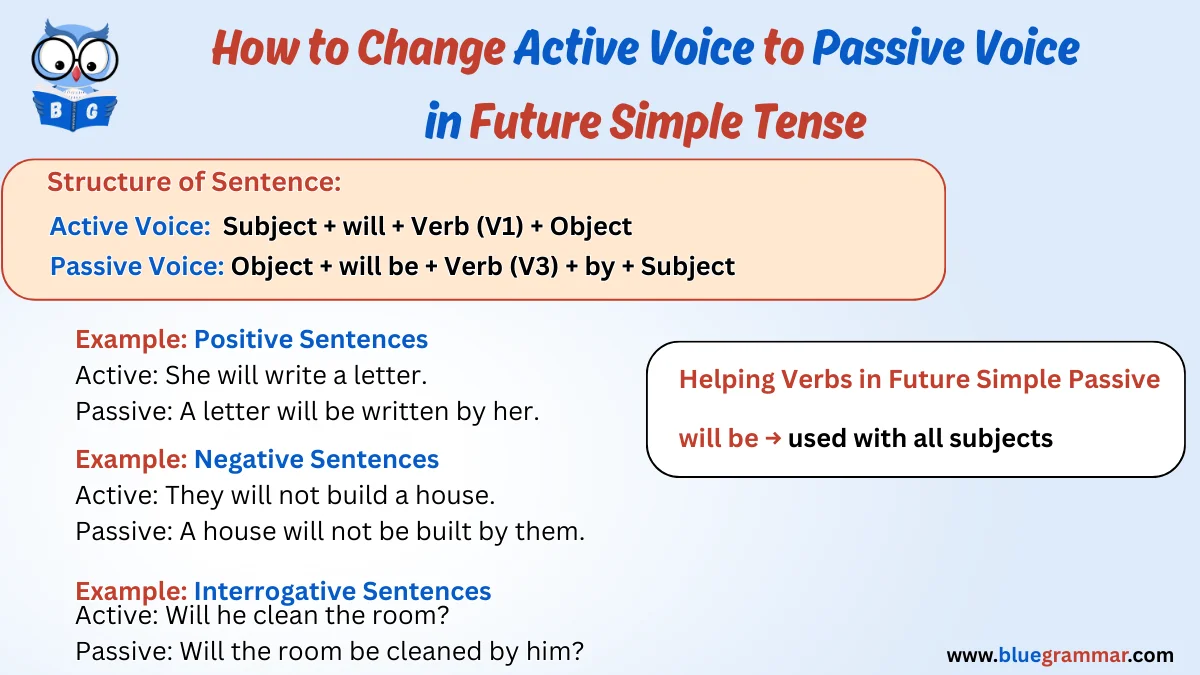
The future simple tense is used to talk about actions that will happen in the future or decisions made at the moment of speaking. When a sentence is changed from active voice to passive voice in the future simple tense, the object of the active sentence becomes the subject of the passive sentence. The main verb changes to its past participle form (V3), and the helping verb “will be” is used. In the passive voice, the focus is on the action that will be done, rather than who will perform the action.
Structure of Active Voice Passive Voice in Future Simple Tense
- Active Voice: Subject + will + Verb (V1) + Object
- Passive Voice: Object + will be + Verb (V3) (+ by + Subject)
Helping Verbs in Future Simple Passive
will be → used with all subjects (I, he, she, it, we, you, they)
Examples of Positive Sentences
- Active: She will play football.
- Passive: Football will be played by her.
- Active: We will build a tower.
- Passive: A tower will be built by us.
- Active: He will wash the car.
- Passive: The car will be washed by him.
Examples of Negative Sentences
- Active: She will not play football.
- Passive: Football will not be played by her.
- Active: We will not build a tower.
- Passive: A tower will not be built by us.
- Active: He will not wash the car.
- Passive: The car will not be washed by him.
Examples of Interrogative Sentences
- Active: Will she play football?
- Passive: Will football be played by her?
- Active: Will we build a tower?
- Passive: Will a tower be built by us?
- Active: Will he wash the car?
- Passive: Will the car be washed by him?
More Examples for Better Understanding
- Active: The teacher will explain the question.
- Passive: The question will be explained by the teacher.
- Active: The chef will bake the cake.
- Passive: The cake will be baked by the chef.
- Active: The teacher will not explain the question.
- Passive: The question will not be explained by the teacher.
- Active: The chef will not bake the cake.
- Passive: The cake will not be baked by the chef.
- Active: Will the teacher explain the question?
- Passive: Will the question be explained by the teacher?
- Active: Will the chef cook the food?
- Passive: Will the food be cooked by the chef?
Key Points to Remember
- Passive voice in the future simple tense uses will be + past participle (V3).
- This tense is used for actions that will happen in the future.
- To make negative sentences, place not between will and be (e.g., will not be).
- To make interrogative sentences, place will at the beginning of the sentence.
- “By + subject” is optional and can be omitted if the doer is unknown or not important.