
The future perfect tense is used to describe an action that will be completed before a specific time or another action in the future. When a sentence is changed from active voice to passive voice in the future perfect tense, the object of the active sentence becomes the subject of the passive sentence. The main verb is changed into its past participle form (V3), and the helping verb “will have been” is used for all subjects.
Passive voice in the future perfect tense emphasizes the completion of an action in the future rather than the doer.
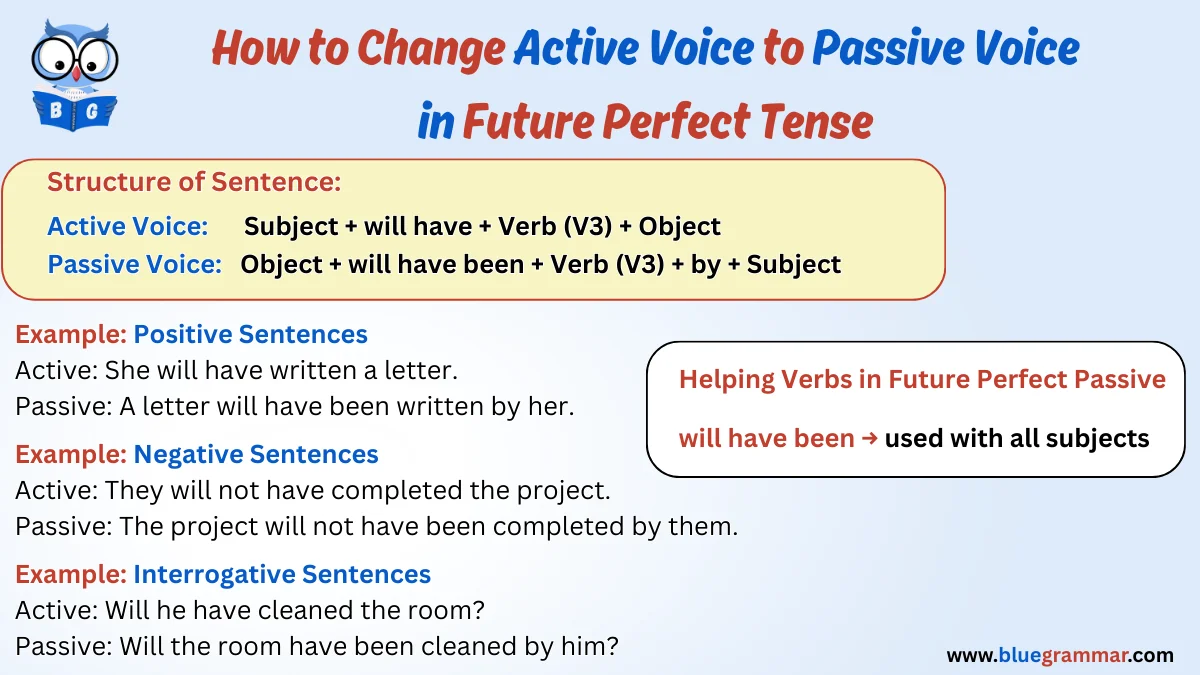
Structure of Active Voice Passive Voice in Future Perfect Tense
- Active Voice: Subject + will have + Verb (V3) + Object
- Passive Voice: Object + will have been + Verb (V3) (+ by + Subject)
Helping Verbs in Future Perfect Passive
will have been → used with all subjects (I, he, she, it, we, you, they)
Examples of Positive Sentences
- Active: She will have written a letter.
- Passive: A letter will have been written by her.
- Active: They will have completed the project.
- Passive: The project will have been completed by them.
- Active: He will have cleaned the room.
- Passive: The room will have been cleaned by him.
Examples of Negative Sentences
- Active: She will not have written a letter.
- Passive: A letter will not have been written by her.
- Active: They will not have completed the project.
- Passive: The project will not have been completed by them.
- Active: He will not have cleaned the room.
- Passive: The room will not have been cleaned by him.
Examples of Interrogative Sentences
- Active: Will she have written a letter?
- Passive: Will a letter have been written by her?
- Active: Will they have completed the project?
- Passive: Will the project have been completed by them?
- Active: Will he have cleaned the room?
- Passive: Will the room have been cleaned by him?
More Examples for Better Understanding
- Active: The teacher will have explained the lesson.
- Passive: The lesson will have been explained by the teacher.
- Active: The chef will have cooked the food.
- Passive: The food will have been cooked by the chef.
- Active: The teacher will not have explained the lesson.
- Passive: The lesson will not have been explained by the teacher.
- Active: The chef will not have cooked rice.
- Passive: Rice will not have been cooked by the chef.
- Active: Will the teacher have explained the lesson?
- Passive: Will the lesson have been explained by the teacher?
- Active: Will the chef have cooked the food?
- Passive: Will the food have been cooked by the chef?
Key Points to Remember
- Passive voice in the future perfect tense uses will have been + past participle (V3).
- This tense shows that an action will be completed before a certain future time.
- The object of the active sentence becomes the subject of the passive sentence.
- For negative sentences, place not after will (e.g., will not have been).
- For interrogative sentences, place will at the beginning of the sentence.
- “By + subject” can be omitted if the doer is unknown or not important.