
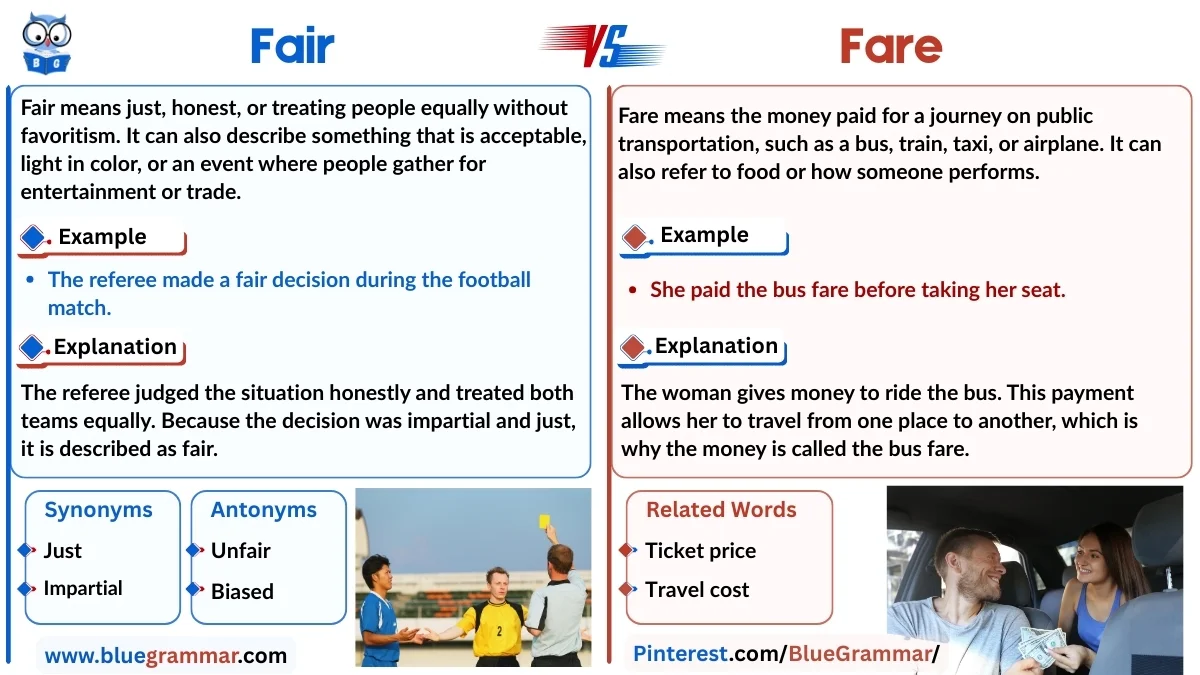
Fair vs. Fare: Difference and Examples
The words fair and fare look similar and sound almost the same, but they have different meanings and uses. Fair can be an adjective meaning just, reasonable, or beautiful, and it can also be a noun meaning a public event with rides or exhibitions. In contrast, fare is usually a noun that refers to the price of a ticket for travel, or it can be a verb meaning to perform or get along. Because these words sound alike, they are often confused in writing. Understanding the difference helps improve clarity and accuracy.
1. Fair
Meaning & Part of Speech: Adjective / Noun — Just, reasonable, or impartial; light in color or clear (adjective); or a public event or gathering with entertainment and stalls (noun).
Explanation: As an adjective, it describes something that is just, reasonable, or impartial, or it can describe beauty, lightness, or clarity (e.g., fair skin or fair weather). As a noun, it refers to a public event or gathering, often with entertainment, stalls, or exhibitions. Overall, fair emphasizes justice, quality, appearance, or organized public events.
Example: It was fair to give everyone an equal chance.
Explanation: In this sentence, fair means just or reasonable. The focus is on treating everyone equally, highlighting impartiality and correctness.
More Examples:
- The judge made a fair decision.
- It’s not fair to blame him for the mistake.
- She has fair skin and blue eyes.
- We enjoyed a fair day at the park.
- The school organized a science fair for students.
- They visited the annual book fair in the city.
Related Words: Just, Impartial, Reasonable, Beautiful, Exhibition
2. Fare
Meaning & Part of Speech: Noun / Verb — The price or money paid for travel on public transport (noun); or to perform, get along, or succeed in a situation (verb).
Explanation: As a noun, it refers to the money paid for a journey on public transport such as a bus, taxi, train, or plane. As a verb, it means to perform, get along, or succeed in a specific situation or attempt. Overall, fare emphasizes the cost of travel or how well someone manages or performs.
Example: The bus fare to the city is $2.50.
Explanation: In this sentence, fare refers to the amount of money a passenger must pay to travel on the bus. It focuses on the cost of transportation rather than justice or events.
More Examples:
- The taxi fare was higher than expected.
- Airplane fares often increase during holidays.
- She fared well in her exams.
- The team fared better than expected in the competition.
- How did he fare during the interview?
Related Words: Ticket price, Charge, Perform, Succeed, Manage
Summary
Although fair and fare sound alike, their meanings are different. Fair can describe justice, beauty, or a public event, while fare refers to the cost of travel or how someone performs in a situation. A simple way to remember the difference is that fare relates to traveling by bus or car (and paying a fare for travel), while fair is about being equail (equal/just) or attending an exhibition.
Exercise: Fill in the Blanks
Choose the correct word (fair or fare) to complete the sentences.
- It was __________ to let everyone participate in the game.
- The train __________ to London is $30.
- She has __________ skin and long blonde hair.
- The school organized a book __________ last week.
- He __________ better than expected in the competition.