
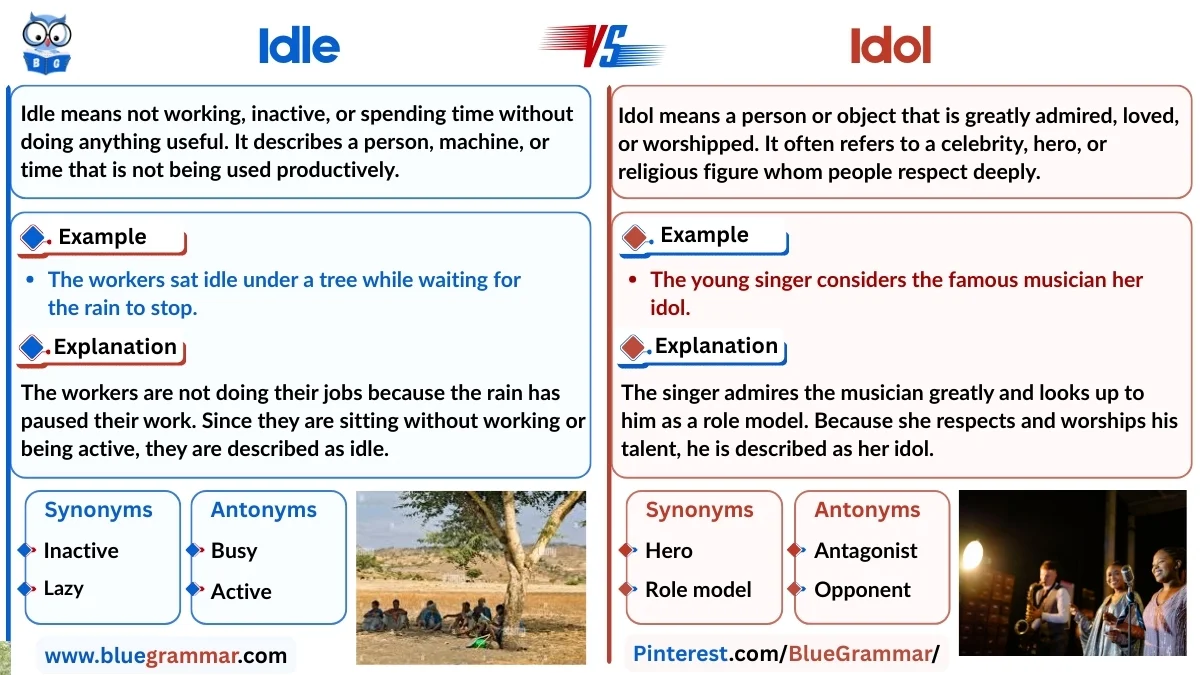
Idle vs. Idol: Difference and Examples
The words idle and idol look and sound very similar, but they have completely different meanings. Idle refers to not being active, in use, or productive, while idol refers to a person or object that is greatly admired, loved, or worshiped. Because of their similar spelling, many learners confuse them in writing. Understanding the difference ensures clarity and helps avoid mistakes.
1. Idle
Meaning & Part of Speech: Adjective / Verb — Not active, not in use, avoiding work, or staying inactive.
Explanation: It is an adjective (and sometimes a verb) that means not active, not in use, or avoiding work. It can describe people, machines, or periods of time when nothing productive is happening. The word often carries a negative connotation when referring to people, suggesting laziness, but it can also simply describe inactivity in a neutral sense. Overall, idle emphasizes inactivity or a lack of purpose.
Example: The workers remained idle during the power outage.
Explanation: In this sentence, idle means that the workers were not working or doing anything productive because the power outage prevented them from performing their tasks. It emphasizes inactivity, not admiration or attention.
More Examples:
- The car engine was idle while waiting at the traffic light.
- He spent the afternoon idle at home instead of studying.
- The factory machines sat idle during the holiday.
- Don’t remain idle when there is work to be done.
- She regretted wasting her idle hours on social media.
Related Words: Inactive, Lazy, Unoccupied, Unused, Dormant
2. Idol
Meaning & Part of Speech: Noun — A person or thing that is greatly admired, loved, or worshiped.
Explanation: It is a noun that means a person or thing that is greatly admired, loved, or worshiped. People often use it to describe celebrities, leaders, or objects of religious worship. An idol inspires admiration, devotion, or respect. Unlike idle, which refers to inactivity, idol focuses on admiration or veneration. Overall, idol emphasizes fame, reverence, or emotional attachment.
Example: The young singer became an idol for millions of fans.
Explanation: In this sentence, idol refers to a person who is admired and looked up to by fans. The word emphasizes fame, popularity, and inspiration, which is completely different from the idea of being idle or inactive.
More Examples:
- Many children consider superheroes their idol.
- She became a fashion idol for young women everywhere.
- Religious idols are often displayed in temples.
- He is an acting idol admired for his talent and dedication.
- The musician’s fans treated him like an idol.
Related Words: Hero, Celebrity, Role model, Famous person, Worshiped figure
Summary
Although idle and idol look and sound very similar, their meanings are entirely different. Idle refers to inactivity, lack of work, or being unproductive, while idol refers to someone or something admired, loved, or worshiped. A simple way to remember the difference is: an idol is someone you look up to (or adore), while idle means doing little to everything (inactive).
Exercise: Fill in the Blanks
Choose the correct word (idle or idol) to complete the sentences.
- The machine remained __________ during the maintenance break.
- Many young fans look up to their favorite singer as an __________.
- He spent the afternoon __________ instead of finishing his homework.
- The actor is considered an __________ in the film industry.
- Don’t remain __________ when there are tasks to complete.