
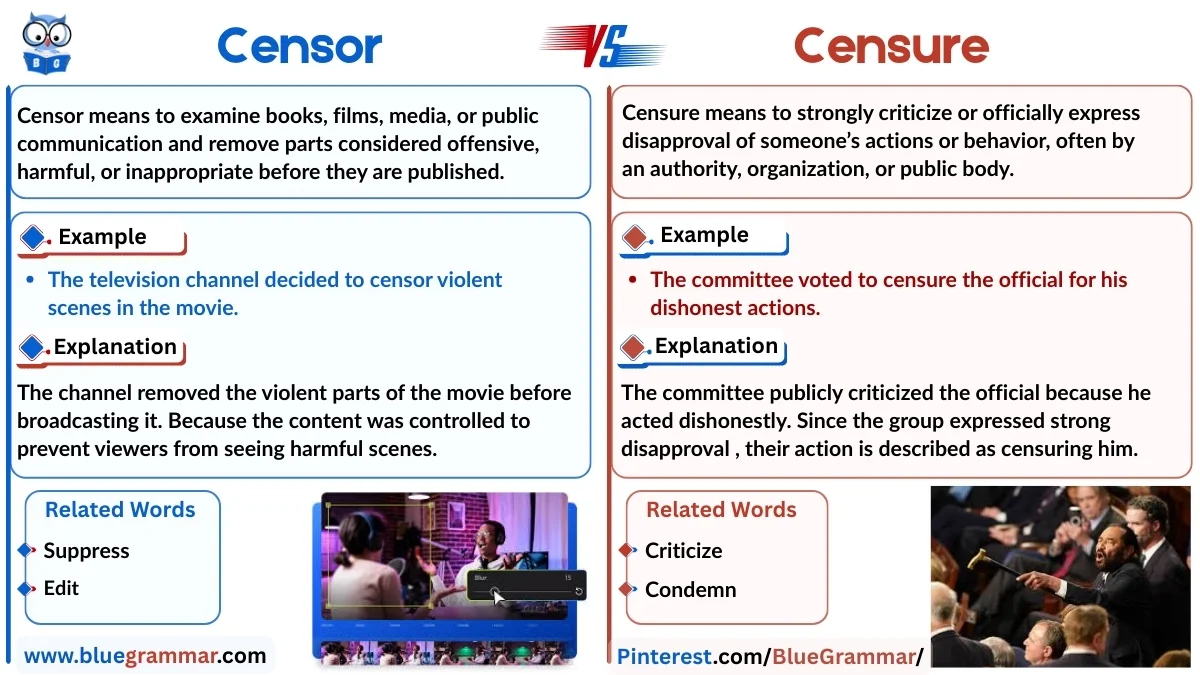
Censor vs. Censure: Difference and Examples
The words censor and censure look and sound similar, but they have different meanings and uses. Censor refers to removing or restricting information that is considered inappropriate or sensitive. In contrast, censure means to strongly criticize or express official disapproval of someone’s actions. Because the two words are spelled similarly and are sometimes used in discussions about authority or control, they are often confused in writing. Understanding the difference helps ensure clearer and more accurate communication.
1. Censor
Meaning & Part of Speech: Verb / Noun — To examine and remove or block parts of books, films, media, or other content considered offensive or harmful; or the official who performs this role.
Explanation: As a verb, it means to examine and remove or block parts of books, films, media, or other content that are considered offensive, harmful, or unsuitable. As a noun, it refers to a person or authority responsible for reviewing and controlling such content. The word is commonly used in contexts involving governments, media organizations, and publishing. Overall, censor emphasizes the act of controlling or restricting information.
Example: The government decided to censor parts of the film.
Explanation: In this sentence, censor means that authorities removed or restricted certain scenes from the film because they were considered inappropriate or sensitive. The word highlights the act of controlling what information or content can be shown to the public.
More Examples:
- Some countries censor news reports to control information.
- The editor had to censor offensive language from the article.
- The television network censored the violent scenes.
- Books were censored during the strict regime.
- The official censor reviewed the film before release.
Related Words: Suppress, Block, Restrict, Edit, Control
2. Censure
Meaning & Part of Speech: Verb / Noun — To strongly criticize or formally express disapproval of someone’s behavior or actions.
Explanation: Censure is usually used as a verb and sometimes as a noun, meaning to strongly criticize or formally express disapproval of someone’s behavior or actions. It often appears in formal or official contexts such as politics, organizations, or institutions where leaders or members are criticized for wrongdoing. Unlike censor, which restricts information, censure focuses on condemnation or judgment. Overall, censure emphasizes strong criticism or official disapproval.
Example: The committee decided to censure the member for violating the rules.
Explanation: In this sentence, censure means that the committee formally criticized and expressed strong disapproval of the member’s actions. The word highlights official condemnation rather than controlling information.
More Examples:
- The council voted to censure the mayor for misconduct.
- Many citizens censured the policy for being unfair.
- The organization issued a statement to censure the leader’s behavior.
- He faced public censure for his controversial remarks.
- The board censured the official after the investigation.
Related Words: Criticize, Condemn, Rebuke, Reprimand, Disapprove
Summary
Although censor and censure look very similar, their meanings are different. Censor means to restrict or remove information or content, while censure means to strongly criticize or express official disapproval. A simple way to remember the difference is that censor relates to controlling information, while censure relates to criticizing someone’s actions.
Exercise: Fill in the Blanks
Choose the correct word (censor or censure) to complete the sentences.
- The television station had to __________ certain scenes from the movie.
- The committee decided to __________ the official for breaking the rules.
- Some governments __________ news that criticizes their policies.
- The council voted to __________ the member for misconduct.
- The editor chose to __________ inappropriate language from the article.