
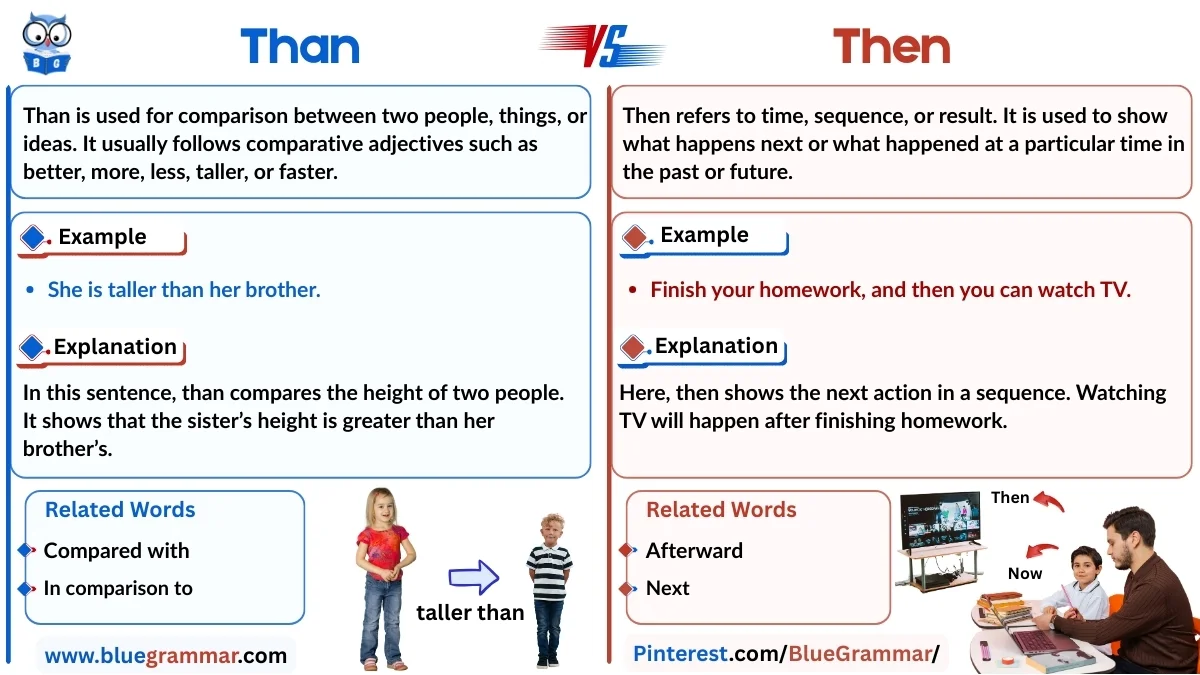
Than vs. Then: Difference and Examples
The words than and then look and sound very similar, but they have completely different meanings and uses. Than is mainly used when making comparisons between two people, things, or ideas. In contrast, then relates to time, sequence, or what happens next. Because these words are spelled almost the same, writers often confuse them in sentences. Learning the difference helps improve grammar accuracy and makes writing clearer and more precise.
1. Than
Meaning & Part of Speech: Conjunction / Preposition — Used when comparing two or more people, objects, actions, or ideas.
Explanation: It is commonly used as a conjunction or preposition when making comparisons. It appears after comparative adjectives or adverbs such as better, more, less, taller, or faster. The word helps show the difference between two people, objects, actions, or ideas. Whenever you compare one thing with another, than is usually required. It is widely used in everyday speech and writing, especially in sentences that highlight differences in size, quality, quantity, or ability. Overall, than emphasizes comparison between two elements.
Example: She is taller than her brother.
Explanation: In this sentence, the word than is used to compare the height of two people: the girl and her brother. The adjective taller is a comparative form, which means it is showing a difference between two individuals. Because a comparison is being made, than correctly connects the two people being compared. Without the word than, the comparison would be incomplete and unclear.
More Examples:
- This road is shorter than the highway.
- Learning vocabulary is easier than memorizing long grammar rules.
- He runs faster than his teammates.
- The blue dress looks better than the red one.
- Reading books is more useful than watching television all day.
Related Words: Compared with, Rather than, More than, Less than, Other than
2. Then
Meaning & Part of Speech: Adverb — Refers to time, chronological sequence, order of events, or logical consequence ("what happens next").
Explanation: It is an adverb that mainly refers to time, order, or sequence of events. It shows what happens next or what happened at a particular moment in the past or future. The word is often used when giving instructions, telling a story, or describing a series of actions. Expressions such as first… then, and then, and back then are very common in English. Unlike than, which compares things, then connects events in a logical or chronological order. Overall, then highlights the idea of time or what happens next.
Example: Finish your homework, then you can go outside.
Explanation: In this sentence, then shows the sequence of two actions. The first action is finishing homework, and the second action is going outside. The word then connects these two steps and indicates that the second action should happen only after the first one is completed. This usage clearly expresses the order in which the activities should occur.
More Examples:
- First mix the ingredients, then bake the cake.
- She finished her work and then went home.
- We lived in Karachi then.
- He checked his email and then started the meeting.
- If the weather improves, then we will go for a picnic.
Related Words: Next, Afterward, Later, Subsequently, At that time
Summary
Although than and then look almost identical, their meanings are very different. Than is used when comparing two things, while then refers to time, sequence, or what happens next. A simple way to remember the difference is: than is used for comparison (both have the letter a), while then is used for time or sequence (both have the letter e).
Exercise: Fill in the Blanks
Choose the correct word (than or then) to complete the sentences.
- She is younger __________ her sister.
- Finish your lunch, __________ you can watch television.
- This book is more interesting __________ the previous one.
- First complete the form, __________ submit it to the office.
- The weather today is colder __________ yesterday.