
Perspective vs. Prospective: Difference and Examples
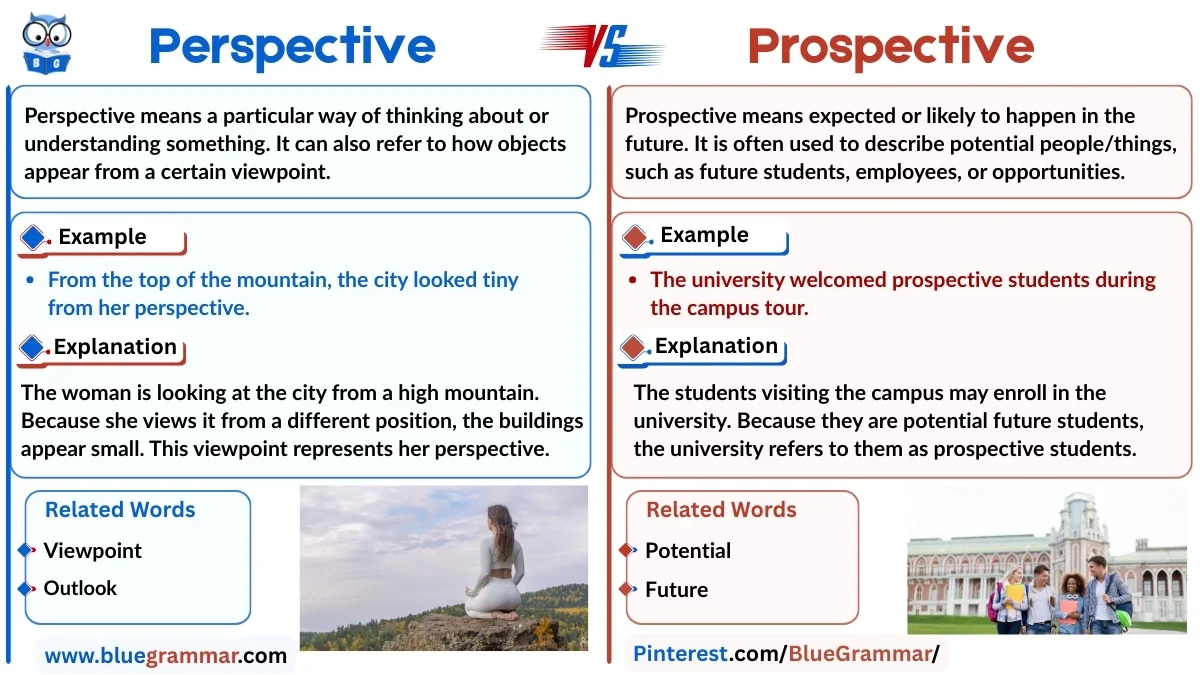
The words perspective and prospective look similar and are sometimes confused in writing, but they have very different meanings. Perspective refers to a particular way of thinking about or understanding something, or a viewpoint toward a situation. In contrast, prospective describes something that is expected or likely to happen in the future. Learning the difference helps improve vocabulary and ensures clear communication.
1. Perspective
Meaning & Part of Speech: Noun — A particular point of view, attitude, or way of considering something; also a visual technique showing depth.
Explanation: It is a noun that refers to a particular point of view, way of thinking, or attitude toward something. It describes how a person understands or interprets a situation based on their experiences, knowledge, or beliefs. In discussions, people may have different perspectives on the same issue because their backgrounds and opinions vary. The word is also used in art and design to describe representing objects so they appear three-dimensional. Overall, perspective emphasizes a viewpoint or way of understanding something.
Example: From a teacher’s perspective, practice is essential for learning.
Explanation: In this sentence, perspective refers to the teacher’s point of view or way of thinking about learning. It shows how the teacher understands the importance of practice based on experience and professional knowledge.
More Examples:
- Everyone has a different perspective on the problem.
- Travel can broaden a person’s perspective on life.
- The article explains the issue from a historical perspective.
- Listening to others helps us understand their perspective.
- The artist used perspective to create depth in the painting.
Related Words: Viewpoint, Point of view, Outlook, Opinion, Angle
2. Prospective
Meaning & Part of Speech: Adjective — Expected or likely to happen or become something in the future; potential.
Explanation: It is an adjective that describes something that is expected, likely, or planned for the future. It is often used to refer to people or things that may become something later. For example, someone applying to a university may be called a prospective student, meaning a potential future student. The word is commonly used in business, education, and professional contexts. Overall, prospective highlights the idea of something that may happen or exist in the future.
Example: The university welcomed many prospective students during the open day.
Explanation: In this sentence, prospective describes students who may join the university in the future. They are not currently students, but they are considering enrolling, so they are potential or future students.
More Examples:
- The company interviewed several prospective employees.
- The event attracted many prospective buyers.
- She met with a prospective client to discuss the project.
- The college provides information for prospective applicants.
- The organization hopes to attract prospective investors.
Related Words: Potential, Future, Possible, Likely, Upcoming
Summary
Although perspective and prospective look similar, their meanings are quite different. Perspective refers to a viewpoint or way of understanding something, while prospective describes something that may happen or exist in the future. A simple way to remember the difference is that perspective relates to perception (how you see things), while prospective relates to prospects (what may happen in the future).
Exercise: Fill in the Blanks
Choose the correct word (perspective or prospective) to complete the sentences.
- From a scientific __________, the results were very interesting.
- The company met several __________ investors.
- Travel helps people gain a broader __________ on life.
- The university organized a meeting for __________ students.
- From her __________, the plan seemed risky.