
All Together vs. Altogether: Difference and Examples
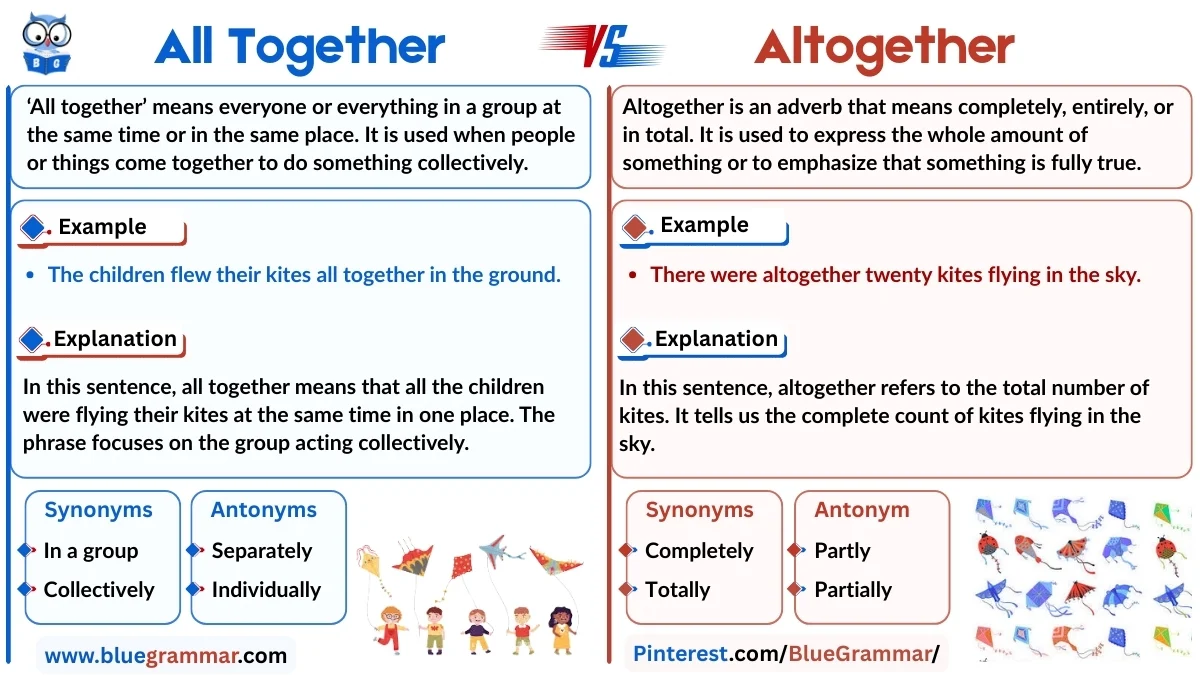
The words all together and altogether sound similar but have different meanings and uses. All together refers to a group of people or things being in the same place or acting as one, while altogether means completely, entirely, or in total. Confusing these two can change the meaning of a sentence, so understanding their difference is important for clear communication.
1. All Together
Meaning & Part of Speech: Phrase / Adverbial Phrase — In a group, gathered in the same place, or acting as one unit.
Explanation: It is a phrase used when a group of people or things are in the same place, at the same time, or acting as one unit. It emphasizes physical presence, unity, or collective action among multiple individuals or items.
Example: The family sat all together for dinner.
Explanation: In this sentence, all together means that every family member was present in one place at the same time for the meal.
More Examples:
- The students stood all together for the class photo.
- We gathered all together to celebrate her birthday.
- The team worked all together to finish the project.
- They sang all together in the choir.
- The birds flew all together in a group across the sky.
Related Words: United, As one, In a group, Collectively, In unison
2. Altogether
Meaning & Part of Speech: Adverb — Completely, entirely, totally, or in total.
Explanation: It is an adverb that means completely, entirely, or in total. It is used to describe the degree of something or to state a grand total, summarizing a situation as a whole.
Example: The trip was altogether enjoyable.
Explanation: In this sentence, altogether means that the trip was completely or entirely enjoyable, emphasizing the overall experience.
More Examples:
- He was altogether surprised by the news.
- The movie was altogether different from what I expected.
- That explanation was altogether confusing.
- There were ten chairs, altogether, in the room.
- She decided to quit the job altogether.
Related Words: Completely, Entirely, Totally, Wholly, Fully
Summary
Although all together and altogether sound similar, they are used differently. All together refers to a group being in the same place or acting as one, while altogether means completely, entirely, or in total. A simple way to remember the difference is that all together has two words with a space, meaning all of us together as a group, while altogether is one single word meaning all-in-all or totally.
Exercise: Fill in the Blanks
Choose the correct word (all together or altogether) to complete the sentences.
- The family was __________ in the living room for the movie.
- That experience was __________ unforgettable.
- The students stood __________ for the group photo.
- There were twenty chairs, __________, in the hall.
- We sang __________ in harmony during the performance.