
Beside vs. Besides: Difference and Examples
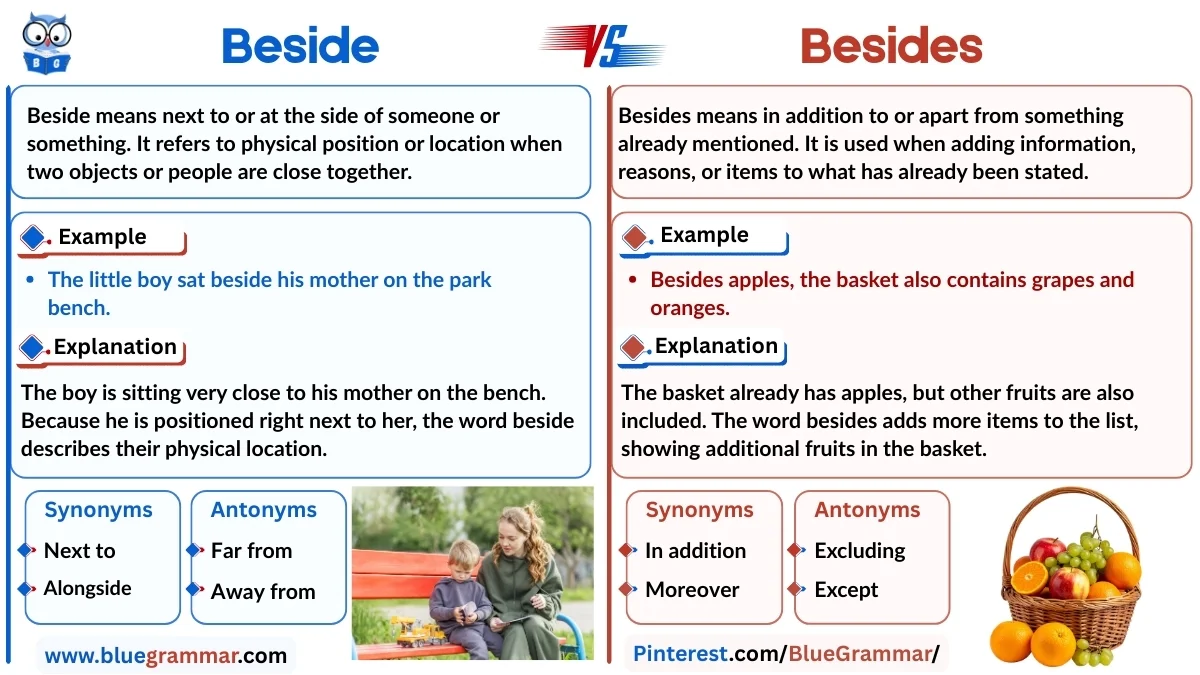
The words beside and besides look very similar, but they have different meanings and uses. Beside usually refers to position or location, meaning “next to” or “at the side of” something. In contrast, besides has two main uses: it can mean “in addition to” or “apart from.” Because their spellings are almost the same, many learners confuse them in writing. Understanding the difference helps make English more precise and natural.
1. Beside
Meaning & Part of Speech: Preposition — Next to, at the side of, or alongside someone or something.
Explanation: It describes physical position or location and is used when one thing is directly adjacent to another. The word is common in everyday conversation, directions, and descriptions of places or arrangements. Overall, beside emphasizes physical closeness or being next to something.
Example: She sat beside her friend during the movie.
Explanation: In this sentence, beside shows the physical position of the girl in relation to her friend. It indicates that she is sitting next to her friend, emphasizing proximity and placement.
More Examples:
- The lamp is beside the bed.
- He stood beside his father in the photograph.
- The dog lay beside the fireplace.
- There is a small garden beside the house.
- Please place the chairs beside the table.
Related Words: Next to, Alongside, By, Near, Adjacent to
2. Besides
Meaning & Part of Speech: Preposition / Adverb — In addition to, as well as, or apart from / other than.
Explanation: It has two common uses: "in addition to" (used to add extra information) and "apart from" or "other than" (used to indicate exception or contrast). It can function as a preposition or adverb depending on the sentence. Overall, besides emphasizes adding something or considering something else beyond what is already mentioned.
Example: Besides English, she speaks Spanish and French.
Explanation: In this sentence, besides means “in addition to English.” The word adds extra information about the languages she can speak, showing that she knows multiple languages beyond the first one mentioned.
More Examples:
- Besides math, he enjoys reading and painting.
- No one came to the party besides his family.
- Besides being tall, she is also very athletic.
- There is no reason to worry besides the minor issue.
- He has no friends besides his brother.
Related Words: In addition to, Moreover, As well as, Except, Other than
Summary
Although beside and besides look almost the same, their meanings are very different. Beside refers to physical position or location, meaning “next to” or “at the side of.” Besides is used to mean “in addition to” or “apart from,” often adding extra information or showing exceptions. A simple way to remember the difference is that besides has an extra s for something extra or something else, while beside is simply by the side.
Exercise: Fill in the Blanks
Choose the correct word (beside or besides) to complete the sentences.
- She placed her bag __________ the chair.
- __________ English, he can also speak German.
- The cat slept __________ the fireplace all night.
- No one helped me __________ my brother.
- He stood __________ me during the ceremony.