
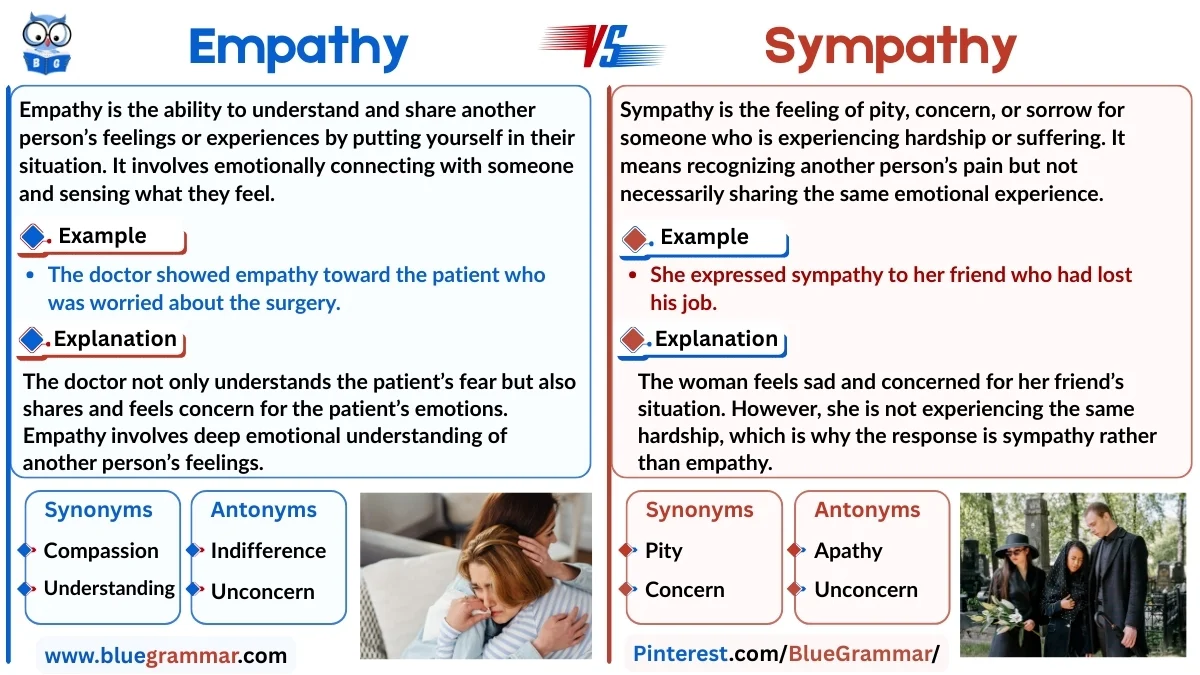
Sympathy vs. Empathy: Difference and Examples
The words sympathy and empathy are often used when talking about understanding someone else’s feelings. Although they are related, their meanings are different. Sympathy means feeling concern or sorrow for someone else’s suffering, while empathy means understanding and sharing the feelings of another person. Because both words involve emotions and compassion, many people use them interchangeably. However, knowing the difference helps us communicate our feelings more accurately and respond better to others.
1. Sympathy
Meaning & Part of Speech: Noun — Feelings of pity, concern, or sorrow for someone who is experiencing difficulty, pain, or sadness.
Explanation: When you show sympathy, you acknowledge another person’s hardship and express care or compassion for them. However, sympathy does not necessarily mean that you personally feel the same emotions as the other person. Instead, it involves recognizing their struggle and offering support, comfort, or kindness. People often express sympathy during times of loss, illness, or hardship. In simple terms, sympathy means feeling sorry for someone and wishing to support them.
Example: She expressed her sympathy to the family after their loss.
Explanation: In this sentence, sympathy means that she showed compassion and concern for the family during a difficult time.
More Examples:
- The community showed sympathy for the victims of the accident.
- He sent a message of sympathy to his grieving friend.
- The teacher expressed sympathy for the student who was feeling unwell.
- Many people offered their sympathy after hearing the sad news.
- Her kind words showed deep sympathy for those affected.
Related Words: Compassion, Pity, Concern, Kindness, Understanding
2. Empathy
Meaning & Part of Speech: Noun — The ability to understand and share the feelings, perspectives, or emotional experiences of another person.
Explanation: When someone shows empathy, they try to imagine what the other person is experiencing and emotionally connect with their situation. Unlike sympathy, empathy involves putting yourself in someone else’s place and truly understanding their emotions. It is often considered an important skill in building strong relationships and effective communication. People who show empathy listen carefully and respond with genuine understanding. In simple terms, empathy means feeling what another person feels and understanding their emotional experience.
Example: The counselor showed great empathy while listening to the student’s problems.
Explanation: In this sentence, empathy means that the counselor tried to understand and emotionally connect with the student’s feelings.
More Examples:
- Good leaders show empathy toward their team members.
- She spoke with empathy to comfort her friend.
- Doctors need empathy when treating patients.
- His empathy helped him understand the struggles of others.
- Teachers often show empathy when students face challenges.
Related Words: Understanding, Sensitivity, Compassion, Insight, Emotional awareness
Summary
Although sympathy and empathy are related to emotions and compassion, they are different. Sympathy means feeling concern or sorrow for someone else’s difficulties, while empathy means understanding and sharing another person’s feelings. A simple way to remember the difference is that sympathy is about feeling for someone, while empathy is about feeling with someone and stepping into their shoes.
Exercise: Fill in the Blanks
Choose the correct word (sympathy or empathy) to complete the sentences.
- The counselor showed great __________ while listening to the student’s problems.
- She expressed her __________ to the family after their loss.
- Good leaders demonstrate __________ when dealing with employees’ concerns.
- Many people sent messages of __________ after hearing the sad news.
- Doctors should treat patients with care and __________.