
Every Day vs. Everyday: Difference and Examples
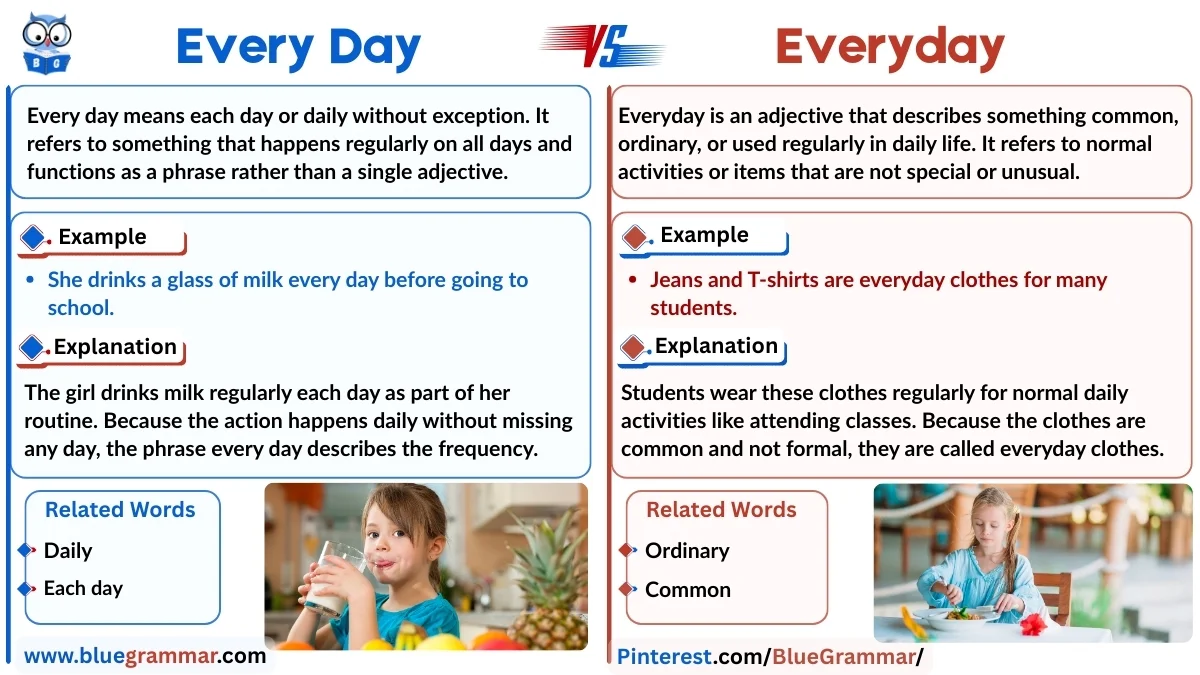
The expressions every day and everyday look almost the same, but they have different meanings and uses. Every day refers to something that happens each day or daily. In contrast, everyday is an adjective that describes something ordinary, common, or used regularly in daily life. Because the difference between them is only a space, many learners confuse these expressions in writing. Understanding the distinction helps improve grammar accuracy and makes sentences clearer.
1. Every Day
Meaning & Part of Speech: Adverbial Phrase — Each day or daily; describes frequency and answers the question “how often?”
Explanation: It is an adverbial phrase used to describe how often something happens. The phrase usually answers the question “how often?” and is commonly used with verbs. It emphasizes regular or repeated actions that occur each day. Overall, every day focuses on frequency or routine.
Example: She goes for a walk every day.
Explanation: In this sentence, every day shows how often she goes for a walk. The phrase indicates that the activity happens daily, highlighting a regular routine.
More Examples:
- He reads the newspaper every day.
- They practice English every day.
- The shop opens every day at 9 a.m.
- I check my email every day.
- She exercises every day to stay healthy.
Related Words: Daily, Each day, Day by day, Regularly, Frequently
2. Everyday
Meaning & Part of Speech: Adjective — Common, ordinary, typical, or used regularly in daily life.
Explanation: Unlike every day, which describes how often something happens, everyday describes the nature or quality of something. The word often appears before a noun to describe routine items or situations. Overall, everyday emphasizes normal or usual things in daily life.
Example: These shoes are perfect for everyday use.
Explanation: In this sentence, everyday describes the type of use. It means the shoes are suitable for normal daily activities rather than special occasions.
More Examples:
- She wore everyday clothes to the store.
- The article discusses everyday problems faced by students.
- Mobile phones are now part of everyday life.
- This bag is ideal for everyday activities.
- Cooking is an everyday task for many people.
Related Words: Ordinary, Common, Routine, Regular, Typical
Summary
Although every day and everyday look very similar, they serve different purposes. Every day means each day and describes how often something happens, while everyday is an adjective that describes something ordinary or commonly used. A simple way to remember the difference is that every day (two words) relates to time or frequency, while everyday (one word) describes common daily things and usually stands right before a noun.
Exercise: Fill in the Blanks
Choose the correct word (every day or everyday) to complete the sentences.
- She drinks coffee __________ before work.
- These shoes are comfortable for __________ use.
- He studies English __________.
- Smartphones are part of __________ life.
- The store is open __________ except Sunday.