
Emigrate vs. Immigrate: Difference and Examples
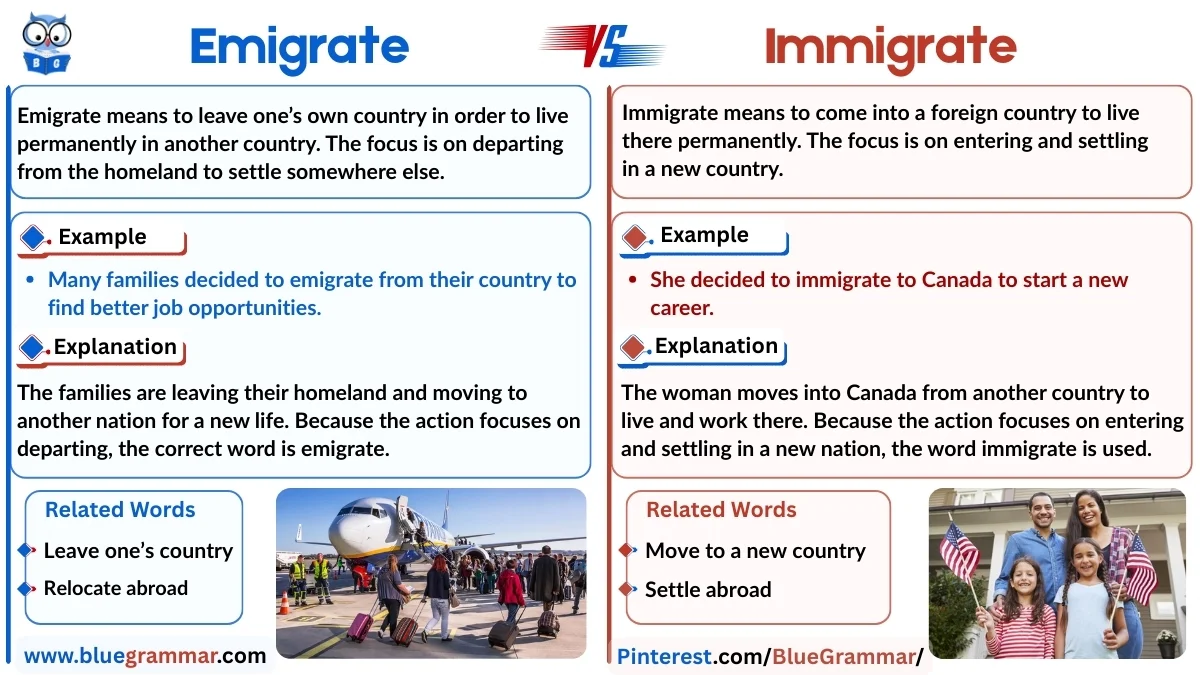
The words emigrate and immigrate look and sound very similar, but they have different meanings depending on the direction of movement. Emigrate means to leave one’s country to live in another country, while immigrate means to come into a new country to live there permanently. Because both words describe people moving between countries, they are often confused in writing. Understanding the difference helps ensure clearer and more accurate communication when discussing migration.
1. Emigrate
Meaning & Part of Speech: Verb — To leave one’s own country in order to live in another country.
Explanation: The focus of this word is on departing from the home country. People often emigrate for reasons such as better job opportunities, education, safety, or a different lifestyle. The word is commonly used in discussions about migration, population movement, and international relocation. Overall, emigrate emphasizes the act of leaving a country.
Example: Many people emigrate from their homeland in search of better opportunities.
Explanation: In this sentence, emigrate describes people leaving their own country to settle somewhere else. The focus is on their departure from their homeland rather than their arrival in the new country.
More Examples:
- She decided to emigrate from her country to start a new life abroad.
- Thousands of workers emigrate each year for better employment.
- His grandparents emigrated to another country many years ago.
- Some families emigrate because of economic challenges.
- They planned to emigrate after completing their studies.
Related Words: Leave, Depart, Relocate, Move abroad, Resettle
2. Immigrate
Meaning & Part of Speech: Verb — To come into a foreign country to live there permanently.
Explanation: The focus of this word is on arriving and settling in a new country. People immigrate to build new lives, find work, pursue education, or join family members. The word is often used in legal, social, and political discussions about migration. Overall, immigrate emphasizes entering and settling in a new country.
Example: Her family plans to immigrate to Canada next year.
Explanation: In this sentence, immigrate refers to the family moving into Canada to live there permanently. The word highlights their arrival and settlement in the new country.
More Examples:
- Many skilled workers immigrate to different countries for career opportunities.
- His parents immigrated to the United States in the 1990s.
- She hopes to immigrate after receiving a job offer abroad.
- Thousands of people immigrate every year for education and work.
- They decided to immigrate to join their relatives.
Related Words: Settle, Arrive, Enter, Relocate, Move in
Summary
Although emigrate and immigrate look very similar, they describe movement from different perspectives. Emigrate focuses on leaving one’s own country, while immigrate focuses on entering and settling in a new country. A simple way to remember the difference is that emigrate means exit from a country, while immigrate means into a country.
Exercise: Fill in the Blanks
Choose the correct word (emigrate or immigrate) to complete the sentences.
- Many people __________ from their homeland to find better jobs abroad.
- Her family plans to __________ to Australia next year.
- His grandparents __________ from Europe many years ago.
- Skilled professionals often __________ to countries with strong economies.
- They decided to __________ after receiving permanent residency approval.