
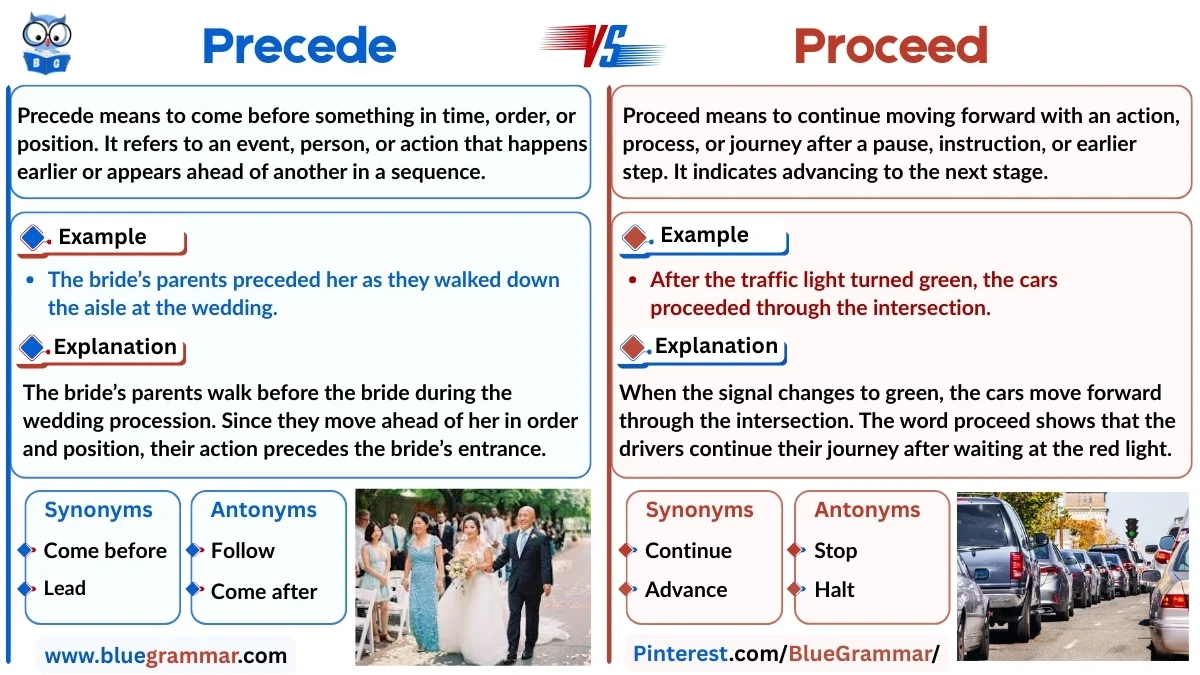
Precede vs. Proceed: Difference and Examples
The words precede and proceed look and sound similar, but they have different meanings and uses. Precede means to come before something in time, order, or position. In contrast, proceed means to continue or move forward with an action or process. Because these words differ by only one letter, they are often confused in writing. Understanding the difference between them helps improve vocabulary and ensures clearer and more accurate communication.
1. Precede
Meaning & Part of Speech: Verb — To come before something else in time, order, rank, or position.
Explanation: It is a verb that means to come before something else in time, order, or position. It is often used when describing events, actions, or items that appear earlier than others. For example, one event may precede another, or one chapter may precede the next in a book. The word is commonly used in formal writing, academic texts, and descriptions of sequences. Overall, precede emphasizes the idea of something happening or appearing earlier than something else.
Example: A short introduction will precede the main presentation.
Explanation: In this sentence, precede means that the introduction will come before the main presentation. The word indicates the order of events, showing that the introduction happens first and the presentation follows afterward.
More Examples:
- A warning usually precedes a storm.
- The opening ceremony will precede the competition.
- Chapter one precedes chapter two in the book.
- A brief discussion preceded the final decision.
- His reputation for hard work preceded him.
Related Words: Come before, Lead, Forego, Antedate, Go ahead of
2. Proceed
Meaning & Part of Speech: Verb — To carry on or continue an action, or to move forward in a location or process.
Explanation: It is a verb that means to continue moving forward or to carry on with an action, plan, or process. It is often used when someone starts or continues an activity after preparation or permission. The word commonly appears in formal instructions, meetings, events, and official announcements. For example, a meeting may proceed after introductions, or a person may proceed with a plan after approval. Overall, proceed emphasizes continuation or moving forward with something.
Example: After the introduction, the speaker will proceed with the main topic.
Explanation: In this sentence, proceed means that the speaker will continue or move forward with the main part of the presentation. The introduction happens first, and then the speaker carries on with the next stage of the discussion.
More Examples:
- The meeting will proceed as scheduled.
- Once the signal is given, the runners will proceed to the track.
- The company decided to proceed with the new project.
- After checking the documents, the officer allowed them to proceed.
- She paused for a moment and then proceeded with her speech.
Related Words: Continue, Advance, Carry on, Move forward, Go ahead
Summary
Although precede and proceed look very similar, their meanings are different. Precede means to come before something in time or order, while proceed means to continue or move forward with an action. A simple way to remember the difference is that precede starts with pre (like a preview or prefix that comes before), while proceed starts with pro (like progress or moving forward).
Exercise: Fill in the Blanks
Choose the correct word (precede or proceed) to complete the sentences.
- A short speech will __________ the award ceremony.
- After the instructions, the participants will __________ with the activity.
- Heavy clouds often __________ a storm.
- The manager asked the team to __________ with the project.
- The opening remarks will __________ the discussion.