
Aural vs. Oral: Difference and Examples
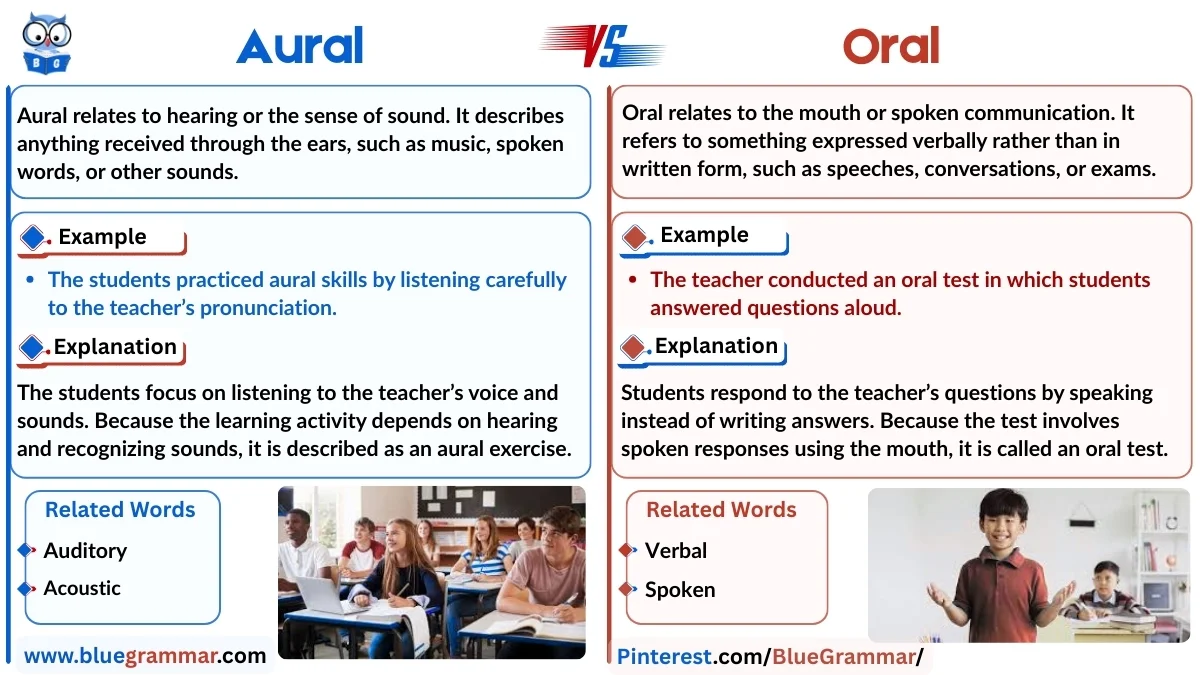
The words aural and oral look and sound similar, but they have different meanings and uses. Aural relates to hearing or the sense of sound, while oral relates to the mouth or spoken communication. Because both words involve sound and communication, they are sometimes confused in writing. Understanding the difference helps improve vocabulary and ensures more accurate expression.
1. Aural
Meaning & Part of Speech: Adjective — Relating to the ear, hearing, or the perception of sound.
Explanation: It is an adjective that refers to hearing or the sense of sound. It is commonly used in contexts related to listening, audio experiences, or sound perception. The word often appears in fields such as music, linguistics, and medicine when describing things that are heard rather than seen or written. Overall, aural emphasizes the act of listening or hearing sounds.
Example: The language course focuses on aural skills to improve listening ability.
Explanation: In this sentence, aural refers to skills related to hearing and understanding spoken language. The course emphasizes listening practice so students can better recognize and understand sounds.
More Examples:
- The musician has excellent aural memory for melodies.
- The test measures students’ aural comprehension.
- Headphones improve the aural experience of music.
- The program helps develop aural recognition of different sounds.
- Good aural training helps musicians identify musical notes.
Related Words: Auditory, Listening, Sound-related, Acoustic, Hearing
2. Oral
Meaning & Part of Speech: Adjective — Relating to the mouth, spoken rather than written speech, or verbal communication.
Explanation: It is an adjective that relates to the mouth or spoken communication. It is often used when referring to speech, spoken exams, or communication that happens through speaking rather than writing. The word is common in education, medicine, and everyday communication. Overall, oral emphasizes speaking or something related to the mouth.
Example: The students must pass an oral exam at the end of the course.
Explanation: In this sentence, oral refers to an exam that is conducted by speaking rather than writing. The students answer questions verbally instead of submitting written responses.
More Examples:
- The teacher asked the class to give an oral presentation.
- The doctor checked the patient’s oral health.
- They practiced oral communication skills in class.
- The job interview included an oral test.
- Children learn oral language before they learn to write.
Related Words: Spoken, Verbal, Mouth-related, Vocal, Speech-based
Summary
Although aural and oral look similar, they have different meanings. Aural relates to hearing and listening, while oral relates to the mouth and spoken communication. A simple way to remember the difference is that aural connects to audio or ears, while oral connects to an open mouth or speaking.
Exercise: Fill in the Blanks
Choose the correct word (aural or oral) to complete the sentences.
- The music program focuses on developing __________ skills.
- The students prepared an __________ presentation for the class.
- Headphones improve the __________ quality of the recording.
- The course includes both written and __________ exams.
- Musicians often develop strong __________ memory for melodies.