
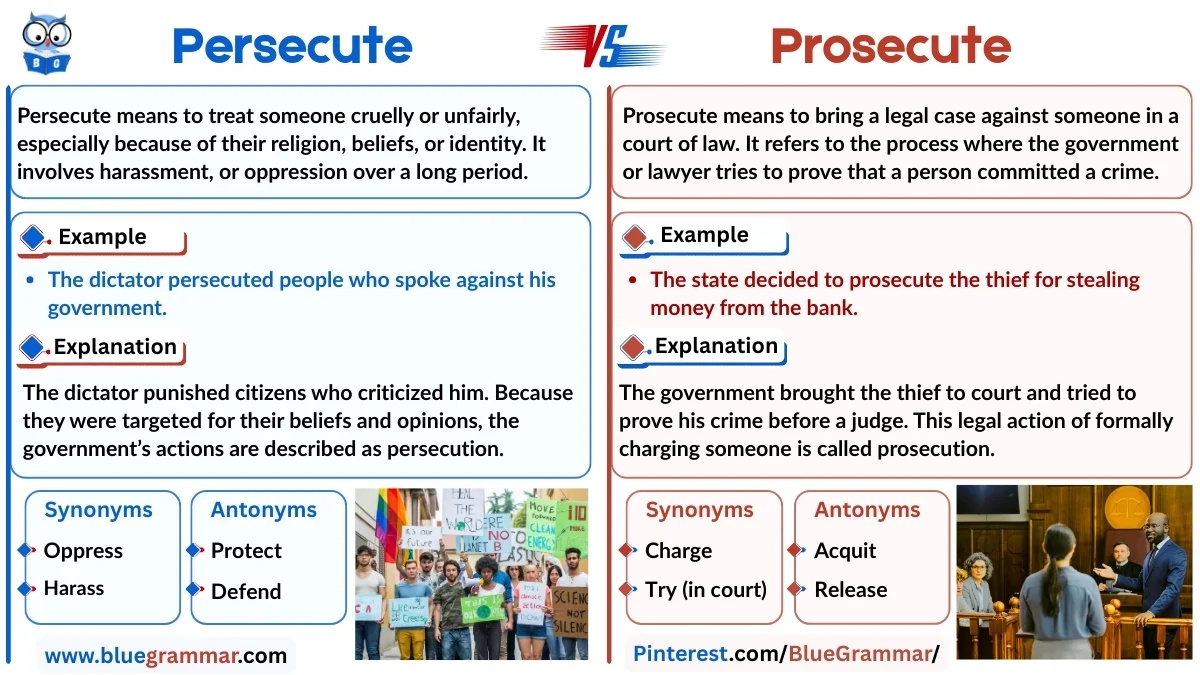
Persecute vs. Prosecute: Difference and Examples
The words persecute and prosecute look and sound somewhat similar, but they have very different meanings. Persecute means to treat someone unfairly or cruelly over a long period of time, usually because of their beliefs, race, religion, or identity. In contrast, prosecute means to take legal action against someone in a court of law for a crime. Because these words are spelled similarly and both relate to conflict or punishment, they are sometimes confused in writing. Understanding the difference helps ensure clear and accurate communication.
1. Persecute
Meaning & Part of Speech: Verb — To harass, oppress, or treat someone cruelly and unfairly, especially because of their race, religion, or political beliefs.
Explanation: It is a verb that means to treat someone cruelly, unfairly, or harshly over a long period of time, often because of their religion, political beliefs, ethnicity, or other personal characteristics. The word is commonly used in discussions about human rights, history, and social issues. Persecution usually involves discrimination, oppression, or repeated harassment directed at a person or group. It emphasizes unjust treatment rather than legal action. Overall, persecute highlights the idea of prolonged cruelty or oppression toward someone.
Example: Many groups throughout history have been persecuted for their religious beliefs.
Explanation: In this sentence, persecuted means that certain groups were treated unfairly or cruelly because of their religion. The word suggests long-term discrimination, oppression, or suffering directed toward those groups because of their beliefs.
More Examples:
- The minority community was persecuted for many years.
- People should never be persecuted because of their opinions.
- The novel describes a family persecuted by an unjust government.
- Some refugees left their country after being persecuted.
- The organization works to protect people who are persecuted.
Related Words: Oppress, Harass, Mistreat, Discriminate against, Abuse
2. Prosecute
Meaning & Part of Speech: Verb — To institute legal proceedings against a person or organization in a court of law for a crime.
Explanation: It is a verb that means to bring legal action against someone in court for committing a crime. It is a formal legal term used in law and government systems. When someone is prosecuted, lawyers present evidence and arguments in court to prove that the person has broken the law. The process is carried out by a prosecutor, who represents the government or the state. Unlike persecution, prosecution follows legal procedures and aims to achieve justice through the court system. Overall, prosecute emphasizes lawful action taken to punish criminal behavior.
Example: The government decided to prosecute the company for breaking environmental laws.
Explanation: In this sentence, prosecute means that the government will take the company to court because it is accused of violating environmental regulations. The word shows that legal action is being taken through the justice system.
More Examples:
- The authorities plan to prosecute those responsible for the fraud.
- The lawyer worked hard to prosecute the criminal case.
- The state will prosecute anyone involved in the illegal activity.
- He was prosecuted for violating tax laws.
- The court agreed to prosecute the case.
Related Words: Charge, Sue, Litigate, Bring to trial, Take legal action
Summary
Although persecute and prosecute look similar, their meanings are very different. Persecute means to treat someone cruelly or unfairly over a long period, often because of their beliefs or identity, while prosecute means to take legal action against someone in a court of law for committing a crime. A simple way to remember the difference is that persecute involves personal bias or oppression, while prosecute involves proceeding in a legal court of law.
Exercise: Fill in the Blanks
Choose the correct word (persecute or prosecute) to complete the sentences.
- Many people were forced to leave their country after being __________ for their beliefs.
- The government decided to __________ the company for violating safety laws.
- No one should be __________ because of their religion.
- The authorities promised to __________ those responsible for the crime.
- Throughout history, some communities were unfairly __________ by rulers.