
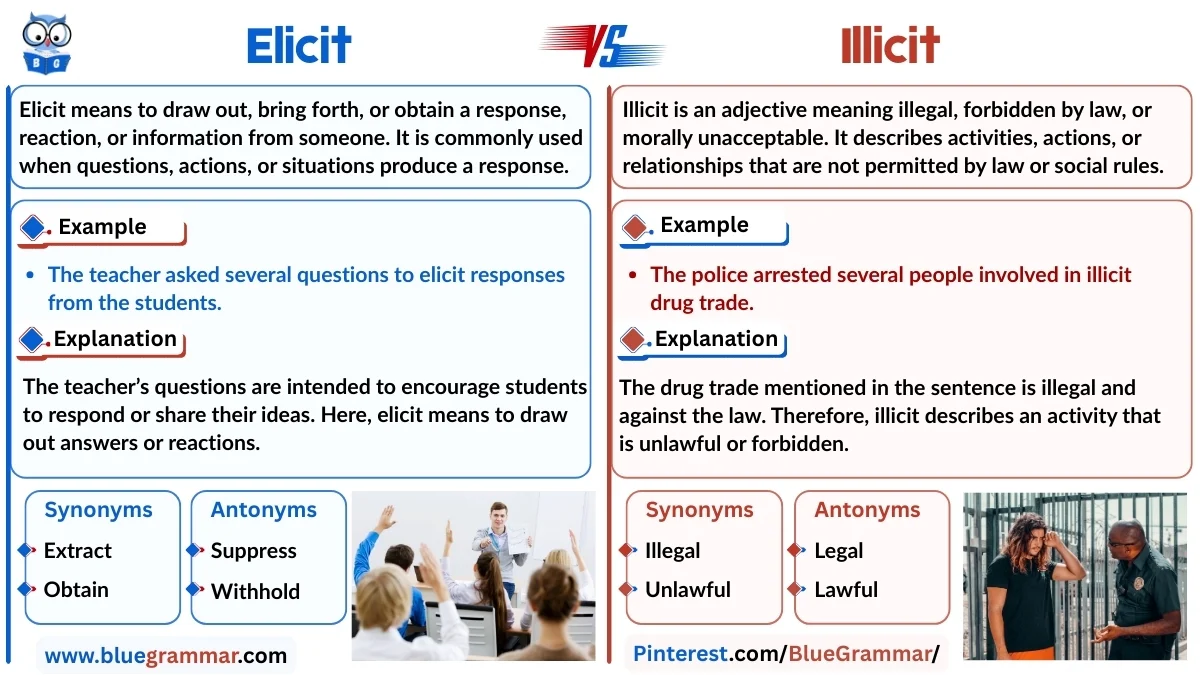
Elicit vs. Illicit: Difference and Examples
The words elicit and illicit look and sound somewhat similar, but they have very different meanings. Elicit is a verb that means to draw out or obtain a response, reaction, or information from someone. In contrast, illicit is an adjective that describes something that is illegal or not permitted by law or rules. Because the spellings differ by only one letter, many learners confuse these words in writing. Understanding their meanings and usage helps ensure clear and accurate communication.
1. Elicit
Meaning & Part of Speech: Verb — To draw out, obtain, or bring out a response, reaction, or piece of information from someone.
Explanation: It is commonly used when someone asks questions or takes actions that cause another person to reveal feelings, ideas, or facts. Teachers, interviewers, and researchers often try to elicit responses or opinions from people during discussions or studies. The word emphasizes the act of encouraging or prompting someone to share something that may not have been expressed otherwise. In many situations, elicit involves communication, questioning, or interaction. Overall, the word focuses on the process of bringing information or reactions to the surface.
Example: The teacher asked questions to elicit answers from the students.
Explanation: In this sentence, elicit means that the teacher asked questions in order to encourage students to respond and share their knowledge.
More Examples:
- The interviewer tried to elicit honest opinions from the candidate.
- The comedian’s jokes elicited laughter from the audience.
- The survey was designed to elicit feedback from customers.
- Her speech elicited strong emotions from the crowd.
- The detective asked questions to elicit important information.
Related Words: Draw out, Obtain, Extract, Evoke, Prompt
2. Illicit
Meaning & Part of Speech: Adjective — Illegal, forbidden, or not allowed by law or social rules.
Explanation: It is commonly used to refer to activities, trade, or relationships that are considered unlawful or improper. For example, authorities often work to stop illicit activities such as illegal trade or smuggling. The word suggests that the action or behavior goes against official regulations or accepted standards. In many contexts, illicit carries a negative meaning because it involves wrongdoing or secrecy. Overall, illicit emphasizes that something is not legally or morally permitted.
Example: The police discovered an illicit trade of stolen goods.
Explanation: In this sentence, illicit describes the illegal activity of trading stolen items, which is against the law.
More Examples:
- The authorities are working to stop illicit drug trafficking.
- He was involved in an illicit business operation.
- The police uncovered an illicit network of smugglers.
- They were accused of selling illicit products online.
- The government imposed strict penalties on illicit trade.
Related Words: Illegal, Unlawful, Prohibited, Forbidden, Criminal
Summary
Although elicit and illicit look similar, they have completely different meanings. Elicit is a verb that means to draw out or obtain information, reactions, or responses. On the other hand, illicit is an adjective that describes something illegal or not allowed by law. A simple way to remember the difference is that elicit is an explicit action to extract info, while illicit refers to illegal or improper activity.
Exercise: Fill in the Blanks
Choose the correct word (elicit or illicit) to complete the sentences.
- The teacher asked a question to __________ responses from the class.
- The police discovered an __________ trade of stolen goods.
- The survey aims to __________ honest opinions from customers.
- Authorities are trying to stop __________ activities in the region.
- His speech managed to __________ a strong reaction from the audience.