
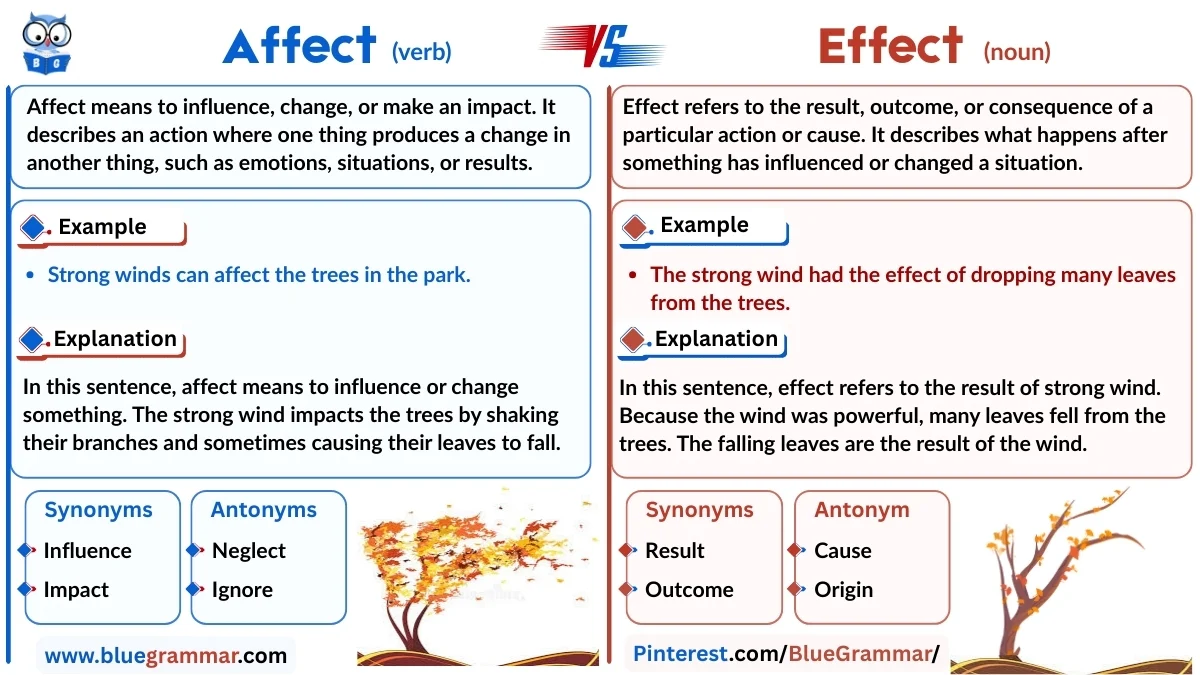
Affect vs. Effect: Difference and Examples
The words affect and effect are commonly confused in English because they sound similar and are related in meaning. Affect is usually a verb that means to influence or make a change, while effect is usually a noun that refers to the result or outcome of a change. Knowing the difference is essential for using these words correctly in writing and speaking.
1. Affect
Meaning & Part of Speech: Verb — To influence, change, alter, or produce an impact on someone or something.
Explanation: It describes the action of influencing, changing, or having an impact on something. It focuses on the process or act that causes a difference in someone or something. For example, when a new policy is introduced at work, it may affect the way employees perform their tasks. Similarly, environmental factors such as weather, pollution, or stress can affect a person’s health, mood, or daily routine. In essence, affect emphasizes the action that produces a change, highlighting the influence or alteration being made rather than the final outcome.
Example: The heavy rain affected the growth of the plants.
Explanation: In this sentence, affected shows that the heavy rain had an influence on how well the plants grew. It describes the action of causing a change.
More Examples:
- High winds affected the leaves on the trees.
- His mood affects how he interacts with others.
- The new law will affect many small businesses.
- Pollution affects the health of city residents.
- Her decision affected the outcome of the project.
Related Words: Influence, Change, Alter, Modify, Impact
2. Effect
Meaning & Part of Speech: Noun — The result, outcome, or consequence of an action or event.
Explanation: It refers to the result, outcome, or consequence of an action or event. It focuses on what happens as a result of a particular influence or change. For instance, taking medicine may have a positive effect on someone’s health, meaning that the person experiences improvement as a result. Similarly, a new law might have a significant effect on society, such as improving safety or changing behaviors. In short, effect emphasizes the end result or consequence of an action rather than the action itself.
Example: The medicine had a positive effect on his health.
Explanation: Here, effect describes the result of taking the medicine—his health improved. It focuses on the outcome rather than the action.
More Examples:
- The new rules had a good effect on student behavior.
- The sunlight has a warming effect on the room.
- The speech made a strong effect on the audience.
- Lack of sleep can have a negative effect on concentration.
- Exercise has many beneficial effects on the body.
Related Words: Result, Outcome, Consequence, Influence, Impact
Summary
Although affect and effect are related, they are used differently. Affect is usually a verb that means to influence or cause a change, while effect is a noun that refers to the result or outcome of a change. A simple way to remember the difference is the acronym RAVEN: Remember Affect = Verb, Effect = Noun (or Affect is the Action, and Effect is the End result).
Exercise: Fill in the Blanks
Choose the correct word (affect or effect) to complete the sentences.
- High winds can __________ the leaves of trees.
- The new law had a positive __________ on the community.
- Her speech did not __________ the audience as expected.
- The medicine had a strong __________ on his recovery.
- Lack of sleep can __________ your ability to focus.