
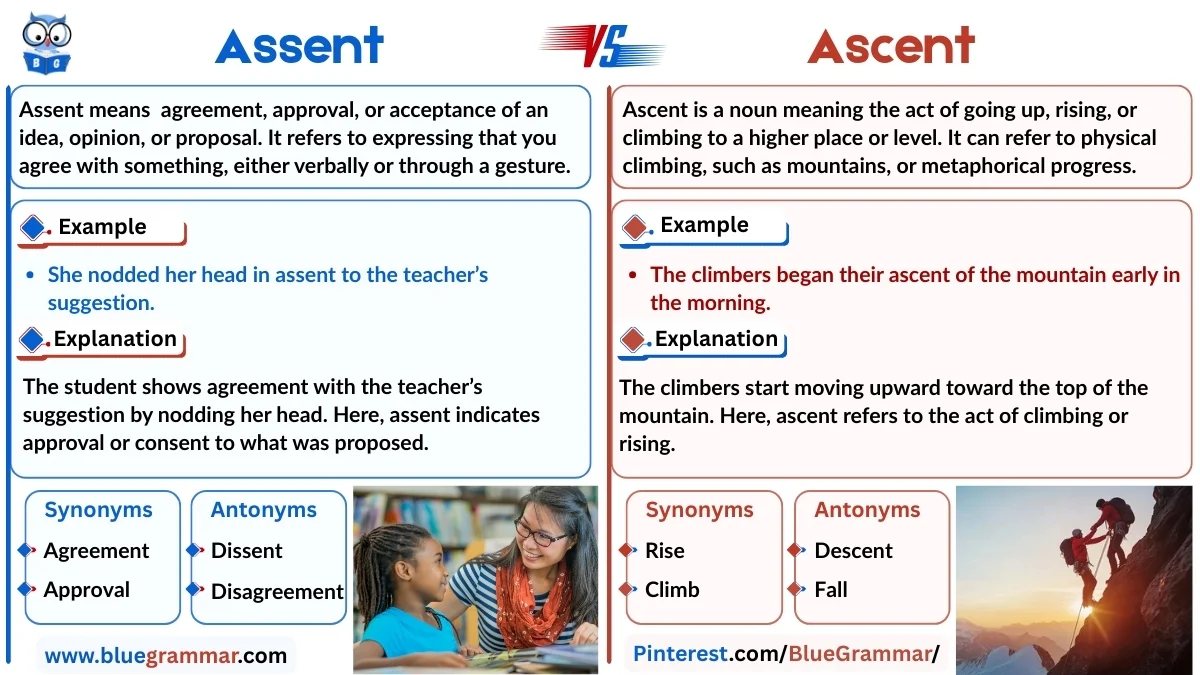
Assent vs. Ascent: Difference and Examples
The words assent and ascent sound the same but have very different meanings. Because they are pronounced alike, they are known as homophones, which often confuse English learners. Assent refers to agreement or approval, while ascent refers to the act of going up or climbing. Understanding the difference between these two words will help you use them correctly in writing and communication.
1. Assent
Meaning & Part of Speech: Noun / Verb — Agreement, approval, or acceptance of an idea, statement, or proposal (noun); or to express agreement (verb).
Explanation: It is used when someone expresses that they agree with something that has been said or suggested. People may show assent through words such as “yes” or “okay,” or even by nodding their heads. The word is often used in formal or written contexts to describe consent or approval. In discussions or meetings, someone may give their assent to a plan or decision after considering it. Overall, assent emphasizes the act of expressing agreement or acceptance.
Example: The manager gave his assent to the new project plan.
Explanation: In this sentence, assent means that the manager agreed with or approved the new project plan.
More Examples:
- She nodded in assent during the meeting.
- The committee gave its assent to the proposal.
- The teacher asked for the students’ assent before starting the activity.
- He smiled and showed his assent to the suggestion.
- The board finally gave assent to the policy changes.
Related Words: Agreement, Approval, Consent, Acceptance, Permission
2. Ascent
Meaning & Part of Speech: Noun — The act of climbing, moving upward, or rising to a higher physical position, level, or status.
Explanation: It is often used when talking about climbing mountains, going uphill, or moving upward physically or metaphorically. The word can also describe progress or advancement, such as someone’s rise to success or power. In many contexts, ascent suggests effort and movement toward a higher position. For example, climbers experience a difficult ascent when climbing a steep mountain. Overall, ascent focuses on the idea of upward movement or progress.
Example: The hikers began their ascent of the mountain early in the morning.
Explanation: In this sentence, ascent refers to the act of climbing or moving upward as the hikers start going up the mountain.
More Examples:
- The ascent to the hilltop was steep and tiring.
- The climbers celebrated after their successful ascent.
- The airplane started its ascent shortly after take-off.
- His ascent to the position of manager was impressive.
- The path became difficult during the mountain ascent.
Related Words: Climb, Rise, Uphill, Elevation, Advancement
Summary
Although assent and ascent sound the same, they have different meanings. Assent refers to agreement or approval, while ascent refers to the act of going up or climbing. A simple way to remember the difference is that assent has a double s for say yes or signed agreement, while ascent contains sc like scale or scramble up a mountain.
Exercise: Fill in the Blanks
Choose the correct word (assent or ascent) to complete the sentences.
- The committee gave its __________ to the new rule.
- The hikers prepared for the difficult __________ of the mountain.
- She nodded in __________ when she heard the plan.
- The airplane began its __________ into the sky.
- The manager gave his __________ to the proposal.