
Eminent vs. Imminent: Difference and Examples
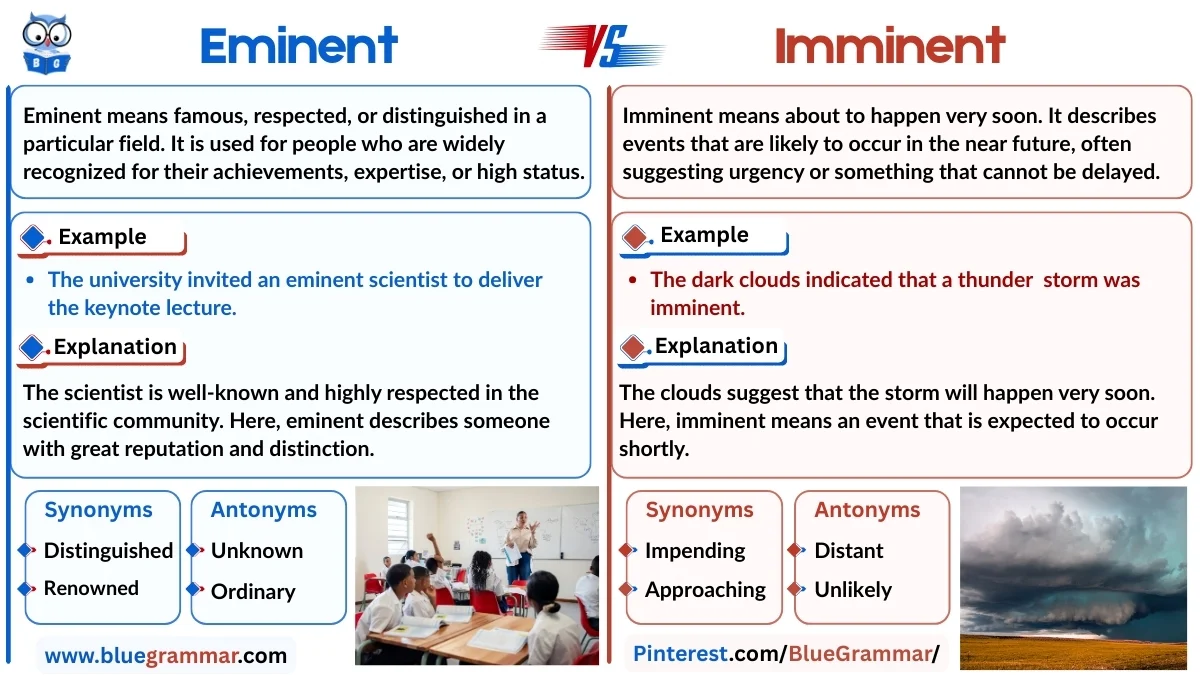
The words eminent and imminent look and sound very similar, but they have completely different meanings. Eminent describes someone who is famous, respected, or highly distinguished in a particular field. In contrast, imminent refers to something that is about to happen very soon. Because their spellings are so close, these words are often confused in writing. Learning the difference between them helps improve vocabulary and ensures accurate communication.
1. Eminent
Meaning & Part of Speech: Adjective — Famous, respected, or highly distinguished in a particular profession or field.
Explanation: It is commonly used for people who have achieved great success or recognition because of their knowledge, skills, or contributions. For example, scientists, scholars, leaders, and artists may be called eminent when they are widely admired for their achievements. The word often appears in formal or academic contexts when referring to someone with a strong reputation. Being eminent usually means standing out among others in the same field. Overall, the word emphasizes honor, reputation, and excellence.
Example: The conference invited an eminent scientist to speak about climate change.
Explanation: In this sentence, eminent describes the scientist as someone highly respected and well-known for their expertise.
More Examples:
- The university honored an eminent professor for his research.
- She became an eminent writer after publishing several successful books.
- The eminent doctor was known for his medical discoveries.
- Many eminent leaders attended the international summit.
- The award recognized her as an eminent artist in the field of painting.
Related Words: Distinguished, Renowned, Famous, Prominent, Notable
2. Imminent
Meaning & Part of Speech: Adjective — About to happen very soon or likely to occur in the near future.
Explanation: It is often used to describe events that are expected to occur shortly, sometimes with a sense of urgency or seriousness. For example, people might talk about an imminent storm, danger, or decision when it is expected to happen very soon. The word emphasizes the closeness in time of an upcoming event. It is commonly used in news reports, warnings, and formal communication. Overall, imminent highlights the idea that something is approaching or about to occur.
Example: Dark clouds suggested that a storm was imminent.
Explanation: In this sentence, imminent means that the storm is expected to happen very soon.
More Examples:
- The announcement of the results is imminent.
- The government warned citizens about an imminent flood.
- The company prepared for the imminent launch of its new product.
- There were signs of an imminent change in weather.
- The team was ready for the imminent start of the match.
Related Words: Approaching, Near, Upcoming, Pending, Forthcoming
Summary
Although eminent and imminent look very similar, they have completely different meanings. Eminent describes a person who is famous, respected, or distinguished in a particular field, while imminent refers to something that is about to happen very soon. A simple way to remember the difference is that eminent is related to excellence, while imminent relates to something occurring immediately.
Exercise: Fill in the Blanks
Choose the correct word (eminent or imminent) to complete the sentences.
- The university invited an __________ professor to give a lecture.
- Dark clouds showed that rain was __________.
- The award was given to an __________ scientist for his discoveries.
- The company prepared for the __________ release of its new product.
- The conference welcomed several __________ leaders from around the world.