
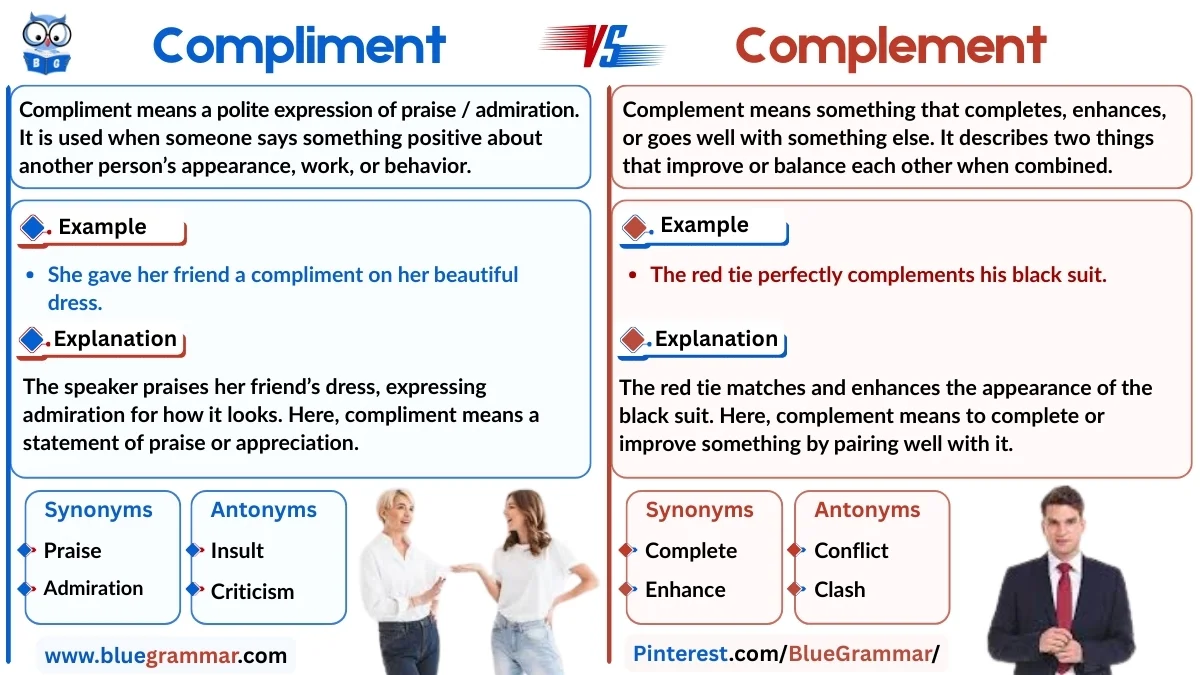
Compliment vs. Complement: Difference and Examples
The words compliment and complement look and sound very similar, but they have different meanings. Compliment usually refers to praise or a polite expression of admiration, while complement refers to something that completes or enhances something else. Because only one letter differs in their spelling, these words are often confused in writing. Understanding their meanings and uses can help learners avoid mistakes and communicate more clearly.
1. Compliment
Meaning & Part of Speech: Noun / Verb — A polite expression of praise, admiration, or approval, or the act of giving such praise.
Explanation: When you give someone a compliment, you are saying something positive about their appearance, work, or behavior. Compliments are often used in social interactions to encourage others and show appreciation. People may compliment someone on their clothing, skills, achievements, or kindness. As a verb, compliment means the act of giving praise or admiration to someone. Overall, compliment focuses on expressing positive words or appreciation toward someone.
Example: She gave her friend a compliment on her beautiful dress.
Explanation: In this sentence, compliment refers to a positive remark praising the friend’s dress.
More Examples:
- The teacher complimented the student for his excellent work.
- He received a compliment on his presentation.
- She smiled after hearing the compliment about her cooking.
- The manager complimented the team on their success.
- A sincere compliment can make someone feel appreciated.
Related Words: Praise, Admiration, Appreciation, Flattery, Approval
2. Complement
Meaning & Part of Speech: Noun / Verb — Something that completes, enhances, or goes well with something else, or to add to something in a way that improves it.
Explanation: When two things complement each other, they combine in a way that improves the overall quality or appearance. The word is commonly used when talking about colors, food combinations, skills, or design elements that work well together. For example, certain flavors may complement each other in cooking, or two colors may complement each other in fashion. As a verb, complement means to add something that improves or completes another thing. Overall, complement emphasizes harmony and balance between elements.
Example: The fresh vegetables complement the flavor of the soup.
Explanation: In this sentence, complement means that the vegetables improve or enhance the taste of the soup when combined with it.
More Examples:
- The blue tie complements his shirt perfectly.
- Her skills complement the abilities of her teammates.
- The lighting complements the design of the room.
- A good side dish can complement the main course.
- The colors of the painting complement each other beautifully.
Related Words: Complete, Enhance, Improve, Match, Harmonize
Summary
Although compliment and complement look almost the same, their meanings are different. Compliment refers to praise or a positive remark given to someone, while complement refers to something that completes or enhances something else. A simple way to remember the difference is that compIiment (with an i) is about I giving praise, while compLement (with an e) is about things that enhance or complete each other.
Exercise: Fill in the Blanks
Choose the correct word (compliment or complement) to complete the sentences.
- She received a nice __________ on her new hairstyle.
- The sauce perfectly __________ the flavor of the grilled chicken.
- The teacher gave a __________ to the student for his hard work.
- The colors of the curtains __________ the furniture in the room.
- A sincere __________ can brighten someone’s day.