
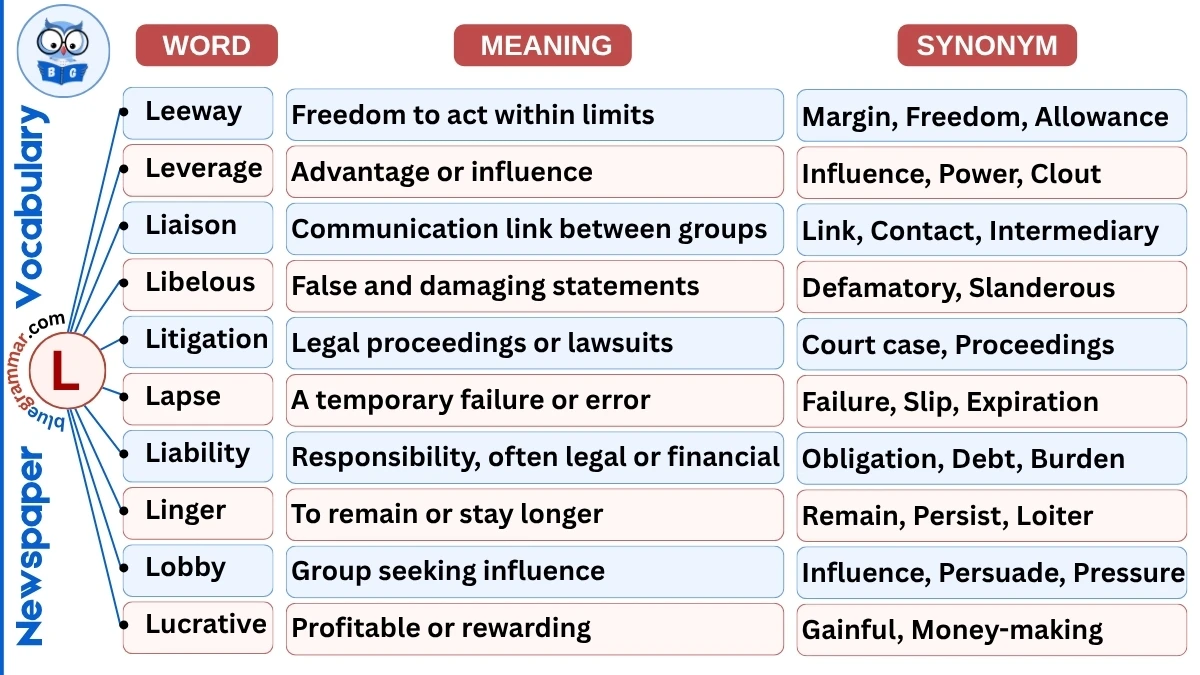
Newspaper Vocabulary | Words Starting with L
Welcome to our comprehensive guide on newspaper vocabulary starting with the letter L. Mastering these formal, precise, and analytical terms will greatly enhance your reading comprehension of news articles, opinion pieces, and editorial columns, as well as elevate your written English.
1. Leeway
Part of Speech: Noun
Meaning: Freedom to act within limits.
Explanation: Often used in policy and legal contexts, leeway describes the flexibility allowed in decisions or actions. It can also indicate tolerance for deviation.
Example: The minister has some leeway in implementing reforms.
2. Leverage
Part of Speech: Noun, Verb
Meaning: Advantage or influence.
Explanation: Commonly used in politics, business, and negotiations, leverage refers to the power to influence outcomes. It can be strategic or financial.
Example: The company used its market share as leverage in negotiations.
3. Liaison
Part of Speech: Noun
Meaning: Communication link between groups.
Explanation: Liaison is often used in diplomacy, corporate reporting, or law enforcement. It refers to someone facilitating coordination between parties.
Example: The diplomat acted as a liaison between the two governments.
4. Libelous
Part of Speech: Adjective
Meaning: False and damaging statements.
Explanation: Frequently used in media and legal reporting, libelous describes content that defames someone. Newspapers and journalists must avoid publishing libelous material.
Example: The article was criticized as libelous.
5. Literal
Part of Speech: Adjective
Meaning: Exact or factual meaning.
Explanation: Literal is used to distinguish between metaphorical and actual meanings. It helps clarify facts in reports.
Example: The report gave a literal description of the events.
6. Litigation
Part of Speech: Noun
Meaning: Legal proceedings or lawsuits.
Explanation: Litigation is common in business, corporate, and political news. It refers to the process of taking a case to court.
Example: The company faced litigation over patent infringement.
7. Logistic
Part of Speech: Adjective
Meaning: Related to planning and coordination.
Explanation: Often used in event, business, or military reporting, logistic refers to managing resources and processes efficiently.
Example: The organizers handled the logistic challenges of the conference expertly.
8. Lament
Part of Speech: Verb, Noun
Meaning: To express sorrow.
Explanation: Lament is often used in human-interest, social, or political news to express regret or mourning.
Example: Citizens lamented the loss of the historic building.
9. Lapse
Part of Speech: Noun, Verb
Meaning: A temporary failure or error.
Explanation: Lapse is used in legal, political, or social reporting. It often refers to a momentary mistake or oversight.
Example: The lapse in security caused public outrage.
10. Laud
Part of Speech: Verb
Meaning: To praise publicly.
Explanation: This word appears in editorial, political, or corporate reporting. It highlights recognition of achievements or contributions.
Example: The minister lauded the volunteers for their work.
11. Liability
Part of Speech: Noun
Meaning: Responsibility, often legal or financial.
Explanation: Liability is commonly used in business, law, and governance. It refers to obligations or accountability.
Example: The company faced liability for the defective products.
12. Liberal
Part of Speech: Adjective, Noun
Meaning: Open-minded or progressive.
Explanation: This word is used in political and social reporting. It describes policies, views, or people that are progressive or tolerant.
Example: The new policy reflected a liberal approach to education.
13. Linger
Part of Speech: Verb
Meaning: To remain or stay longer.
Explanation: Linger is often used in social, economic, or environmental reporting. It indicates persistence or continuation.
Example: The effects of the recession continue to linger in rural areas.
14. Lobby
Part of Speech: Noun, Verb
Meaning: Group seeking influence.
Explanation: Lobby is used in political and corporate news. It refers to advocacy groups trying to influence decisions or legislation.
Example: Environmental lobbyists pushed for stricter regulations.
15. Lucrative
Part of Speech: Adjective
Meaning: Profitable or rewarding.
Explanation: This word appears in business and finance news. It highlights ventures, contracts, or deals that generate substantial profits.
Example: The contract proved lucrative for the tech company.
16. Lukewarm
Part of Speech: Adjective
Meaning: Unenthusiastic or indifferent.
Explanation: Often used in political, business, or social reporting, lukewarm describes weak support, reactions, or interest.
Example: The proposal received a lukewarm response from lawmakers.
17. Lull
Part of Speech: Noun, Verb
Meaning: Temporary calm or pause.
Explanation: This word is used in conflict, economic, or social reporting. It refers to a brief period of inactivity or reduction in intensity.
Example: There was a lull in fighting before negotiations resumed.
18. Lure
Part of Speech: Verb, Noun
Meaning: Attraction or enticement.
Explanation: Lure is used in political, economic, or crime news to describe incentives or temptations.
Example: Tax breaks lured investors to the city.
19. Legitimate
Part of Speech: Adjective, Verb
Meaning: Lawful or valid.
Explanation: This word is frequently used in legal, political, and corporate news. It describes actions or claims that are proper and justified.
Example: The company had legitimate grounds to sue.
20. Loom
Part of Speech: Verb
Meaning: To appear threatening.
Explanation: Loom is used in political, social, and economic news. It conveys an impending problem or danger.
Example: A financial crisis looms over the economy.
21. Litigate
Part of Speech: Verb
Meaning: To take a case to court.
Explanation: Litigate is often used in legal and corporate reporting. It refers to formally pursuing legal action.
Example: The company decided to litigate over patent infringement.
22. Longstanding
Part of Speech: Adjective
Meaning: Existing for a long time.
Explanation: This word appears in social, political, or business news. It describes issues, relationships, or traditions that have persisted.
Example: The longstanding dispute between the two countries was finally resolved.
23. Landmark
Part of Speech: Noun, Adjective
Meaning: Very important or historic.
Explanation: Often used in law, politics, and business, landmark highlights decisions, events, or policies of major significance.
Example: The court issued a landmark ruling on environmental protection.
24. Lawmaker
Part of Speech: Noun
Meaning: Person who makes laws.
Explanation: This word is common in political reporting. It describes legislators or members of parliament actively shaping policy.
Example: Lawmakers debated the new bill for hours.
25. Legislation
Part of Speech: Noun
Meaning: Laws or legal measures.
Explanation: Legislation is frequently mentioned in political and governmental news. It refers to the process of making or enacting laws.
Example: New legislation was introduced to regulate online businesses.