
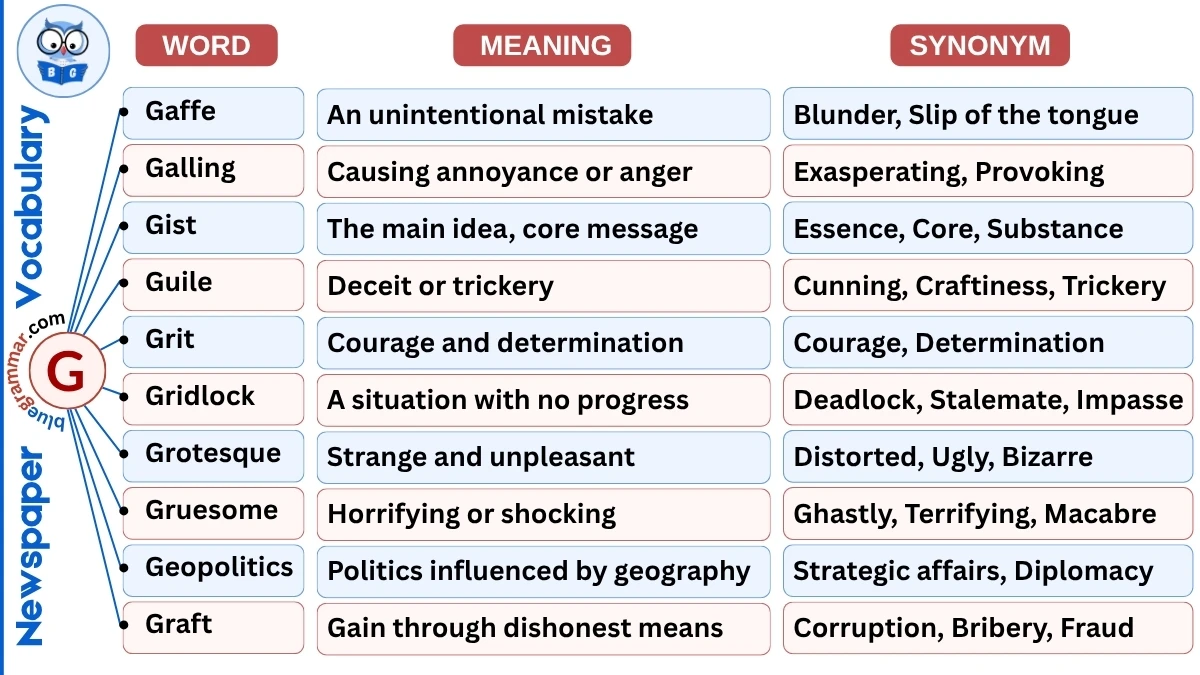
Newspaper Vocabulary | Words Starting with G
Welcome to our comprehensive guide on newspaper vocabulary starting with the letter G. Mastering these formal, precise, and analytical terms will greatly enhance your reading comprehension of news articles, opinion pieces, and editorial columns, as well as elevate your written English.
1. Gallows
Part of Speech: Noun
Meaning: A structure for execution.
Explanation: This word appears in crime or historical news. It symbolizes capital punishment or severe legal consequences. It is often used metaphorically for extreme punishment.
Example: The criminal was sentenced to the gallows.
2. Gaffe
Part of Speech: Noun
Meaning: A careless mistake.
Explanation: This word is common in political news. It refers to embarrassing errors made by public figures, often during speeches or interviews.
Example: The minister’s remark was seen as a major gaffe.
3. Galling
Part of Speech: Adjective
Meaning: Causing annoyance or anger.
Explanation: This word describes situations that are frustrating or humiliating. It is often used in opinion writing.
Example: The defeat was a galling experience for the team.
4. Garner
Part of Speech: Verb
Meaning: To collect or gain.
Explanation: This word is used in political and business news. It refers to gaining support, votes, or attention.
Example: The policy garnered widespread support.
5. Gauge
Part of Speech: Verb, Noun
Meaning: To measure or assess.
Explanation: This word is used when evaluating situations or trends. It is common in economic and analytical reports.
Example: Experts are trying to gauge public opinion.
6. Gist
Part of Speech: Noun
Meaning: The main idea.
Explanation: This word is used when summarizing information. It helps readers understand the core message quickly.
Example: The gist of the report is clear.
7. Glimpse
Part of Speech: Noun, Verb
Meaning: A brief look.
Explanation: This word is used to describe partial or limited information. It often appears in previews or early reports.
Example: The report gives a glimpse of future plans.
8. Grievance
Part of Speech: Noun
Meaning: A complaint or injustice.
Explanation: This word is common in labor and social news. It refers to issues raised by individuals or groups.
Example: Workers filed grievances against management.
9. Grim
Part of Speech: Adjective
Meaning: Serious or worrying.
Explanation: This word is used in negative contexts such as crises or disasters. It highlights severity.
Example: The report presented a grim outlook.
10. Gross
Part of Speech: Adjective, Verb, Noun
Meaning: Extreme or serious.
Explanation: In news, this word is often used in legal contexts like “gross negligence.” It indicates something very serious.
Example: The company was accused of gross misconduct.
11. Groundwork
Part of Speech: Noun
Meaning: Basic foundation.
Explanation: This word is used in development and planning news. It refers to initial efforts that support future success.
Example: The reforms laid the groundwork for growth.
12. Guile
Part of Speech: Noun
Meaning: Deceit or trickery.
Explanation: This word is used in political and crime reporting. It describes dishonest tactics used to achieve goals.
Example: The scheme was carried out with guile.
13. Grit
Part of Speech: Noun
Meaning: Courage and determination.
Explanation: This word is often used in inspirational or human-interest stories. It highlights perseverance.
Example: She showed grit during the crisis.
14. Gridlock
Part of Speech: Noun
Meaning: A situation with no progress.
Explanation: This word is widely used in politics. It describes deadlock where decisions cannot be made.
Example: The parliament remained in gridlock.
15. Grave
Part of Speech: Adjective, Noun
Meaning: Very serious.
Explanation: This word is used to describe critical situations. It appears in warnings and official statements.
Example: The country faces a grave crisis.
16. Gloom
Part of Speech: Noun
Meaning: Darkness or sadness.
Explanation: This word is used to describe negative mood or outlook. It is common in economic and social reports.
Example: Economic uncertainty spread gloom.
17. Grant
Part of Speech: Verb, Noun
Meaning: To give or approve.
Explanation: This word is used in legal, financial, and administrative news. It refers to providing permission or funds.
Example: The court granted bail to the accused.
18. Grotesque
Part of Speech: Adjective
Meaning: Strange and unpleasant.
Explanation: This word is used to describe shocking or disturbing situations. It often appears in crime reporting.
Example: The scene was described as grotesque.
19. Gruesome
Part of Speech: Adjective
Meaning: Horrifying or shocking.
Explanation: This word is used in crime and disaster news. It highlights disturbing details.
Example: The incident had gruesome details.
20. Grasp
Part of Speech: Verb, Noun
Meaning: To understand.
Explanation: This word is used when explaining complex ideas. It refers to understanding something clearly.
Example: It is difficult to grasp the full impact.
21. Geopolitics
Part of Speech: Noun
Meaning: Politics influenced by geography.
Explanation: This word is used in international news. It refers to how location and resources affect global relations.
Example: Geopolitics shapes global alliances.
22. Governance
Part of Speech: Noun
Meaning: The act of governing.
Explanation: This word is used in political and administrative contexts. It refers to how a country or organization is managed.
Example: Good governance ensures stability.
23. Growth
Part of Speech: Noun
Meaning: Increase or development.
Explanation: This word is widely used in economic news. It refers to expansion in economy, population, or business.
Example: The country reported economic growth.
24. Guarantee
Part of Speech: Noun, Verb
Meaning: A promise or assurance.
Explanation: This word is used in legal and financial contexts. It refers to ensuring something will happen.
Example: The policy guarantees equal rights.
25. Graft
Part of Speech: Noun, Verb
Meaning: Corruption or bribery.
Explanation: This word is commonly used in political reporting. It refers to illegal gains through dishonest means.
Example: Officials were accused of graft.