
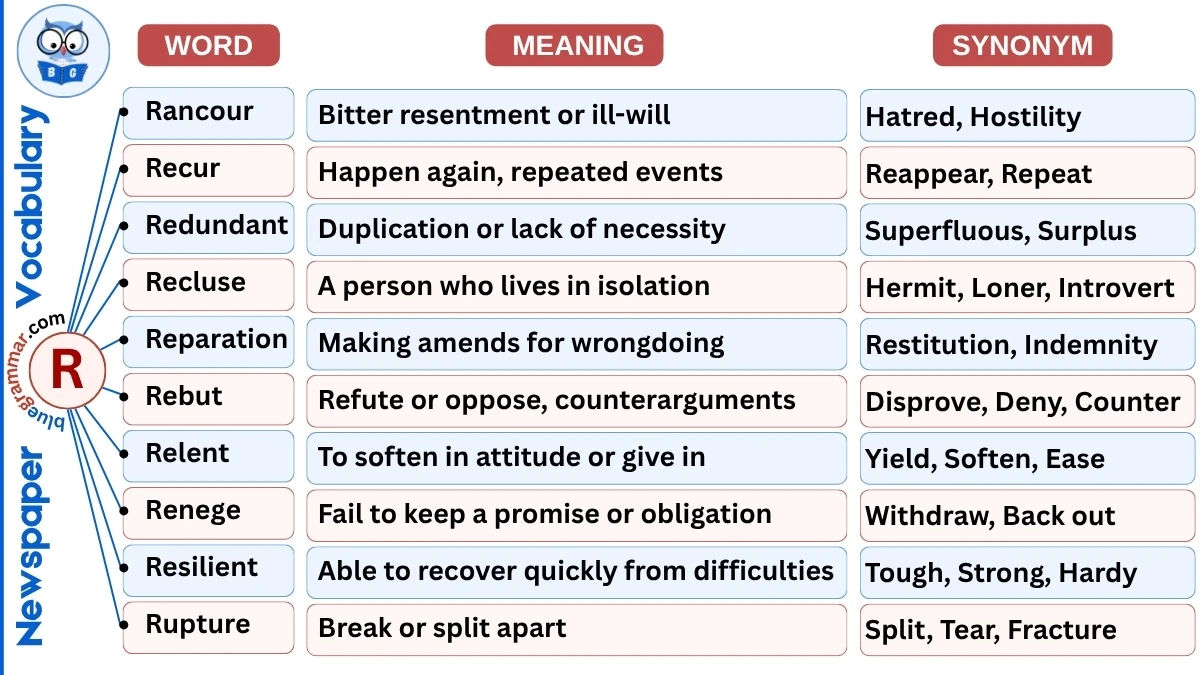
Newspaper Vocabulary | Words Starting with R
Welcome to our comprehensive guide on newspaper vocabulary starting with the letter R. Mastering these formal, precise, and analytical terms will greatly enhance your reading comprehension of news articles, opinion pieces, and editorial columns, as well as elevate your written English.
1. Rancour
Part of Speech: Noun
Meaning: Bitter resentment or ill-will.
Explanation: Rancour is often used in political, social, or international reporting to describe deep hostility between individuals or groups.
Example: The debate ended with rancour between the rival politicians.
2. Recompense
Part of Speech: Noun, Verb
Meaning: Compensation or reward for loss or harm.
Explanation: Recompense is used in legal, financial, and social reporting. It emphasizes making amends or providing restitution.
Example: Victims of the accident were given recompense by the company.
3. Reclamation
Part of Speech: Noun
Meaning: Act of reclaiming or restoring something.
Explanation: Reclamation is used in environmental, industrial, and social reporting. It refers to recovering land, resources, or rights.
Example: The government started a reclamation project for degraded farmland.
4. Recluse
Part of Speech: Noun, Adjective
Meaning: A person who lives in isolation.
Explanation: Recluse is used in human-interest, cultural, or social reporting. It highlights withdrawal from society or public life.
Example: The author became a recluse after his sudden fame.
5. Reconnaissance
Part of Speech: Noun
Meaning: Survey or exploration to gather information.
Explanation: Reconnaissance is used in military, political, and investigative reporting. It refers to assessing situations or collecting intelligence.
Example: Troops conducted reconnaissance to identify enemy positions.
6. Reparation
Part of Speech: Noun
Meaning: Making amends for wrongdoing.
Explanation: Reparation is used in political, social, or legal reporting. It emphasizes compensation or corrective actions for past harm.
Example: The government offered reparation to communities affected by the floods.
7. Repercussion
Part of Speech: Noun
Meaning: Consequence or result of an action.
Explanation: Repercussion is used in political, economic, and social reporting. It highlights indirect or long-term effects.
Example: The policy change had unexpected repercussions on local businesses.
8. Reprimand
Part of Speech: Noun, Verb
Meaning: Formal criticism or warning.
Explanation: Reprimand is used in political, corporate, and legal reporting. It describes official censure of behavior or actions.
Example: The minister received a reprimand for his inappropriate remarks.
9. Relegate
Part of Speech: Verb
Meaning: Assign to a lower position or category.
Explanation: Relegate is used in corporate, sports, and social reporting. It indicates demotion, reduction, or marginalization.
Example: The team was relegated to the second division after poor performance.
10. Relent
Part of Speech: Verb
Meaning: To soften in attitude or give in.
Explanation: Relent is used in political, social, and negotiation reporting. It describes yielding after resistance or pressure.
Example: The authorities finally relented after weeks of protests.
11. Remnant
Part of Speech: Noun, Adjective
Meaning: Remaining part of something.
Explanation: Remnant is used in historical, social, and cultural reporting. It refers to leftover items, populations, or traces.
Example: The ruins are remnants of the ancient civilization.
12. Renege
Part of Speech: Verb
Meaning: Fail to keep a promise or obligation.
Explanation: Renege is used in political, legal, and business reporting. It emphasizes breaking commitments or agreements.
Example: The company reneged on its promise to increase wages.
13. Reverberate
Part of Speech: Verb
Meaning: Echo or have continuing effect.
Explanation: Reverberate is used in political, social, and economic reporting. It describes impacts that continue to be felt widely.
Example: The scandal reverberated across the international media.
14. Resilient
Part of Speech: Adjective
Meaning: Able to recover quickly from difficulties.
Explanation: Resilient is used in human-interest, economic, and social reporting. It highlights endurance, strength, and adaptability.
Example: The community proved resilient after the devastating flood.
15. Resurgence
Part of Speech: Noun
Meaning: Revival or comeback.
Explanation: Resurgence is used in political, social, and economic reporting. It describes renewed activity, interest, or growth.
Example: There has been a resurgence of interest in traditional crafts.
16. Retribution
Part of Speech: Noun
Meaning: Punishment for wrongdoing.
Explanation: Retribution is used in crime, legal, and political reporting. It emphasizes justice or vengeance for harmful actions.
Example: The court imposed severe retribution on the offenders.
17. Revolutionize
Part of Speech: Verb
Meaning: Completely change or transform.
Explanation: Revolutionize is used in business, technological, and social reporting. It describes transformative or radical changes.
Example: The internet has revolutionized communication globally.
18. Rugged
Part of Speech: Adjective
Meaning: Strongly built or rough.
Explanation: Rugged is used in environmental, political, or human-interest reporting. It can describe terrain, individuals, or conditions.
Example: The hikers faced rugged terrain during their expedition.
19. Rupture
Part of Speech: Noun, Verb
Meaning: Break or split apart.
Explanation: Rupture is used in political, social, and health reporting. It describes breaks in relationships, systems, or physical structures.
Example: Diplomatic ties ruptured after the controversial statements.
20. Radical
Part of Speech: Adjective, Noun
Meaning: Extreme or fundamental change.
Explanation: Radical is used in political, social, and economic reporting. It describes revolutionary ideas or actions.
Example: The party proposed radical reforms to the education system.
21. Ramification
Part of Speech: Noun
Meaning: Consequence or implication.
Explanation: Ramification is used in political, economic, and social reporting. It highlights outcomes or effects of decisions.
Example: The new law has serious ramifications for small businesses.
22. Rebut
Part of Speech: Verb
Meaning: Refute or oppose.
Explanation: Rebut is used in political, legal, and journalistic reporting. It describes presenting counterarguments or evidence.
Example: The senator rebutted allegations of misconduct in his speech.
23. Reconcile
Part of Speech: Verb
Meaning: Restore friendly relations.
Explanation: Reconcile is used in political, social, and corporate reporting. It describes settling differences or disputes.
Example: The two parties reconciled after months of negotiations.
24. Recur
Part of Speech: Verb
Meaning: Happen again.
Explanation: Recur is used in economic, political, or social reporting. It describes repeated events, problems, or patterns.
Example: Protests recurred despite government promises.
25. Redundant
Part of Speech: Adjective
Meaning: Unnecessary or repetitive.
Explanation: Redundant is used in corporate, policy, and editorial reporting. It highlights duplication or lack of necessity.
Example: The report contains redundant information that could confuse readers.