
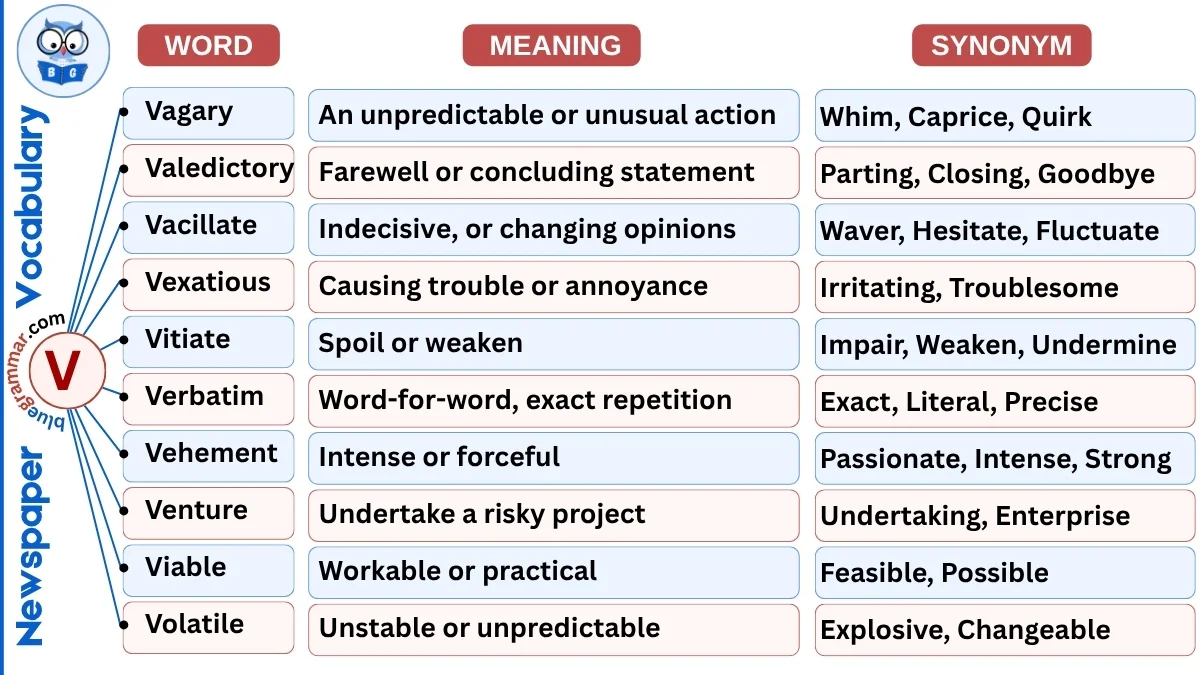
Newspaper Vocabulary | Words Starting with V
Welcome to our comprehensive guide on newspaper vocabulary starting with the letter V. Mastering these formal, precise, and analytical terms will greatly enhance your reading comprehension of news articles, opinion pieces, and editorial columns, as well as elevate your written English.
1. Vagary
Part of Speech: Noun
Meaning: An unpredictable or unusual action.
Explanation: Vagary is used in political, economic, and social reporting. It highlights sudden changes or unexpected developments.
Example: The market reacted to the vagaries of international trade policies.
2. Valedictory
Part of Speech: Adjective, Noun
Meaning: Farewell or concluding statement.
Explanation: Valedictory is used in political, educational, and organizational reporting. It refers to final speeches or messages marking an end.
Example: The president gave a valedictory address before leaving office.
3. Vandal
Part of Speech: Noun
Meaning: Someone who deliberately destroys property.
Explanation: Vandal is used in crime, social, and political reporting. It emphasizes deliberate damage or lawlessness.
Example: Vandals defaced the public monument overnight.
4. Vexation
Part of Speech: Noun
Meaning: Irritation or annoyance.
Explanation: Vexation is used in social, political, and human-interest reporting. It describes frustration caused by events or individuals.
Example: The delay in the election results caused public vexation.
5. Vexatious
Part of Speech: Adjective
Meaning: Causing trouble or annoyance.
Explanation: Vexatious is used in legal, political, and social reporting. It refers to actions or claims that are unnecessarily problematic.
Example: The lawsuit was dismissed as vexatious and without merit.
6. Victor
Part of Speech: Noun
Meaning: Winner or conqueror.
Explanation: Victor is used in political, sports, and conflict reporting. It describes those who emerge successful in contests or struggles.
Example: The opposition party was declared the victor in the elections.
7. Vitiate
Part of Speech: Verb
Meaning: Spoil or weaken.
Explanation: Vitiate is used in legal, political, and economic reporting. It emphasizes actions that compromise integrity or effectiveness.
Example: Corruption can vitiate the effectiveness of government policies.
8. Verbatim
Part of Speech: Adverb, Adjective
Meaning: Word-for-word.
Explanation: Verbatim is used in legal, political, and journalistic reporting. It emphasizes exact repetition or quoting.
Example: The speech was reproduced verbatim in the official report.
9. Vacillate
Part of Speech: Verb
Meaning: Waver or be indecisive.
Explanation: Vacillate is used in political, corporate, and social reporting. It describes hesitation or changing opinions.
Example: The committee vacillated on the proposal for weeks.
10. Vague
Part of Speech: Adjective
Meaning: Unclear or indefinite.
Explanation: Vague is used in political, legal, and social reporting. It describes ambiguity or lack of clarity.
Example: The politician gave a vague response to the reporter’s question.
11. Valid
Part of Speech: Adjective
Meaning: Well-founded or legally acceptable.
Explanation: Valid is used in legal, policy, and academic reporting. It describes legitimacy, correctness, or credibility.
Example: The court confirmed the valid claim of the plaintiff.
12. Vanish
Part of Speech: Verb
Meaning: Disappear suddenly.
Explanation: Vanish is used in investigative, social, and human-interest reporting. It emphasizes sudden absence or loss.
Example: The suspect vanished before the police could arrive.
13. Vary
Part of Speech: Verb
Meaning: Change or differ.
Explanation: Vary is used in political, economic, and social reporting. It describes differences or fluctuations across conditions or groups.
Example: Opinions on the new law vary across regions.
14. Vehement
Part of Speech: Adjective
Meaning: Intense or forceful.
Explanation: Vehement is used in political, social, and editorial reporting. It emphasizes strong emotion or conviction.
Example: The minister issued a vehement denial of the allegations.
15. Venture
Part of Speech: Noun, Verb
Meaning: Undertake a risky project.
Explanation: Venture is used in business, political, and economic reporting. It describes initiatives that involve uncertainty or risk.
Example: Entrepreneurs ventured into the tech industry despite economic challenges.
16. Verdict
Part of Speech: Noun
Meaning: Official decision or judgment.
Explanation: Verdict is used in legal, political, and social reporting. It refers to conclusions after deliberation or trial.
Example: The jury delivered a unanimous verdict of guilty.
17. Versatile
Part of Speech: Adjective
Meaning: Adaptable or multifunctional.
Explanation: Versatile is used in human-interest, corporate, and political reporting. It describes flexibility or capability in various contexts.
Example: The candidate proved to be versatile, handling multiple portfolios efficiently.
18. Veto
Part of Speech: Noun, Verb
Meaning: Reject or prohibit officially.
Explanation: Veto is used in political and legislative reporting. It describes formal disapproval or refusal of proposals.
Example: The president decided to veto the controversial bill.
19. Viable
Part of Speech: Adjective
Meaning: Workable or practical.
Explanation: Viable is used in economic, political, and policy reporting. It emphasizes feasibility and sustainability.
Example: The committee proposed a viable solution to the housing crisis.
20. Vigilant
Part of Speech: Adjective
Meaning: Watchful or alert.
Explanation: Vigilant is used in political, social, and security reporting. It describes careful attention to prevent danger or problems.
Example: Security forces remained vigilant during the election period.
21. Violate
Part of Speech: Verb
Meaning: Break or infringe.
Explanation: Violate is used in legal, political, and social reporting. It emphasizes breaking laws, rules, or rights.
Example: The company violated environmental regulations and faced fines.
22. Virtue
Part of Speech: Noun
Meaning: Moral excellence or quality.
Explanation: Virtue is used in social, political, and cultural reporting. It highlights ethical behavior or positive traits.
Example: Honesty is considered a virtue in public office.
23. Volatile
Part of Speech: Adjective
Meaning: Unstable or unpredictable.
Explanation: Volatile is used in economic, political, and social reporting. It describes situations prone to rapid changes or fluctuations.
Example: The stock market remained volatile after the global crisis.
24. Vindicate
Part of Speech: Verb
Meaning: Clear from blame or justify.
Explanation: Vindicate is used in legal, political, and social reporting. It emphasizes proving correctness or innocence.
Example: New evidence helped vindicate the accused politician.
25. Voucher
Part of Speech: Noun
Meaning: Certificate or proof of entitlement.
Explanation: Voucher is used in economic, social, and corporate reporting. It often refers to proof for goods, services, or benefits.
Example: The government distributed vouchers for free school supplies.