
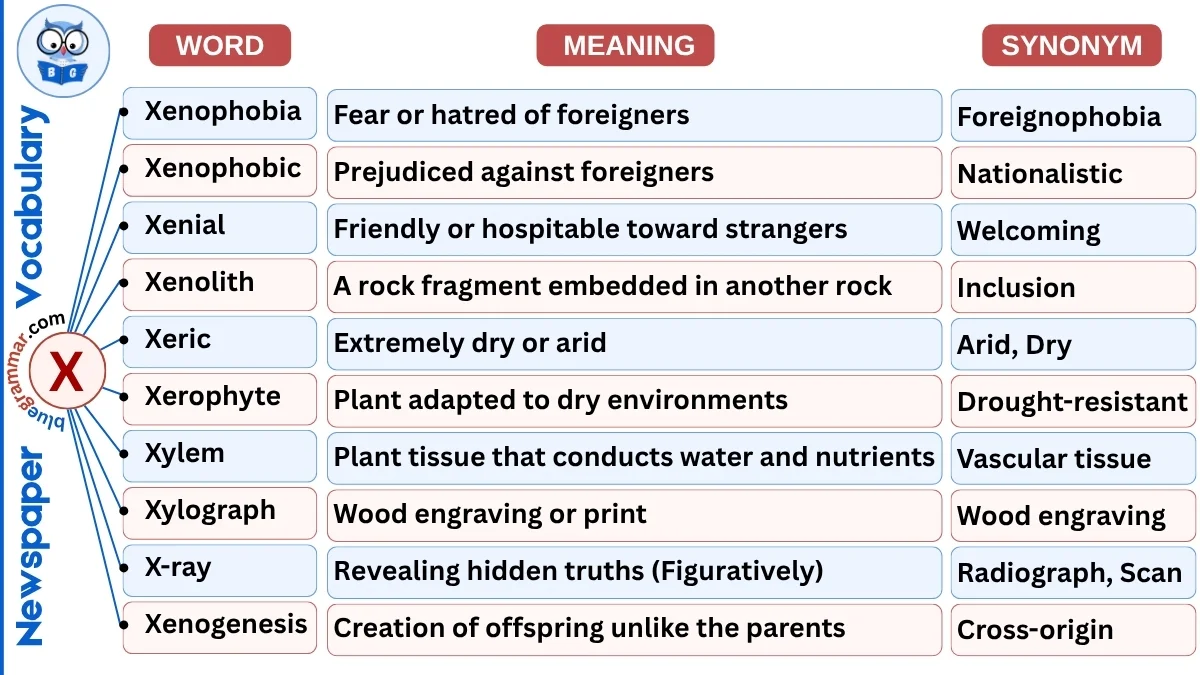
Newspaper Vocabulary | Words Starting with X
Welcome to our comprehensive guide on newspaper vocabulary starting with the letter X. Mastering these formal, precise, and analytical terms will greatly enhance your reading comprehension of news articles, opinion pieces, and editorial columns, as well as elevate your written English.
1. Xenophobia
Part of Speech: Noun
Meaning: Fear or hatred of foreigners.
Explanation: Xenophobia is widely used in political, social, and international reporting. It describes prejudice against people from other countries or cultures.
Example: Rising xenophobia led to increased tensions between neighboring communities.
2. Xenophobic
Part of Speech: Adjective
Meaning: Displaying xenophobia; prejudiced against foreigners.
Explanation: Xenophobic is often used in journalism and political commentary. It describes attitudes, policies, or behaviors that discriminate against outsiders.
Example: The government faced criticism for its xenophobic immigration policies.
3. Xenial
Part of Speech: Adjective
Meaning: Friendly or hospitable toward strangers.
Explanation: Xenial is used in cultural and social reporting, especially when describing international relations or hospitality.
Example: The ambassador’s xenial approach helped strengthen bilateral ties.
4. Xenolith
Part of Speech: Noun
Meaning: A rock fragment embedded in another rock.
Explanation: Xenolith appears in scientific and environmental reporting. Geologists use it to describe rock formations.
Example: The volcanic eruption revealed a xenolith containing ancient minerals.
5. Xeric
Part of Speech: Adjective
Meaning: Extremely dry or arid.
Explanation: Xeric is used in environmental, agricultural, and climate reporting. It describes habitats or regions with minimal moisture.
Example: Scientists studied the xeric conditions of the desert ecosystem.
6. Xerophyte
Part of Speech: Noun
Meaning: Plant adapted to dry environments.
Explanation: Xerophyte is used in environmental and scientific reporting. It describes plants that survive with very little water.
Example: Cacti are common xerophytes in arid regions.
7. Xylem
Part of Speech: Noun
Meaning: Plant tissue that conducts water and nutrients.
Explanation: Xylem is used in botanical and environmental reporting. It explains how water moves through plants.
Example: Researchers examined the xylem structure to understand drought resistance.
8. Xylograph
Part of Speech: Noun
Meaning: Wood engraving or print.
Explanation: Xylograph is used in art, culture, and historical reporting. It refers to prints or illustrations made from carved wood.
Example: The museum displayed a rare 19th-century xylograph of a cityscape.
9. X-ray
Part of Speech: Noun, Verb, Adjective
Meaning: Imaging method; also used figuratively in journalism.
Explanation: X-ray is used in scientific, medical, and investigative reporting. Figuratively, it can describe exposing or revealing hidden truths.
Example: The report acted as an X-ray into the company’s financial irregularities.
10. Xenogenesis
Part of Speech: Noun
Meaning: Creation of offspring unlike the parents.
Explanation: Xenogenesis is used in scientific and speculative journalism. It describes genetic or evolutionary processes.
Example: The study explored xenogenesis in hybrid plant species.