
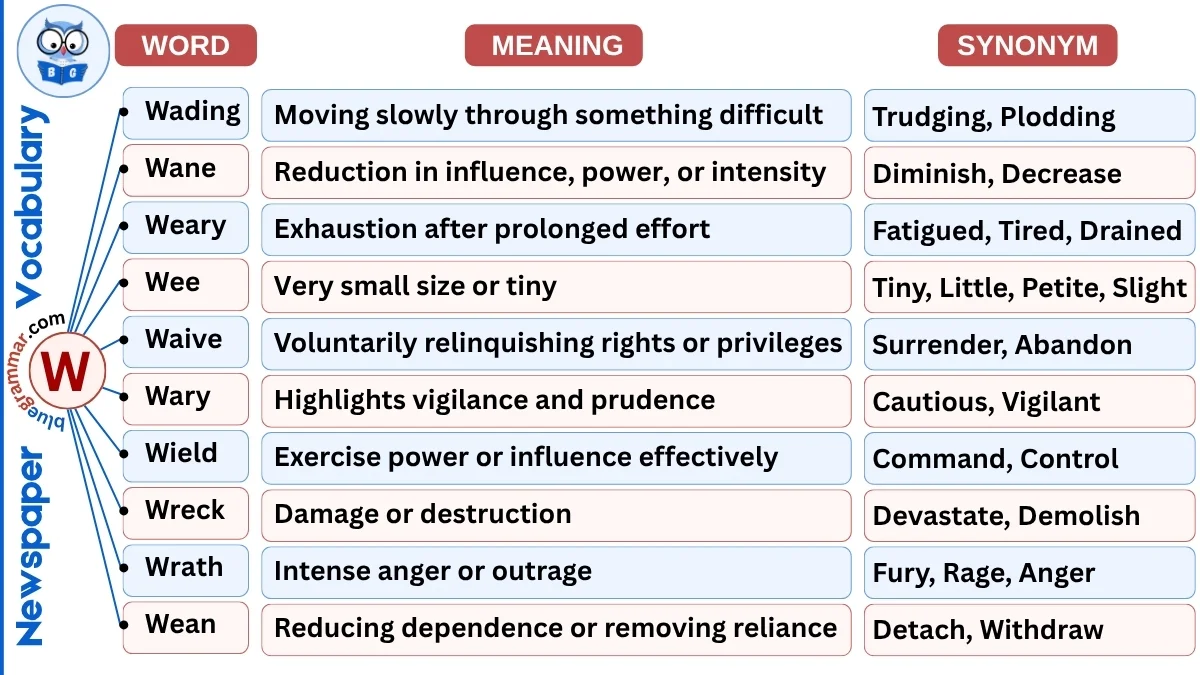
Newspaper Vocabulary | Words Starting with W
Welcome to our comprehensive guide on newspaper vocabulary starting with the letter W. Mastering these formal, precise, and analytical terms will greatly enhance your reading comprehension of news articles, opinion pieces, and editorial columns, as well as elevate your written English.
1. Wading
Part of Speech: Verb (Present Participle)
Meaning: Moving slowly through something difficult.
Explanation: Wading is used in social, environmental, and investigative reporting. It describes physically or metaphorically moving through challenges.
Example: Officials are wading through piles of documents to uncover fraud.
2. Wane
Part of Speech: Verb, Noun
Meaning: Decrease gradually.
Explanation: Wane is used in political, economic, and social reporting. It describes reduction in influence, power, or intensity.
Example: Public interest in the campaign began to wane after the scandal.
3. Watery
Part of Speech: Adjective
Meaning: Lacking substance or strength; containing water.
Explanation: Watery is used in environmental, political, and descriptive reporting. It emphasizes weakness or diluted quality.
Example: The report provided only a watery explanation of the issue.
4. Watershed
Part of Speech: Noun, Adjective
Meaning: Critical turning point.
Explanation: Watershed is used in political, social, and historical reporting. It describes events that mark a significant change.
Example: The election was a watershed moment for the country’s democracy.
5. Weary
Part of Speech: Adjective, Verb
Meaning: Tired or fatigued.
Explanation: Weary is used in human-interest, political, and social reporting. It conveys exhaustion or frustration after prolonged effort.
Example: Citizens grew weary of endless political debates.
6. Wee
Part of Speech: Adjective
Meaning: Very small or tiny.
Explanation: Wee is used in informal, human-interest, and cultural reporting. It emphasizes small size or quantity.
Example: A wee village in the mountains welcomed the tourists.
7. Waive
Part of Speech: Verb
Meaning: Give up a right or claim.
Explanation: Waive is used in legal, corporate, and policy reporting. It describes voluntarily relinquishing rights or privileges.
Example: The company decided to waive late fees for customers.
8. Warrant
Part of Speech: Noun, Verb
Meaning: Justify or authorize.
Explanation: Warrant is used in legal, political, and investigative reporting. It emphasizes authority or grounds for action.
Example: The judge issued a warrant for the suspect’s arrest.
9. Wary
Part of Speech: Adjective
Meaning: Cautious or alert.
Explanation: Wary is used in political, economic, and social reporting. It highlights vigilance and prudence.
Example: Investors remained wary of the volatile market.
10. Waver
Part of Speech: Verb, Noun
Meaning: Hesitate or fluctuate.
Explanation: Waver is used in political, economic, and social reporting. It describes indecision or changing stance.
Example: The committee wavered on approving the new policy.
11. Weigh
Part of Speech: Verb
Meaning: Consider carefully.
Explanation: Weigh is used in political, business, and social reporting. It emphasizes evaluating options or consequences.
Example: Leaders weighed the impact of the proposed tax reforms.
12. Widespread
Part of Speech: Adjective
Meaning: Existing or happening over a large area.
Explanation: Widespread is used in political, social, and environmental reporting. It describes prevalence or broad occurrence.
Example: Widespread protests erupted across the nation.
13. Withhold
Part of Speech: Verb
Meaning: Refuse to give or keep back.
Explanation: Withhold is used in political, corporate, and social reporting. It describes holding back information, funds, or consent.
Example: The agency decided to withhold key documents from the public.
14. Withstand
Part of Speech: Verb
Meaning: Resist or endure successfully.
Explanation: Withstand is used in political, environmental, and social reporting. It emphasizes surviving pressures or challenges.
Example: The city’s infrastructure withstood the severe storm.
15. Witness
Part of Speech: Verb, Noun
Meaning: See or observe; a person giving evidence.
Explanation: Witness is used in legal, political, and social reporting. It refers to observing events or testifying in court.
Example: Several residents witnessed the incident and reported it to authorities.
16. Withdraw
Part of Speech: Verb
Meaning: Remove or retreat.
Explanation: Withdraw is used in political, military, and economic reporting. It describes retreating from positions, agreements, or markets.
Example: The troops were ordered to withdraw from the conflict zone.
17. Worsen
Part of Speech: Verb
Meaning: Become worse.
Explanation: Worsen is used in political, social, and health reporting. It highlights deteriorating conditions or situations.
Example: The economic crisis worsened after the sudden drop in exports.
18. Worthwhile
Part of Speech: Adjective
Meaning: Valuable or beneficial.
Explanation: Worthwhile is used in social, economic, and policy reporting. It emphasizes effort or investment that produces meaningful results.
Example: The volunteers found the cleanup efforts worthwhile.
19. Wreck
Part of Speech: Verb, Noun
Meaning: Destroy or ruin.
Explanation: Wreck is used in social, environmental, and political reporting. It emphasizes damage or destruction.
Example: The hurricane wrecked thousands of homes along the coast.
20. Wrath
Part of Speech: Noun
Meaning: Extreme anger.
Explanation: Wrath is used in political, social, and editorial reporting. It emphasizes intense anger or outrage.
Example: The public’s wrath was directed at corrupt officials.
21. Wean
Part of Speech: Verb
Meaning: Gradually detach or accustom.
Explanation: Wean is used in social, economic, and policy reporting. It refers to reducing dependence or gradually removing reliance.
Example: The government aims to wean the economy off subsidies.
22. Wield
Part of Speech: Verb
Meaning: Exercise power or influence.
Explanation: Wield is used in political, corporate, and social reporting. It emphasizes using authority or capability effectively.
Example: The CEO wields considerable influence over the company’s strategy.
23. Wreak
Part of Speech: Verb
Meaning: Cause or inflict (damage or harm).
Explanation: Wreak is used in political, social, and environmental reporting. It emphasizes the effect of actions or events.
Example: The storm wreaked havoc on coastal communities.
24. Wistful
Part of Speech: Adjective
Meaning: Showing longing or melancholy.
Explanation: Wistful is used in social, cultural, and human-interest reporting. It conveys reflective or nostalgic emotions.
Example: He gave a wistful glance at his old school building.
25. Warranted
Part of Speech: Adjective
Meaning: Justified or deserved.
Explanation: Warranted is used in political, legal, and editorial reporting. It emphasizes legitimacy or the need for action.
Example: The criticism was warranted given the government’s failure to act.