
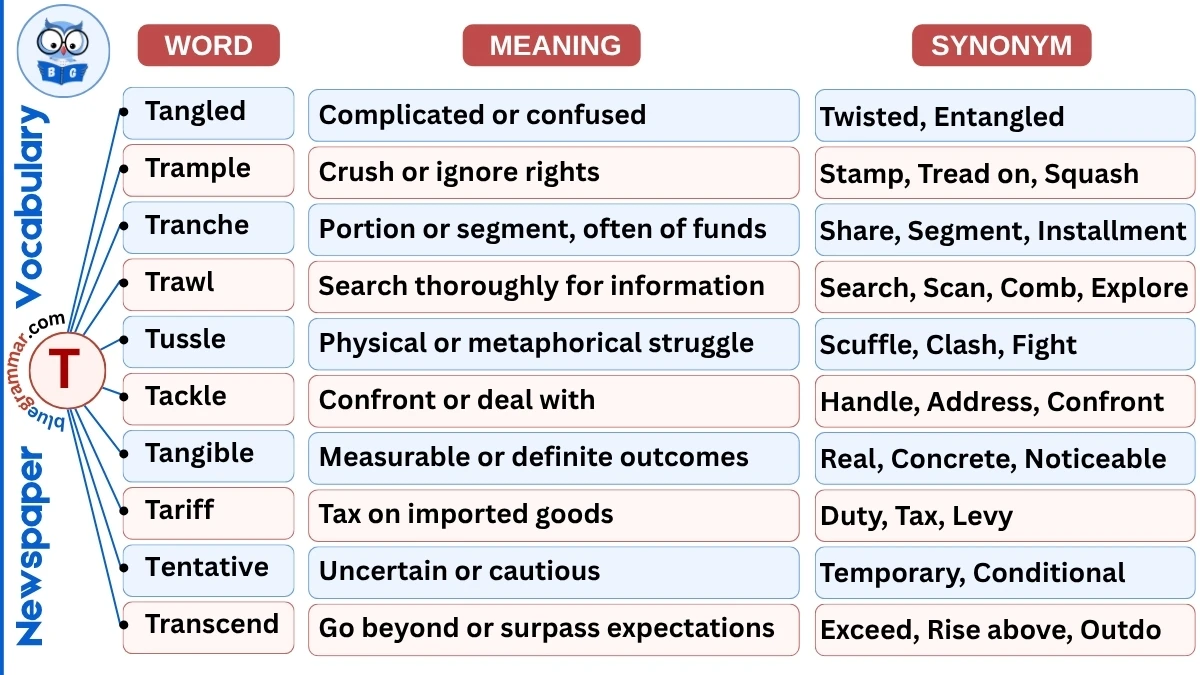
Newspaper Vocabulary | Words Starting with T
Welcome to our comprehensive guide on newspaper vocabulary starting with the letter T. Mastering these formal, precise, and analytical terms will greatly enhance your reading comprehension of news articles, opinion pieces, and editorial columns, as well as elevate your written English.
1. Tangled
Part of Speech: Adjective
Meaning: Complicated or confused.
Explanation: Tangled is used in political, social, and investigative reporting. It describes complex situations, disputes, or networks.
Example: The investigation revealed a tangled web of corruption.
2. Tamper
Part of Speech: Verb
Meaning: Interfere with or alter improperly.
Explanation: Tamper is used in legal, political, and social reporting. It emphasizes unauthorized interference or manipulation.
Example: Officials warned against tampering with election documents.
3. Telltale
Part of Speech: Adjective, Noun
Meaning: Revealing or indicative.
Explanation: Telltale is used in investigative, social, and political reporting. It highlights signs or evidence that reveal hidden information.
Example: The telltale signs of fraud were found in the accounts.
4. Tectonic
Part of Speech: Adjective
Meaning: Significant, often transformative or structural.
Explanation: Tectonic is used metaphorically in political, social, or economic reporting. It emphasizes fundamental or large-scale changes.
Example: The treaty caused tectonic shifts in regional politics.
5. Tempered
Part of Speech: Adjective
Meaning: Moderated or balanced.
Explanation: Tempered is used in political, social, and analytical reporting. It highlights controlled or moderated actions, responses, or reactions.
Example: His tempered response calmed the tense negotiations.
6. Theocracy
Part of Speech: Noun
Meaning: Government by religious authority.
Explanation: Theocracy is used in political and international reporting. It describes governance where religious leaders hold power.
Example: The country was ruled as a strict theocracy for decades.
7. Tirade
Part of Speech: Noun
Meaning: Long, angry speech.
Explanation: Tirade is used in political, social, and editorial reporting. It emphasizes harsh criticism or public outburst.
Example: The mayor launched into a tirade against corrupt officials.
8. Trample
Part of Speech: Verb
Meaning: Crush or ignore rights.
Explanation: Trample is used in political, social, and human-rights reporting. It describes violation or suppression of rights or laws.
Example: The protesters claimed their freedoms were trampled.
9. Tranche
Part of Speech: Noun
Meaning: Portion or segment, often of funds.
Explanation: Tranche is used in economic, financial, and policy reporting. It refers to installments or allocated segments.
Example: The government released the first tranche of the bailout package.
10. Trawl
Part of Speech: Verb, Noun
Meaning: Search thoroughly.
Explanation: Trawl is used in investigative, journalistic, and research reporting. It describes careful searching for information or evidence.
Example: Reporters trawled through documents to uncover the scandal.
11. Travail
Part of Speech: Noun, Verb
Meaning: Hard work or suffering.
Explanation: Travail is used in social, human-interest, and political reporting. It describes struggles or difficult efforts.
Example: The refugees endured years of travail before reaching safety.
12. Trough
Part of Speech: Noun
Meaning: Low point, often in economic terms.
Explanation: Trough is used in economic and business reporting. It refers to the lowest point in cycles, such as market or production.
Example: The economy hit a trough before slowly recovering.
13. Turbidity
Part of Speech: Noun
Meaning: Cloudiness or murkiness, often in water.
Explanation: Turbidity is used in environmental and scientific reporting. It measures water quality or clarity.
Example: The river’s turbidity increased after heavy rainfall.
14. Tussle
Part of Speech: Noun, Verb
Meaning: Physical or metaphorical struggle.
Explanation: Tussle is used in political, social, and sports reporting. It emphasizes conflict or competition.
Example: Parties tussled over the proposed legislation.
15. Tooth and Nail
Part of Speech: Idiom / Adverbial Phrase
Meaning: With fierce determination.
Explanation: Tooth and nail is used in political, business, and social reporting. It describes intense effort or fight.
Example: The two companies fought tooth and nail for the contract.
16. Tackle
Part of Speech: Verb
Meaning: Confront or deal with.
Explanation: Tackle is used in political, economic, and social reporting. It emphasizes addressing problems or challenges directly.
Example: Authorities are tackling the issue of urban pollution.
17. Tangible
Part of Speech: Adjective
Meaning: Clear, real, or perceptible.
Explanation: Tangible is used in economic, political, and business reporting. It describes measurable or definite outcomes.
Example: The government promised tangible improvements in infrastructure.
18. Tariff
Part of Speech: Noun, Verb
Meaning: Tax on imported goods.
Explanation: Tariff is used in economic, trade, and political reporting. It highlights policies affecting commerce and international trade.
Example: The new tariff on steel imports angered manufacturers.
19. Tedious
Part of Speech: Adjective
Meaning: Boring or monotonous.
Explanation: Tedious is used in human-interest, political, and investigative reporting. It describes prolonged or dull processes.
Example: The committee’s tedious hearings lasted all week.
20. Temper
Part of Speech: Verb, Noun
Meaning: Moderate or adjust.
Explanation: Temper is used in political, social, and editorial reporting. It emphasizes balancing extremes or controlling intensity.
Example: The CEO tempered her criticism with praise for efforts made.
21. Tense
Part of Speech: Adjective
Meaning: Stressed or strained.
Explanation: Tense is used in political, social, and conflict reporting. It highlights situations with high stress or potential conflict.
Example: Relations between the two countries remained tense after the border clash.
22. Tentative
Part of Speech: Adjective
Meaning: Uncertain or cautious.
Explanation: Tentative is used in political, social, and scientific reporting. It indicates provisional plans or hesitant actions.
Example: Officials made a tentative announcement about reopening schools.
23. Terminate
Part of Speech: Verb
Meaning: End or stop.
Explanation: Terminate is used in legal, corporate, and policy reporting. It emphasizes formal ending of agreements, employment, or operations.
Example: The company decided to terminate the contract due to breach of terms.
24. Thrive
Part of Speech: Verb
Meaning: Prosper or grow successfully.
Explanation: Thrive is used in economic, social, and environmental reporting. It emphasizes success or flourishing conditions.
Example: Small businesses are thriving despite economic challenges.
25. Transcend
Part of Speech: Verb
Meaning: Go beyond or surpass.
Explanation: Transcend is used in political, social, and cultural reporting. It describes overcoming limitations or surpassing expectations.
Example: Her leadership transcended party lines, earning widespread respect.