
Newspaper Vocabulary | Words Starting with E
Welcome to our comprehensive guide on newspaper vocabulary starting with the letter E. Mastering these formal, precise, and analytical terms will greatly enhance your reading comprehension of news articles, opinion pieces, and editorial columns, as well as elevate your written English.
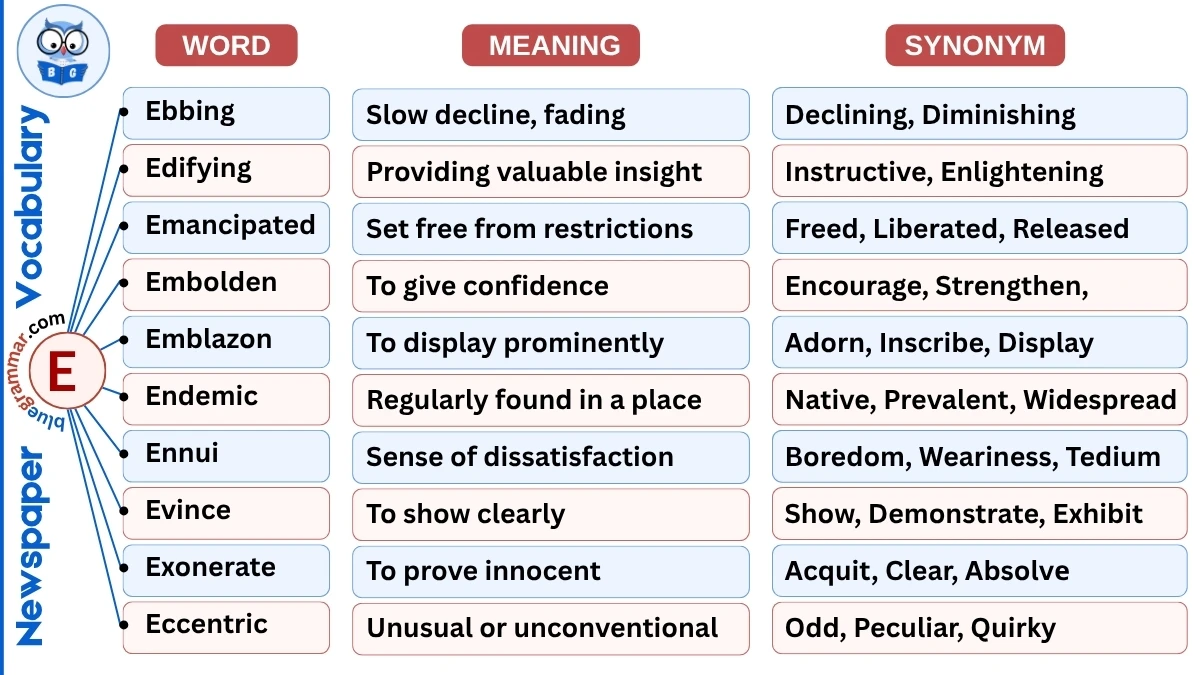
1. Ebbing
Part of Speech: Verb (present participle), Adjective
Meaning: Gradually decreasing.
Explanation: This word is often used in economic and political news. It describes a slow decline in strength, interest, or intensity. It suggests a fading trend rather than a sudden drop.
Example: Public support for the policy is ebbing.
2. Edifying
Part of Speech: Adjective
Meaning: Instructive or enlightening.
Explanation: “Edifying” is used for content that teaches or improves understanding. In news, it may describe speeches, programs, or discussions that provide valuable insight.
Example: The documentary was both informative and edifying.
3. Electorate
Part of Speech: Noun
Meaning: People eligible to vote.
Explanation: This word is widely used in political reporting. It refers to the group of citizens who can vote in elections. Their opinions and choices shape political outcomes.
Example: The electorate will decide the future leadership.
4. Emancipated
Part of Speech: Adjective, Verb (past tense)
Meaning: Set free from restrictions.
Explanation: This word is used in social and historical contexts. It refers to gaining freedom from control, oppression, or limitations.
Example: The movement helped emancipated communities gain rights.
5. Embolden
Part of Speech: Verb
Meaning: To give confidence.
Explanation: This word is often used when actions encourage people to act more boldly. It can have both positive and negative meanings in news contexts.
Example: The decision emboldened protesters.
6. Emblazon
Part of Speech: Verb
Meaning: To display prominently.
Explanation: This word is used when something is clearly shown or highlighted. In news, it often refers to headlines, logos, or messages.
Example: The slogan was emblazoned across banners.
7. Empanel
Part of Speech: Verb
Meaning: To select a jury or group.
Explanation: This word is commonly used in legal reporting. It refers to forming a panel, especially a jury for a trial.
Example: The court empaneled a jury for the case.
8. Endemic
Part of Speech: Adjective, Noun
Meaning: Regularly found in a place.
Explanation: This word is used in health and environmental news. It refers to diseases or issues that are consistently present in a region.
Example: The disease is endemic in rural areas.
9. Ennui
Part of Speech: Noun
Meaning: A feeling of boredom.
Explanation: This word is used in cultural and social contexts. It describes a sense of dissatisfaction or lack of interest.
Example: Economic stagnation led to public ennui.
10. Entrust
Part of Speech: Verb
Meaning: To give responsibility.
Explanation: This word is used when authority or responsibility is given to someone. It is common in governance and organizational news.
Example: The task was entrusted to senior officials.
11. Ensconce
Part of Speech: Verb
Meaning: To settle securely.
Explanation: This word is used to describe someone being comfortably established in a position. It often appears in political or institutional contexts.
Example: He was ensconced in a powerful role.
12. Ensnare
Part of Speech: Verb
Meaning: To trap or involve.
Explanation: This word is used in crime and political reporting. It refers to getting someone caught in a difficult or harmful situation.
Example: The scandal ensnared several officials.
13. Epitomise
Part of Speech: Verb
Meaning: To represent perfectly.
Explanation: This word is used when something is a perfect example of a quality or idea. It often appears in opinion and feature writing.
Example: The leader epitomises resilience.
14. Evince
Part of Speech: Verb
Meaning: To show clearly.
Explanation: This word is used in formal reporting. It describes revealing or demonstrating a quality or feeling.
Example: The data evinces strong growth.
15. Envisage
Part of Speech: Verb
Meaning: To imagine or plan.
Explanation: This word is used in policy and planning contexts. It refers to thinking about future possibilities or strategies.
Example: The plan envisages long-term reforms.
16. Excruciating
Part of Speech: Adjective
Meaning: Extremely painful.
Explanation: This word is used in both physical and emotional contexts. It describes intense pain or discomfort.
Example: Survivors described excruciating conditions.
17. Exonerate
Part of Speech: Verb
Meaning: To prove innocent.
Explanation: This word is used in legal news. It refers to clearing someone of blame or charges after investigation.
Example: New evidence helped exonerate the accused.
18. Exert
Part of Speech: Verb
Meaning: To apply effort.
Explanation: This word is used when describing effort or influence. It is common in political and economic contexts.
Example: The group exerted pressure on authorities.
19. Extricate
Part of Speech: Verb
Meaning: To free from difficulty.
Explanation: This word is used when someone escapes a complex or dangerous situation. It is common in crisis reporting.
Example: The country struggled to extricate itself from debt.
20. Earmark
Part of Speech: Verb, Noun
Meaning: To set aside for a purpose.
Explanation: This word is widely used in budget and policy news. It refers to allocating resources for specific uses.
Example: Funds were earmarked for education.
21. Eccentric
Part of Speech: Adjective, Noun
Meaning: Unusual or unconventional.
Explanation: This word is used to describe behavior or ideas that are different from the norm. It may be neutral or slightly negative.
Example: The inventor was known for eccentric ideas.
22. Eclectic
Part of Speech: Adjective
Meaning: Derived from various sources.
Explanation: This word is used in cultural and creative contexts. It describes a mix of different styles or ideas.
Example: The event featured an eclectic mix of performances.
23. Edifice
Part of Speech: Noun
Meaning: A large building or system.
Explanation: This word can be used literally or metaphorically. In news, it may describe institutions or structures.
Example: The reform aims to rebuild the economic edifice.
24. Embargo
Part of Speech: Noun, Verb
Meaning: A ban on trade.
Explanation: This word is commonly used in international relations. It refers to restrictions placed on trade or communication.
Example: The country imposed an embargo on imports.
25. Erode
Part of Speech: Verb
Meaning: To gradually destroy.
Explanation: This word is used in both physical and abstract contexts. It describes slow damage or decline over time.
Example: Corruption can erode public trust.