
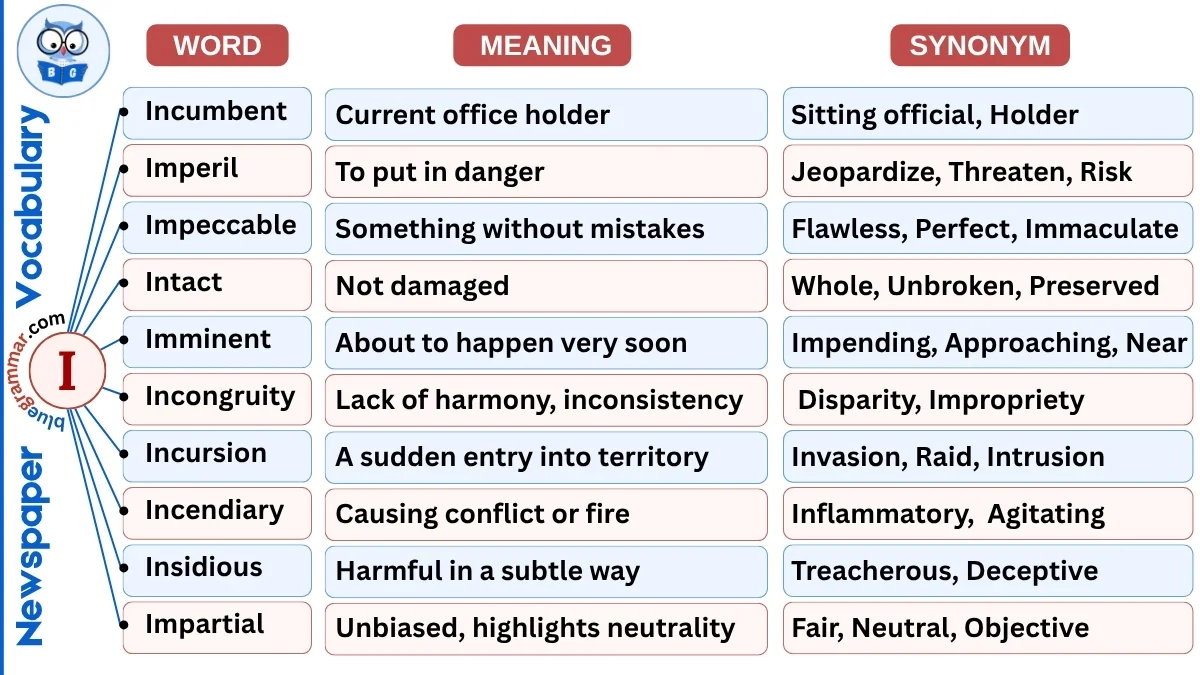
Newspaper Vocabulary | Words Starting with I
Welcome to our comprehensive guide on newspaper vocabulary starting with the letter I. Mastering these formal, precise, and analytical terms will greatly enhance your reading comprehension of news articles, opinion pieces, and editorial columns, as well as elevate your written English.
1. Incumbent
Part of Speech: Noun, Adjective
Meaning: Current office holder.
Explanation: This word is widely used in political news. It refers to a person who currently holds a position, especially in elections.
Example: The incumbent won the election again.
2. Imperil
Part of Speech: Verb
Meaning: To put in danger.
Explanation: This word is used in serious contexts such as security, environment, or economy. It highlights risk or threat.
Example: The crisis may imperil economic stability.
3. Impeccable
Part of Speech: Adjective
Meaning: Perfect or flawless.
Explanation: This word is used to describe something without mistakes. It often appears in professional or performance contexts.
Example: The report was prepared with impeccable accuracy.
4. Impediment
Part of Speech: Noun
Meaning: An obstacle.
Explanation: This word is used in development and policy discussions. It refers to something that blocks progress.
Example: Lack of funding is a major impediment.
5. Impound
Part of Speech: Verb
Meaning: To seize legally.
Explanation: This word is used in legal and administrative news. It refers to taking possession of property by authority.
Example: Police impounded the vehicle.
6. Impose
Part of Speech: Verb
Meaning: To enforce something.
Explanation: This word is common in political and legal news. It refers to applying rules, taxes, or restrictions.
Example: The government imposed new taxes.
7. Imposter
Part of Speech: Noun
Meaning: Someone pretending to be another.
Explanation: This word is used in crime and fraud reporting. It refers to deception and identity misuse.
Example: The imposter was arrested.
8. Impute
Part of Speech: Verb
Meaning: To attribute blame.
Explanation: This word is used in formal reporting. It refers to assigning responsibility, often unfairly.
Example: Critics imputed failure to leadership.
9. Imminent
Part of Speech: Adjective
Meaning: About to happen.
Explanation: This word is used in urgent news situations. It signals that something is expected very soon.
Example: A storm is imminent.
10. Ingenuity
Part of Speech: Noun
Meaning: Cleverness or creativity.
Explanation: This word is used in innovation and development news. It highlights smart solutions.
Example: The solution showed great ingenuity.
11. Ingenious
Part of Speech: Adjective
Meaning: Very clever.
Explanation: This word is used to describe creative ideas or inventions.
Example: Engineers designed an ingenious system.
12. Incongruity
Part of Speech: Noun
Meaning: Lack of harmony.
Explanation: This word is used in analysis. It highlights mismatch or inconsistency.
Example: There was an incongruity in the data.
13. Incursion
Part of Speech: Noun
Meaning: An invasion or attack.
Explanation: This word is used in military and border news. It refers to sudden entry into territory.
Example: The incursion raised tensions.
14. Incendiary
Part of Speech: Adjective, Noun
Meaning: Causing conflict or fire.
Explanation: This word is used both literally and metaphorically. It can refer to fire-related or provocative statements.
Example: His remarks were incendiary.
15. Insidious
Part of Speech: Adjective
Meaning: Harmful in a subtle way.
Explanation: This word describes dangers that develop gradually. It is common in health and political contexts.
Example: Corruption can be insidious.
16. Insubstantial
Part of Speech: Adjective
Meaning: Weak or lacking substance.
Explanation: This word is used in criticism. It refers to arguments or claims that are not strong.
Example: The evidence was insubstantial.
17. Instigate
Part of Speech: Verb
Meaning: To provoke or start.
Explanation: This word is used in conflict and crime reporting. It refers to causing something to begin.
Example: He was accused of instigating violence.
18. Intent
Part of Speech: Noun, Adjective
Meaning: Purpose or intention.
Explanation: This word is used in legal and general contexts. It refers to what someone plans to do.
Example: The act was done with clear intent.
19. Intact
Part of Speech: Adjective
Meaning: Not damaged.
Explanation: This word is used in disaster and general reporting. It refers to something remaining whole.
Example: The building remained intact.
20. Invidious
Part of Speech: Adjective
Meaning: Unfair or discriminatory.
Explanation: This word is used in political and social contexts. It refers to unjust treatment.
Example: The policy was criticized as invidious.
21. Ideology
Part of Speech: Noun
Meaning: A system of beliefs.
Explanation: This word is widely used in political reporting. It refers to ideas guiding a group or party.
Example: The party’s ideology influenced decisions.
22. Illicit
Part of Speech: Adjective
Meaning: Illegal.
Explanation: This word is used in crime and law enforcement news. It refers to unlawful activities.
Example: Authorities seized illicit goods.
23. Impartial
Part of Speech: Adjective
Meaning: Fair and unbiased.
Explanation: This word is used in media and legal contexts. It highlights neutrality.
Example: The judge remained impartial.
24. Implement
Part of Speech: Verb, Noun
Meaning: To carry out.
Explanation: This word is used in policy and governance news. It refers to putting plans into action.
Example: The reforms were implemented quickly.
25. Indict
Part of Speech: Verb
Meaning: To formally charge.
Explanation: This word is used in legal reporting. It refers to officially accusing someone of a crime.
Example: The court indicted the official.