
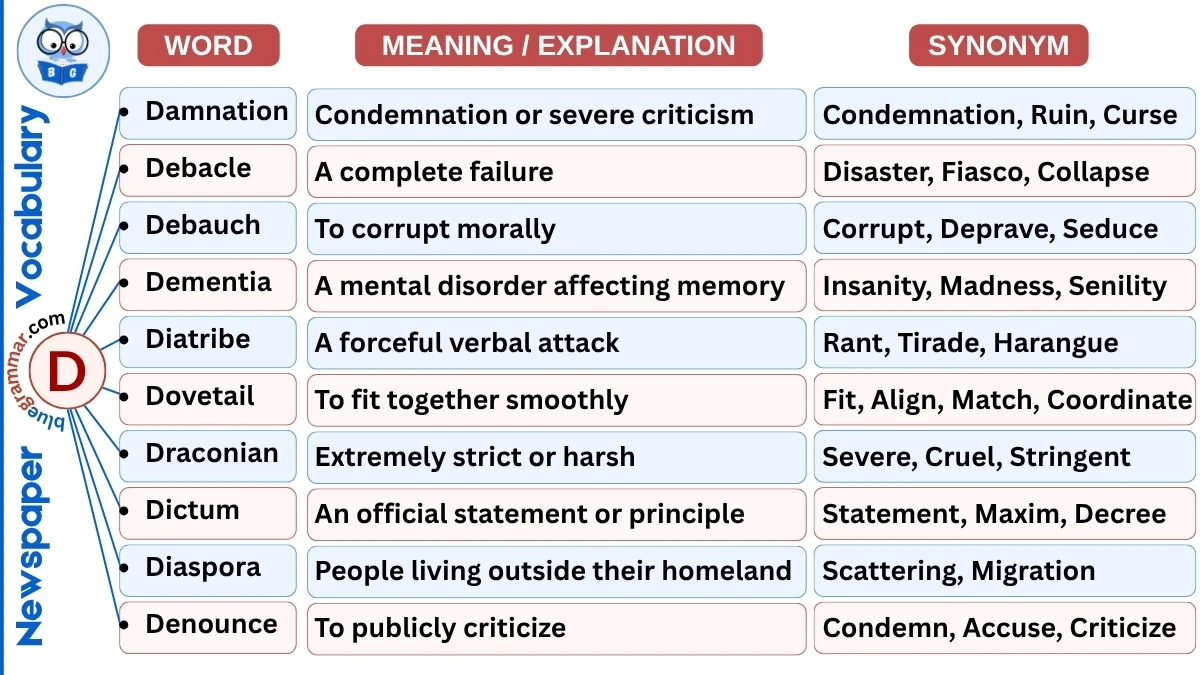
Newspaper Vocabulary | Words Starting with D
Welcome to our comprehensive guide on newspaper vocabulary starting with the letter D. Mastering these formal, precise, and analytical words will greatly enhance your reading comprehension of news articles, opinion pieces, and editorial columns, as well as elevate your written English.
1. Damnation
Part of Speech: Noun
Meaning: Condemnation or severe criticism.
Explanation: In news, this word is used to describe strong disapproval, often in moral or political contexts. It highlights intense criticism of actions or decisions.
Example: The policy faced public damnation.
2. De facto
Part of Speech: Adjective, Adverb
Meaning: Existing in reality, not officially.
Explanation: This term is widely used in political and legal news. It refers to situations that exist in practice, even if not legally recognized.
Example: He became the de facto leader of the party.
3. Debauch
Part of Speech: Verb
Meaning: To corrupt morally.
Explanation: This word is used to describe actions that lead to moral decline or corruption. It often appears in discussions of ethics or social behavior.
Example: Critics say the system debauched public values.
4. Debauched
Part of Speech: Adjective
Meaning: Morally corrupted.
Explanation: This adjective describes a person or system that has become morally degraded. It is often used in strong opinion pieces.
Example: The report exposed a debauched leadership.
5. Dementia
Part of Speech: Noun
Meaning: A mental disorder affecting memory.
Explanation: This word is commonly used in health-related news. It refers to conditions that affect thinking, memory, and daily functioning.
Example: Awareness campaigns focus on dementia care.
6. Detractor
Part of Speech: Noun
Meaning: A critic or opponent.
Explanation: “Detractor” is used in political and public discussions. It refers to someone who criticizes or opposes a person or idea.
Example: The plan faced criticism from detractors.
7. Dialectic
Part of Speech: Noun, Adjective
Meaning: Logical discussion of ideas.
Explanation: This word is used in analytical and academic contexts. It refers to examining ideas through argument and reasoning.
Example: The debate followed a clear dialectic process.
8. Diatribe
Part of Speech: Noun
Meaning: A forceful verbal attack.
Explanation: This word is often used in political reporting. It describes strong, emotional criticism or speech.
Example: The leader launched a diatribe against opponents.
9. Dichotomy
Part of Speech: Noun
Meaning: Division into two parts.
Explanation: This word is used in analysis and opinion pieces. It highlights contrasts or differences between two ideas or groups.
Example: The report showed a clear dichotomy between rich and poor.
10. Dovetail
Part of Speech: Verb
Meaning: To fit together smoothly.
Explanation: This word is used when two ideas, plans, or actions work well together. It is common in policy and planning discussions.
Example: The new policy dovetails with existing laws.
11. Downtrodden
Part of Speech: Adjective
Meaning: Oppressed or treated badly.
Explanation: This word is often used in social and humanitarian news. It refers to people who suffer from injustice or poverty.
Example: The program aims to help the downtrodden.
12. Draconian
Part of Speech: Adjective
Meaning: Extremely strict or harsh.
Explanation: This word is commonly used to describe severe laws or measures. It often carries a negative tone in news reporting.
Example: The government introduced draconian regulations.
13. Dictum
Part of Speech: Noun
Meaning: An official statement or principle.
Explanation: This word is used in legal and formal contexts. It refers to authoritative statements or rules.
Example: The court issued a clear dictum.
14. Diaspora
Part of Speech: Noun
Meaning: People living outside their homeland.
Explanation: This word is widely used in international and cultural news. It refers to communities spread across different countries.
Example: The diaspora contributed to relief efforts.
15. Dampen
Part of Speech: Verb
Meaning: To reduce or weaken.
Explanation: This word is used in economic and emotional contexts. It describes reducing enthusiasm, growth, or impact.
Example: Rising prices dampened consumer confidence.
16. Debacle
Part of Speech: Noun
Meaning: A complete failure.
Explanation: This word is used in reports about major mistakes or disasters. It highlights situations that end badly.
Example: The project turned into a financial debacle.
17. Debilitate
Part of Speech: Verb
Meaning: To weaken.
Explanation: This word is used in health and general contexts. It describes something that reduces strength or effectiveness.
Example: The disease debilitated the population.
18. Deceptive
Part of Speech: Adjective
Meaning: Misleading or dishonest.
Explanation: This word is often used in media and advertising criticism. It refers to something that gives a false impression.
Example: The advertisement was considered deceptive.
19. Decline
Part of Speech: Verb, Noun
Meaning: To decrease or worsen.
Explanation: This word is very common in economic and social news. It refers to a reduction in quality, quantity, or strength.
Example: The economy showed signs of decline.
20. Decree
Part of Speech: Noun, Verb
Meaning: An official order.
Explanation: This word is used in political and legal news. It refers to decisions made by authorities that must be followed.
Example: The government issued a new decree.
21. Defamation
Part of Speech: Noun
Meaning: Damaging someone’s reputation.
Explanation: This word is used in legal and media contexts. It refers to false statements that harm a person’s image.
Example: The case involved serious defamation claims.
22. Deficit
Part of Speech: Noun
Meaning: A shortage or lack.
Explanation: This word is widely used in economic news. It refers to situations where spending exceeds income.
Example: The country is facing a budget deficit.
23. Deliberate
Part of Speech: Adjective, Verb
Meaning: Done intentionally.
Explanation: This word is used when actions are planned or purposeful. It can also mean careful consideration.
Example: The damage was a deliberate act.
24. Denounce
Part of Speech: Verb
Meaning: To publicly criticize.
Explanation: This word is often used in political and international news. It refers to openly condemning actions or policies.
Example: Leaders denounced the attack.
25. Derail
Part of Speech: Verb
Meaning: To disrupt or stop progress.
Explanation: This word is used both literally and figuratively. In news, it often describes plans or talks being interrupted.
Example: The incident derailed peace negotiations.