
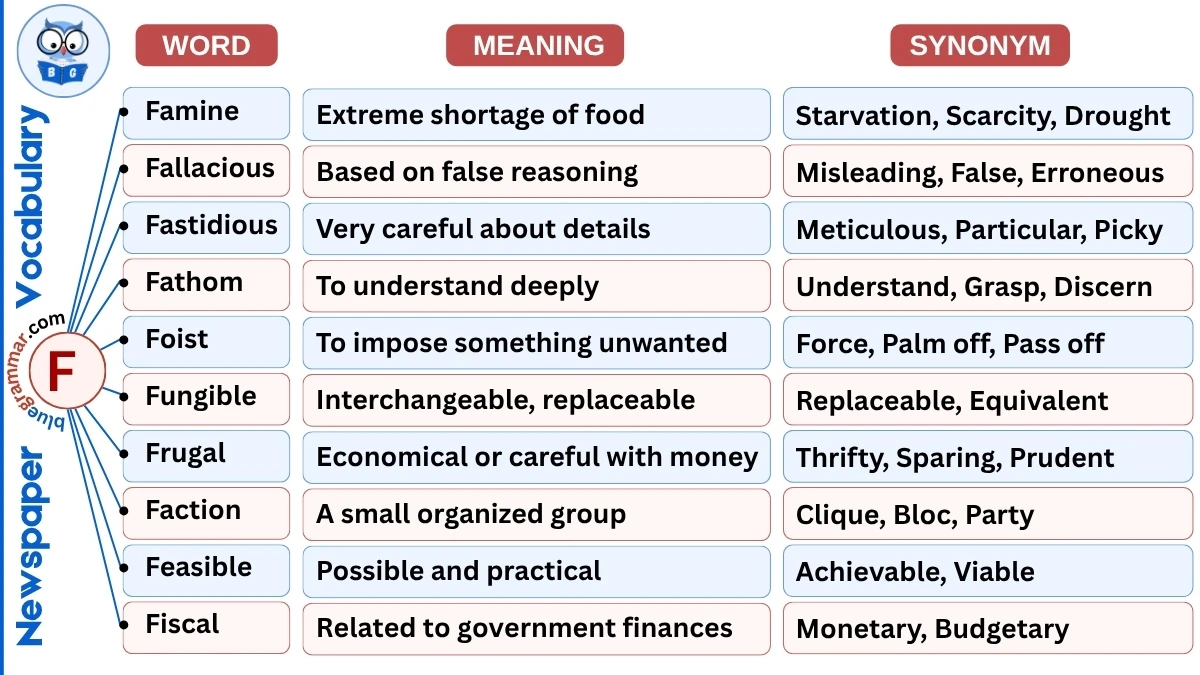
Newspaper Vocabulary | Words Starting with F
Welcome to our comprehensive guide on newspaper vocabulary starting with the letter F. Mastering these formal, precise, and analytical terms will greatly enhance your reading comprehension of news articles, opinion pieces, and editorial columns, as well as elevate your written English.
1. Famine
Part of Speech: Noun
Meaning: Extreme shortage of food.
Explanation: This word is commonly used in humanitarian and global news. It refers to severe hunger affecting large populations due to drought, war, or economic collapse.
Example: The region is facing a devastating famine.
2. Fallacious
Part of Speech: Adjective
Meaning: Based on false reasoning.
Explanation: This word is used in analytical and opinion writing. It describes arguments or claims that are misleading or logically incorrect.
Example: Experts rejected the fallacious claims.
3. Fastidious
Part of Speech: Adjective
Meaning: Very careful about details.
Explanation: This word is used to describe people or processes that demand high standards. It often appears in professional or critical contexts.
Example: The audit was conducted with fastidious care.
4. Fathom
Part of Speech: Verb, Noun
Meaning: To understand deeply.
Explanation: This word is used when something is difficult to understand. It often appears in emotional or complex situations.
Example: It is hard to fathom the scale of the disaster.
5. Felonious
Part of Speech: Adjective
Meaning: Relating to serious crime.
Explanation: This word is used in legal and crime reporting. It refers to actions involving major criminal offenses.
Example: He was charged with felonious conduct.
6. Fiasco
Part of Speech: Noun
Meaning: A complete failure.
Explanation: This word is used in political and organizational news. It describes situations that end badly, often due to poor planning.
Example: The event turned into a public fiasco.
7. Figment
Part of Speech: Noun
Meaning: Something imagined.
Explanation: This word is used when something is not real but created by imagination. It often appears in debates about truth and misinformation.
Example: The claim was dismissed as a figment of imagination.
8. Flank
Part of Speech: Noun, Verb
Meaning: The side of something.
Explanation: This word is used in military and strategic contexts. It can also be used metaphorically in political strategies.
Example: The army attacked from the left flank.
9. Foe
Part of Speech: Noun
Meaning: An enemy.
Explanation: This word is commonly used in political and international news. It refers to opponents or adversaries.
Example: The country warned its foes of retaliation.
10. Foist
Part of Speech: Verb
Meaning: To impose something unwanted.
Explanation: This word is used when something is forced upon others unfairly. It often appears in criticism of policies or decisions.
Example: The policy was foisted on the public.
11. Fungible
Part of Speech: Adjective
Meaning: Interchangeable.
Explanation: This word is used in financial and economic contexts. It refers to items or assets that can be easily replaced by others of the same kind.
Example: Currency is considered fungible.
12. Fracas
Part of Speech: Noun
Meaning: A noisy fight.
Explanation: This word is used in crime and social news. It describes chaotic physical or verbal conflicts.
Example: A fracas broke out during the protest.
13. Fraught
Part of Speech: Adjective
Meaning: Filled with tension or difficulty.
Explanation: This word is often used in political and diplomatic contexts. It describes situations full of stress or problems.
Example: The talks were fraught with tension.
14. Franchise
Part of Speech: Noun, Verb
Meaning: The right to vote or operate a business.
Explanation: This word is used in both political and business contexts. It refers to voting rights or licensed business operations.
Example: Citizens exercised their franchise in the election.
15. Frugal
Part of Speech: Adjective
Meaning: Economical or careful with money.
Explanation: This word is used in economic and lifestyle reporting. It describes careful spending and avoiding waste.
Example: The government adopted a frugal budget.
16. Facilitate
Part of Speech: Verb
Meaning: To make something easier.
Explanation: This word is widely used in policy and administrative news. It refers to actions that help processes run smoothly.
Example: The reforms will facilitate trade.
17. Faction
Part of Speech: Noun
Meaning: A small organized group.
Explanation: This word is often used in political reporting. It refers to groups within larger organizations that have different opinions.
Example: A faction within the party opposed the decision.
18. Feasible
Part of Speech: Adjective
Meaning: Possible and practical.
Explanation: This word is used in planning and development news. It refers to ideas that can realistically be achieved.
Example: The project is financially feasible.
19. Fervent
Part of Speech: Adjective
Meaning: Showing strong feelings.
Explanation: This word is used to describe passionate support or belief. It often appears in political and social movements.
Example: He is a fervent supporter of reform.
20. Fiscal
Part of Speech: Adjective
Meaning: Related to government finances.
Explanation: This word is widely used in economic reporting. It refers to budgets, taxes, and public spending.
Example: The country faces a fiscal crisis.
21. Fluctuate
Part of Speech: Verb
Meaning: To change frequently.
Explanation: This word is commonly used in financial and economic news. It describes rising and falling values.
Example: Prices continue to fluctuate.
22. Forfeit
Part of Speech: Verb, Noun
Meaning: To lose something as a penalty.
Explanation: This word is used in legal and financial contexts. It refers to giving up rights or property due to wrongdoing.
Example: The company may forfeit its license.
23. Formidable
Part of Speech: Adjective
Meaning: Strong or powerful.
Explanation: This word is used to describe opponents, challenges, or forces. It indicates something difficult to overcome.
Example: The team faced a formidable opponent.
24. Foster
Part of Speech: Verb
Meaning: To encourage growth.
Explanation: This word is used in policy and development news. It refers to promoting or supporting progress.
Example: The initiative aims to foster innovation.
25. Fallout
Part of Speech: Noun
Meaning: Negative consequences.
Explanation: This word is used in political and social contexts. It refers to the results of an event, especially harmful ones.
Example: The decision led to political fallout.