
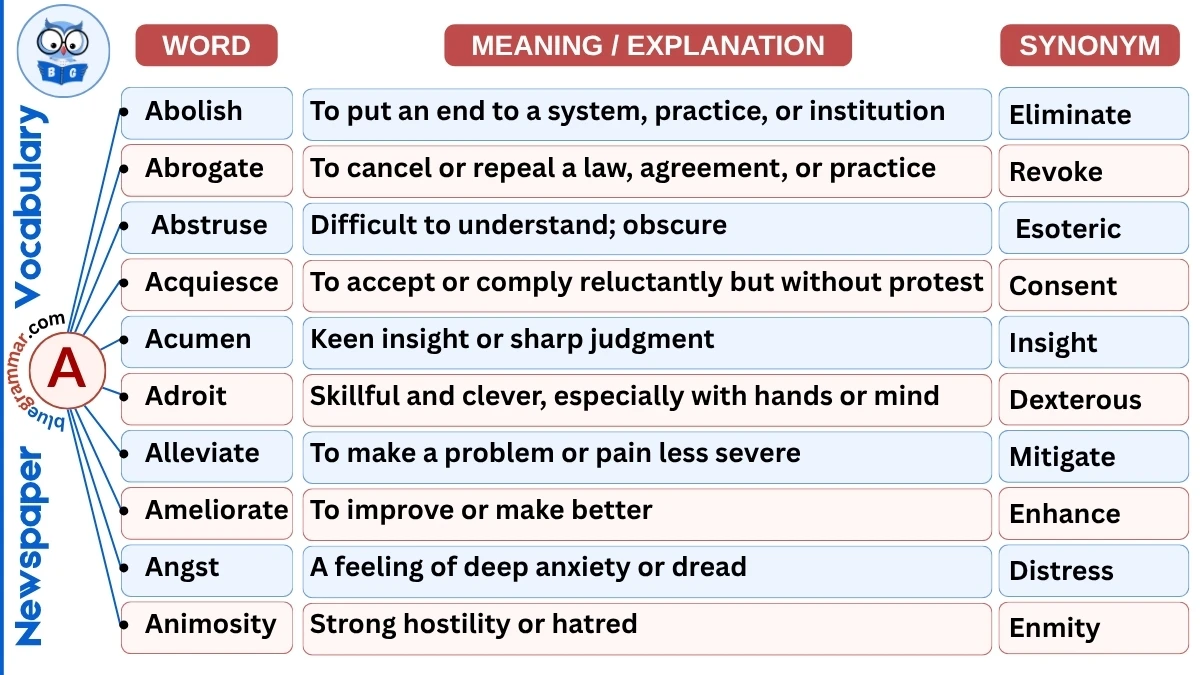
Newspaper Vocabulary | Words Starting with A
Welcome to our comprehensive guide on newspaper vocabulary starting with the letter A. Mastering these formal, precise, and analytical words will greatly enhance your reading comprehension of news articles, opinion pieces, and editorial columns, as well as elevate your written English.
1. Aberration
Part of Speech: Noun
Meaning: A departure from what is normal, usual, or expected.
Explanation: An aberration refers to something unusual or unexpected, often negative. In journalism, it can describe a trend or behavior that deviates from the norm.
Example: The sudden drop in stock prices was an aberration in an otherwise stable market.
2. Abolish
Part of Speech: Verb
Meaning: To formally put an end to a system, practice, or institution.
Explanation: Abolish indicates complete termination of a law, rule, or practice. It is commonly used in legal or social contexts.
Example: The government decided to abolish outdated labor laws.
3. Abrogate
Part of Speech: Verb
Meaning: To officially cancel or repeal a law, agreement, or practice.
Explanation: Abrogate is used in formal contexts to nullify rules or agreements completely. It is often applied in legislative or diplomatic settings.
Example: Parliament decided to abrogate the unfair trade regulations.
4. Abstruse
Part of Speech: Adjective
Meaning: Difficult to understand; obscure.
Explanation: Abstruse describes ideas or concepts that are intellectually challenging. It is often used in academic or technical discussions.
Example: His lecture on quantum physics was fascinating but abstruse.
5. Acquiesce
Part of Speech: Verb
Meaning: To accept or comply reluctantly but without protest.
Explanation: Acquiesce implies passive agreement or silent consent. It suggests acceptance without enthusiasm.
Example: She acquiesced to her manager’s demands, even though she disagreed.
6. Acrimony
Part of Speech: Noun
Meaning: Bitterness or harshness in speech, behavior, or attitude.
Explanation: Acrimony describes hostility or sharpness, often in debates or arguments. It conveys strong negative emotions.
Example: The meeting ended with acrimony between the two rival parties.
7. Acumen
Part of Speech: Noun
Meaning: Keen insight or sharp judgment.
Explanation: Acumen refers to practical intelligence or the ability to make quick, correct decisions. It is often praised in business and politics.
Example: Her financial acumen helped the company avoid bankruptcy.
8. Adroit
Part of Speech: Adjective
Meaning: Skillful and clever, especially with hands or mind.
Explanation: Adroit describes dexterity or competence, both mental and physical. It is used to praise clever or skilled actions.
Example: The surgeon’s adroit handling of the instruments saved the patient’s life.
9. Adversary
Part of Speech: Noun
Meaning: An opponent or enemy.
Explanation: Adversary is commonly used to describe someone who opposes or contests in competition or conflict. It is often used in sports, legal, or political contexts.
Example: The chess champion defeated his long-time adversary.
10. Aesthetic
Part of Speech: Adjective / Noun
Meaning: Concerned with beauty or artistic value.
Explanation: Aesthetic refers to visual appeal or principles of art. It can describe objects, designs, or artistic taste.
Example: The building’s aesthetic appeal attracted tourists.
11. Alleviate
Part of Speech: Verb
Meaning: To make a problem or pain less severe.
Explanation: Alleviate is often used in medical, social, or humanitarian contexts to indicate relief. It reduces the intensity of difficulties.
Example: The medication helped alleviate his chronic pain.
12. Ambiguous
Part of Speech: Adjective
Meaning: Open to more than one interpretation; unclear.
Explanation: Ambiguous describes statements or situations that can be understood in multiple ways. It often causes confusion or debate.
Example: The politician’s statement was deliberately ambiguous.
13. Ameliorate
Part of Speech: Verb
Meaning: To improve or make better.
Explanation: Ameliorate is used to indicate enhancement or mitigation of a negative condition. It often refers to social or environmental improvements.
Example: Policies were introduced to ameliorate living conditions in the slums.
14. Angst
Part of Speech: Noun
Meaning: A feeling of deep anxiety or dread.
Explanation: Angst represents internal worry or existential tension. It is often used to describe emotional unrest or societal unease.
Example: Teenagers often experience angst about their future.
15. Animosity
Part of Speech: Noun
Meaning: Strong hostility or hatred.
Explanation: Animosity refers to long-standing ill will or resentment. It is often present in conflicts between individuals or groups.
Example: There was growing animosity between the rival gangs.
16. Annals
Part of Speech: Noun
Meaning: Historical records or chronological accounts.
Explanation: Annals are formal records of events, usually arranged year by year. They are frequently cited in historical or academic contexts.
Example: The discovery was recorded in the annals of science.
17. Anomaly
Part of Speech: Noun
Meaning: Something that deviates from the norm.
Explanation: Anomaly indicates unusual occurrences or deviations from patterns. It can appear in science, data analysis, or social observations.
Example: The sudden snowfall in April was a weather anomaly.
18. Antagonize
Part of Speech: Verb
Meaning: To cause someone to become hostile or unfriendly.
Explanation: To antagonize means to provoke anger or irritation. It often results in conflict or opposition.
Example: His rude comments antagonized everyone in the meeting.
19. Apathy
Part of Speech: Noun
Meaning: Lack of interest, enthusiasm, or concern.
Explanation: Apathy refers to indifference or lack of motivation. It is often highlighted in social, political, or community contexts.
Example: Voter apathy led to a very low turnout in the election.
20. Apprehend
Part of Speech: Verb
Meaning: To arrest or understand.
Explanation: Apprehend can mean capturing a suspect or grasping an idea. Its usage depends on context, from law enforcement to intellectual understanding.
Example: The police apprehended the thief after a long chase.
21. Aptly
Part of Speech: Adverb
Meaning: In a manner that is appropriate or suitable.
Explanation: Aptly describes actions, titles, or descriptions that are fitting or precise. It is often used in reporting or commentary.
Example: He aptly summarized the key points of the discussion.
22. Arbitrary
Part of Speech: Adjective
Meaning: Based on random choice or personal whim, rather than reason.
Explanation: Arbitrary refers to actions or decisions made without logic or fairness. It is often criticized in governance or policy.
Example: Critics called the law arbitrary and unfair.
23. Arsonist
Part of Speech: Noun
Meaning: A person who deliberately sets fire to property.
Explanation: An arsonist commits the criminal act of intentionally burning property. News reports often cover arson incidents in crime sections.
Example: The police arrested the arsonist who set fire to the abandoned warehouse.
24. Assertive
Part of Speech: Adjective
Meaning: Confidently self-assured and direct.
Explanation: Assertive describes someone who expresses their opinions firmly yet respectfully. It is often praised in leadership and communication.
Example: She is assertive in meetings, ensuring her ideas are heard.
25. Austerity
Part of Speech: Noun
Meaning: Severe economic measures or simplicity in lifestyle.
Explanation: Austerity refers to strict financial policies or personal restraint in spending. It is often applied in economic reporting or historical contexts.
Example: The country implemented austerity measures to tackle the economic crisis.