
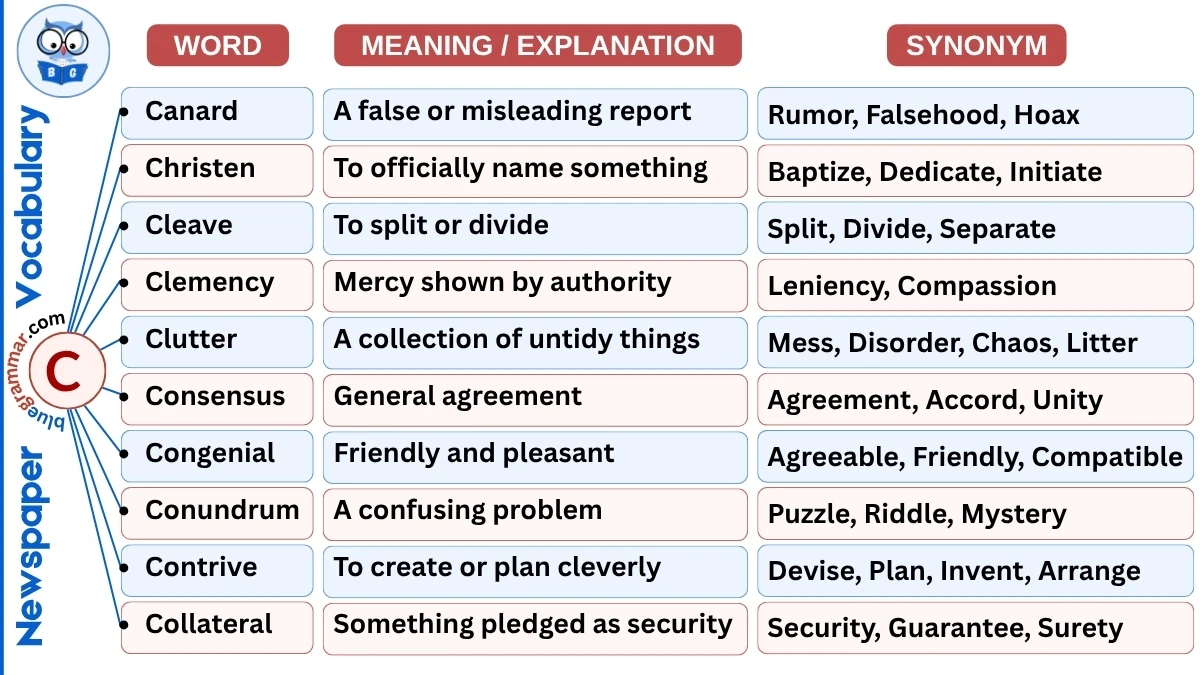
Newspaper Vocabulary | Words Starting with C
Welcome to our comprehensive guide on newspaper vocabulary starting with the letter C. Mastering these formal, precise, and analytical words will greatly enhance your reading comprehension of news articles, opinion pieces, and editorial columns, as well as elevate your written English.
1. Canard
Part of Speech: Noun
Meaning: A false or misleading report.
Explanation: This word is often used in media to describe rumors or false information spread as news. It highlights misinformation that may influence public opinion. Journalists use it to expose fake claims.
Example: The report was dismissed as a political canard.
2. Cap
Part of Speech: Noun, Verb
Meaning: A limit or maximum level.
Explanation: “Cap” is commonly used in economic and policy news. It refers to a restriction placed on prices, spending, or numbers. Governments often impose caps to control situations.
Example: The government imposed a cap on fuel prices.
3. Cavern
Part of Speech: Noun
Meaning: A large cave.
Explanation: While literal in meaning, this word appears in environmental or disaster-related news. It may describe underground spaces or areas affected by natural events.
Example: Rescue teams searched the cavern for survivors.
4. Christen
Part of Speech: Verb
Meaning: To officially name something.
Explanation: This word is used when something new is given a name, such as a ship, project, or initiative. It often appears in formal or ceremonial news.
Example: The new ship was christened last week.
5. Cleave
Part of Speech: Verb
Meaning: To split or divide.
Explanation: In news, this word is often used metaphorically. It describes divisions within groups, parties, or societies. It highlights conflict or separation.
Example: The issue cleaved the party into two groups.
6. Clemency
Part of Speech: Noun
Meaning: Mercy shown by authority.
Explanation: This word is used in legal and political news. It refers to reducing punishment or forgiving someone, usually by a government or leader.
Example: The president granted clemency to the prisoner.
7. Clutter
Part of Speech: Noun, Verb
Meaning: A collection of untidy things.
Explanation: In news, this word is often used metaphorically. It can describe overcrowded information, disorganized systems, or messy situations.
Example: The report was cluttered with unnecessary details.
8. Clutch
Part of Speech: Verb, Noun
Meaning: To grasp tightly.
Explanation: This word can describe physical action or emotional reaction. In news, it is often used to show fear, urgency, or determination.
Example: She clutched the documents during the raid.
9. Combatant
Part of Speech: Noun, Adjective
Meaning: A person involved in fighting.
Explanation: This word is widely used in war and conflict reporting. It refers to soldiers or fighters engaged in battle.
Example: Several combatants were injured in the clash.
10. Comrade
Part of Speech: Noun
Meaning: A companion or ally.
Explanation: “Comrade” is often used in political or ideological contexts. It refers to members of the same group or movement.
Example: He addressed his comrades at the rally.
11. Commensurate
Part of Speech: Adjective
Meaning: Equal in value or importance.
Explanation: This word is used in economic and professional contexts. It describes something that matches or corresponds appropriately.
Example: Salaries should be commensurate with experience.
12. Congenial
Part of Speech: Adjective
Meaning: Friendly and pleasant.
Explanation: This word is used in social and professional news. It describes positive relationships or environments.
Example: The meeting took place in a congenial atmosphere.
13. Conundrum
Part of Speech: Noun
Meaning: A confusing problem.
Explanation: “Conundrum” is often used in analytical news. It refers to complex issues that are difficult to solve.
Example: The government faces an economic conundrum.
14. Contrive
Part of Speech: Verb
Meaning: To create or plan cleverly.
Explanation: This word is used when something is arranged skillfully, sometimes with hidden intent. It may carry a slightly negative tone.
Example: They contrived a plan to win support.
15. Covenant
Part of Speech: Noun, Verb
Meaning: A formal agreement.
Explanation: This word is often used in legal, religious, or international contexts. It refers to serious and binding agreements.
Example: The nations signed a peace covenant.
16. Covert
Part of Speech: Adjective
Meaning: Hidden or secret.
Explanation: “Covert” is commonly used in intelligence and military news. It refers to actions done secretly to avoid attention.
Example: The agency conducted a covert operation.
17. Cue
Part of Speech: Noun, Verb
Meaning: A signal to act.
Explanation: This word is used to describe a prompt or indication for action. In news, it may refer to signals in events or communication.
Example: His statement was a cue for immediate action.
18. Cull
Part of Speech: Verb, Noun
Meaning: To select or remove.
Explanation: This word is used in policy, environment, or data contexts. It refers to reducing numbers or selecting from a group.
Example: Authorities decided to cull infected animals.
19. Critique
Part of Speech: Noun, Verb
Meaning: A detailed analysis or review.
Explanation: This word is common in opinion and editorial writing. It refers to evaluating something critically.
Example: The report received strong critique from experts.
20. Catalyst
Part of Speech: Noun
Meaning: Something that causes change.
Explanation: “Catalyst” is widely used in news to describe events or actions that trigger major developments.
Example: The protest acted as a catalyst for reform.
21. Ceasefire
Part of Speech: Noun
Meaning: An agreement to stop fighting.
Explanation: This word is common in war and conflict news. It refers to a temporary or permanent stop in fighting between groups.
Example: The countries agreed to a ceasefire.
22. Censure
Part of Speech: Noun, Verb
Meaning: Strong criticism or disapproval.
Explanation: This word is used in political and formal contexts. It refers to official criticism by authorities or organizations.
Example: The minister faced censure from the committee.
23. Coherent
Part of Speech: Adjective
Meaning: Logical and clear.
Explanation: This word is used to describe clear communication or arguments. It is often used in analysis and reporting.
Example: The report presented a coherent argument.
24. Collateral
Part of Speech: Noun, Adjective
Meaning: Something pledged as security.
Explanation: In financial news, it refers to assets used to secure loans. It can also refer to unintended damage in conflict.
Example: The bank demanded collateral for the loan.
25. Consensus
Part of Speech: Noun
Meaning: General agreement.
Explanation: This word is widely used in political and social discussions. It refers to a shared agreement among a group.
Example: There was a consensus on the new policy.