
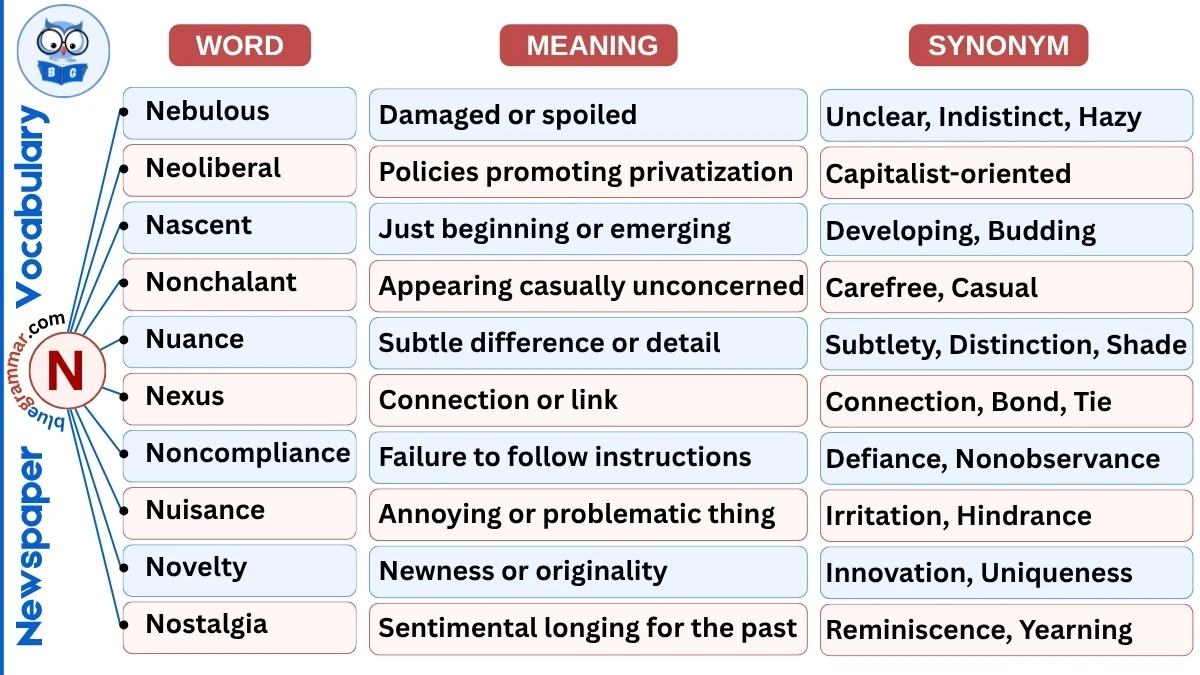
Newspaper Vocabulary | Words Starting with N
Welcome to our comprehensive guide on newspaper vocabulary starting with the letter N. Mastering these formal, precise, and analytical terms will greatly enhance your reading comprehension of news articles, opinion pieces, and editorial columns, as well as elevate your written English.
1. Nebulous
Part of Speech: Adjective
Meaning: Vague or unclear.
Explanation: Nebulous is often used in political, economic, or social reporting to describe ideas, policies, or statements that lack clarity. It emphasizes uncertainty or ambiguity.
Example: The government’s plan for tax reform remained nebulous.
2. Neoliberal
Part of Speech: Adjective, Noun
Meaning: Supporting free-market policies.
Explanation: Neoliberal is used in economic and political reporting to describe policies promoting privatization, deregulation, and market-driven strategies.
Example: The economist criticized the neoliberal approach to healthcare reform.
3. Normalcy
Part of Speech: Noun
Meaning: State of being normal or usual.
Explanation: Normalcy is often used in political or social reporting to indicate return to stability after disruption. It emphasizes routine or expected conditions.
Example: Citizens hoped for a return to normalcy after the protests.
4. Nosedive
Part of Speech: Noun, Verb
Meaning: Sudden and steep decline.
Explanation: Nosedive is used in economic, business, or social reporting to describe rapid falls in values, popularity, or performance.
Example: The stock market took a nosedive after the unexpected announcement.
5. Nonchalance
Part of Speech: Noun
Meaning: Calm or indifferent attitude.
Explanation: Nonchalance is often used to describe public figures or situations where a relaxed attitude contrasts with urgency or controversy.
Example: The CEO’s nonchalance during the crisis drew criticism.
6. Nascent
Part of Speech: Adjective
Meaning: Just beginning or emerging.
Explanation: Nascent is used in business, political, or social reporting to describe new movements, industries, or ideas that are developing.
Example: The nascent tech sector shows great promise for economic growth.
7. Negligence
Part of Speech: Noun
Meaning: Failure to take proper care.
Explanation: Common in legal, social, and investigative reporting, negligence refers to carelessness that causes harm or loss.
Example: The hospital was accused of negligence in patient care.
8. Neutralize
Part of Speech: Verb
Meaning: Counteract or render ineffective.
Explanation: Neutralize is often used in political, military, or strategic reporting. It describes actions taken to diminish the effect of a threat or opposition.
Example: Authorities moved quickly to neutralize the potential security threat.
9. Nominal
Part of Speech: Adjective
Meaning: Minimal or in name only.
Explanation: Nominal is used in economic, legal, and administrative reporting to indicate something small, symbolic, or officially designated without substantial impact.
Example: The fee for the service was nominal, barely covering costs.
10. Nonchalant
Part of Speech: Adjective
Meaning: Appearing casually unconcerned.
Explanation: Nonchalant is used in political, social, and human-interest reporting. It often contrasts with the gravity of the situation.
Example: The politician remained nonchalant despite mounting criticism.
11. Notion
Part of Speech: Noun
Meaning: Idea or concept.
Explanation: Notion is often used in opinion, editorial, and analytical reporting. It describes thoughts or perceptions about policies or events.
Example: The notion of universal healthcare has gained widespread support.
12. Notorious
Part of Speech: Adjective
Meaning: Famous for negative reasons.
Explanation: Notorious is used in crime, social, and political reporting to describe people, events, or entities known for misconduct or controversy.
Example: The company is notorious for unsafe working conditions.
13. Nuance
Part of Speech: Noun
Meaning: Subtle difference or detail.
Explanation: Nuance is frequently used in political, social, and cultural reporting. It highlights complexity or subtlety in situations or arguments.
Example: The diplomat emphasized the nuance in international negotiations.
14. Nullify
Part of Speech: Verb
Meaning: Make void or cancel.
Explanation: Nullify is often used in legal, political, and administrative reporting to indicate invalidation of laws, contracts, or decisions.
Example: The court nullified the previous agreement due to procedural errors.
15. Nurture
Part of Speech: Verb, Noun
Meaning: Care for and encourage development.
Explanation: Nurture is used in social, educational, and economic reporting. It highlights support or fostering growth of individuals, ideas, or projects.
Example: Schools aim to nurture creativity in students.
16. Nexus
Part of Speech: Noun
Meaning: Connection or link.
Explanation: Nexus is often used in investigative, political, and social reporting. It describes relationships or points of convergence between entities or events.
Example: The report revealed a nexus between organized crime and corporate fraud.
17. Nominate
Part of Speech: Verb
Meaning: Propose someone for a position or honor.
Explanation: Nominate is used in political, social, and award reporting. It refers to suggesting candidates for office, recognition, or responsibility.
Example: She was nominated for the Best Journalist Award.
18. Noncompliance
Part of Speech: Noun
Meaning: Failure to follow rules or instructions.
Explanation: Noncompliance is used in legal, health, and corporate reporting. It describes situations where rules, laws, or standards are ignored.
Example: The factory faced fines due to noncompliance with safety regulations.
19. Nuisance
Part of Speech: Noun
Meaning: Annoying or problematic thing.
Explanation: Nuisance is used in social, civic, and environmental reporting. It highlights issues causing inconvenience or harm.
Example: The construction work became a major nuisance for local residents.
20. Negotiate
Part of Speech: Verb
Meaning: Discuss to reach agreement.
Explanation: Negotiate is commonly used in business, diplomacy, and political reporting. It emphasizes dialogue and compromise to resolve conflicts.
Example: Officials negotiated a trade deal to benefit both countries.
21. Narrative
Part of Speech: Noun, Adjective
Meaning: Story or account.
Explanation: Narrative is used in media, political, and social reporting to describe how events are presented or perceived.
Example: The newspaper challenged the government’s official narrative.
22. Novelty
Part of Speech: Noun
Meaning: Newness or originality.
Explanation: Novelty is often used in business, cultural, and tech reporting. It emphasizes innovation or fresh ideas.
Example: The product’s novelty attracted a young customer base.
23. Nostalgia
Part of Speech: Noun
Meaning: Sentimental longing for the past.
Explanation: Nostalgia is used in human-interest, cultural, and social reporting. It reflects public emotions or societal trends.
Example: The festival evoked nostalgia for traditional music and art.
24. Noteworthy
Part of Speech: Adjective
Meaning: Worth attention or significant.
Explanation: Noteworthy is used in political, social, and economic reporting. It highlights facts, events, or achievements deserving recognition.
Example: The judge made a noteworthy statement on judicial reform.
25. Nonpartisan
Part of Speech: Adjective
Meaning: Neutral, not aligned with any party.
Explanation: Nonpartisan is used in political and social reporting. It emphasizes impartiality and objectivity in decisions or reporting.
Example: The committee remained nonpartisan while evaluating the proposals.