
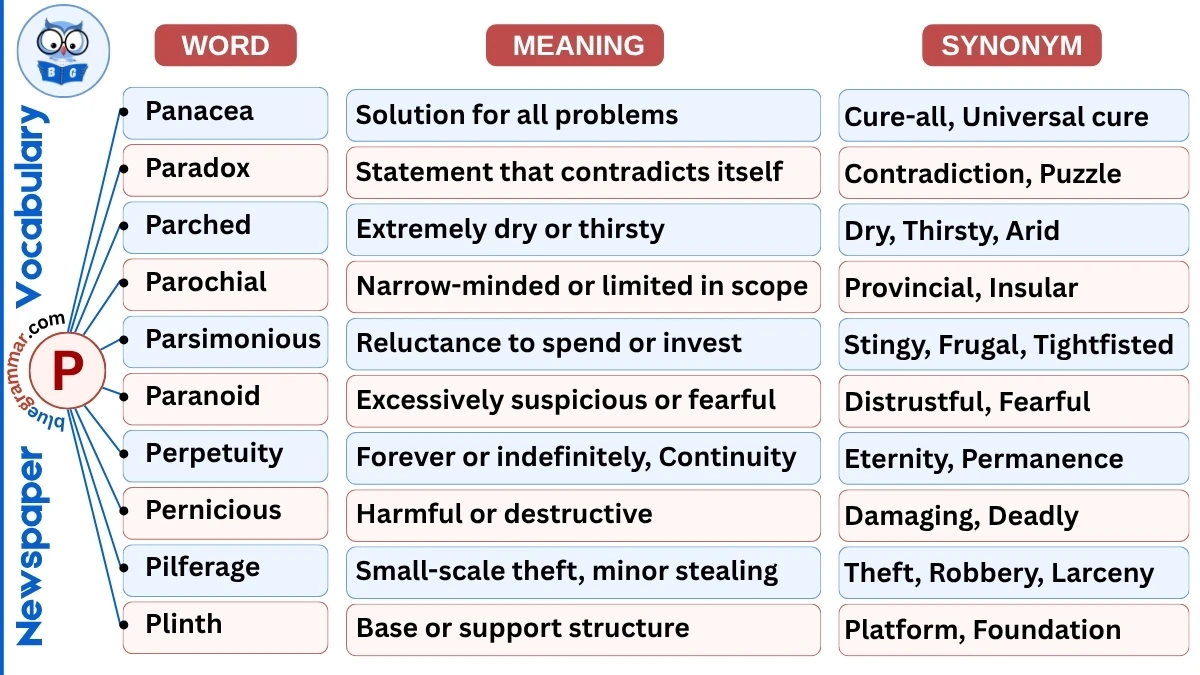
Newspaper Vocabulary | Words Starting with P
Welcome to our comprehensive guide on newspaper vocabulary starting with the letter P. Mastering these formal, precise, and analytical terms will greatly enhance your reading comprehension of news articles, opinion pieces, and editorial columns, as well as elevate your written English.
1. Pamper
Part of Speech: Verb
Meaning: To indulge or spoil someone.
Explanation: Pamper is often used in lifestyle, human-interest, or business reporting. It describes giving excessive care or comfort.
Example: The spa offers packages to pamper its clients.
2. Panacea
Part of Speech: Noun
Meaning: Solution for all problems.
Explanation: Panacea is used in political, economic, and social reporting to describe a remedy that is considered universally effective, often critically.
Example: Education is not a panacea for all societal issues.
3. Paradox
Part of Speech: Noun
Meaning: Statement that contradicts itself.
Explanation: Paradox is used in editorial, analytical, and political reporting. It highlights situations that appear contradictory but reveal deeper truths.
Example: It’s a paradox that technology can both connect and isolate people.
4. Parched
Part of Speech: Adjective
Meaning: Extremely dry or thirsty.
Explanation: Parched is commonly used in environmental, agricultural, and social reporting. It describes lack of water or harsh conditions.
Example: The fields were parched after months of drought.
5. Parochial
Part of Speech: Adjective
Meaning: Narrow-minded or limited in scope.
Explanation: Parochial is used in political and social commentary. It describes views, policies, or organizations restricted to local concerns.
Example: The debate reflected a parochial mindset, ignoring global issues.
6. Parsimonious
Part of Speech: Adjective
Meaning: Extremely frugal or stingy.
Explanation: Parsimonious is used in business, financial, and political reporting. It highlights reluctance to spend or invest.
Example: The company’s parsimonious approach led to underfunded projects.
7. Paranoid
Part of Speech: Adjective
Meaning: Excessively suspicious or fearful.
Explanation: Paranoid is used in political, social, or investigative reporting. It emphasizes mistrust or exaggerated fear.
Example: The government was accused of paranoid surveillance tactics.
8. Patriarchal
Part of Speech: Adjective
Meaning: Dominated by men or male authority.
Explanation: Patriarchal is used in social, political, and cultural reporting. It describes systems, structures, or societies governed by male dominance.
Example: The society maintained a patriarchal hierarchy that limited women’s roles.
9. Perforce
Part of Speech: Adverb
Meaning: Necessarily or by force of circumstance.
Explanation: Perforce is used in formal, political, or analytical reporting. It emphasizes unavoidable actions or outcomes.
Example: He had to, perforce, resign after the scandal.
10. Permeate
Part of Speech: Verb
Meaning: Spread throughout.
Explanation: Permeate is commonly used in political, social, or environmental reporting. It indicates something pervasive or widespread.
Example: Corruption continues to permeate all levels of governance.
11. Perpetuity
Part of Speech: Noun
Meaning: Forever or indefinitely.
Explanation: Perpetuity is used in legal, economic, and policy reporting. It describes lasting agreements, effects, or institutions.
Example: The endowment fund was established to exist in perpetuity.
12. Pernicious
Part of Speech: Adjective
Meaning: Harmful or destructive.
Explanation: Pernicious is often used in social, political, or economic reporting. It emphasizes subtle but serious negative effects.
Example: The pernicious influence of fake news undermines public trust.
13. Pervasive
Part of Speech: Adjective
Meaning: Widespread or all-encompassing.
Explanation: Pervasive is used in political, social, and economic reporting to describe issues or influences that are everywhere.
Example: Social media has a pervasive impact on public opinion.
14. Picaresque
Part of Speech: Adjective
Meaning: Adventurous and episodic.
Explanation: Picaresque is used in cultural, literary, or human-interest reporting. It describes colorful, often mischievous stories or events.
Example: The journalist’s account was a picaresque tale of urban life.
15. Pilferage
Part of Speech: Noun
Meaning: Small-scale theft.
Explanation: Pilferage is used in crime, corporate, and investigative reporting. It describes minor stealing or misappropriation.
Example: Pilferage of office supplies became a frequent issue.
16. Plinth
Part of Speech: Noun
Meaning: Base or support structure.
Explanation: Plinth is used in architectural, cultural, or human-interest reporting. It emphasizes foundation or support in literal and metaphorical contexts.
Example: The statue was mounted on a marble plinth.
17. Pliant
Part of Speech: Adjective
Meaning: Flexible or adaptable.
Explanation: Pliant is used in political, social, or corporate reporting. It describes people or policies that can adjust to circumstances.
Example: The government remained pliant in negotiations with stakeholders.
18. Plagiarism
Part of Speech: Noun
Meaning: Using someone else’s work without credit.
Explanation: Plagiarism is used in academic, media, and corporate reporting. It highlights ethical violations and intellectual theft.
Example: The journalist was accused of plagiarism in the article.
19. Poignant
Part of Speech: Adjective
Meaning: Emotionally touching or moving.
Explanation: Poignant is used in human-interest, cultural, or social reporting. It describes content that evokes deep feelings.
Example: The documentary offered a poignant look at refugee lives.
20. Pogrom
Part of Speech: Noun
Meaning: Organized persecution or massacre.
Explanation: Pogrom is used in historical, political, or social reporting. It highlights targeted violence against a group.
Example: The pogrom resulted in widespread displacement and fear.
21. Pique
Part of Speech: Verb, Noun
Meaning: Arouse interest or resentment.
Explanation: Pique is used in political, social, and business reporting. It can describe stimulating curiosity or causing irritation.
Example: The scandal piqued public interest in government transparency.
22. Pollution
Part of Speech: Noun
Meaning: Contamination harming environment.
Explanation: Pollution is used in environmental, health, and policy reporting. It emphasizes harmful impacts on nature or human health.
Example: Industrial waste contributes to severe pollution in rivers.
23. Polyglot
Part of Speech: Noun, Adjective
Meaning: Knowing multiple languages.
Explanation: Polyglot is used in cultural, social, or educational reporting. It highlights linguistic skill or multicultural contexts.
Example: The ambassador was a polyglot fluent in five languages.
24. Posterity
Part of Speech: Noun
Meaning: Future generations.
Explanation: Posterity is used in political, environmental, or social reporting. It emphasizes responsibilities or impacts on the future.
Example: Laws were enacted to protect forests for posterity.
25. Postulate
Part of Speech: Verb, Noun
Meaning: To suggest or assume.
Explanation: Postulate is used in scientific, political, and analytical reporting. It refers to proposing ideas or principles for consideration.
Example: The researcher postulated a link between pollution and urban health issues.