
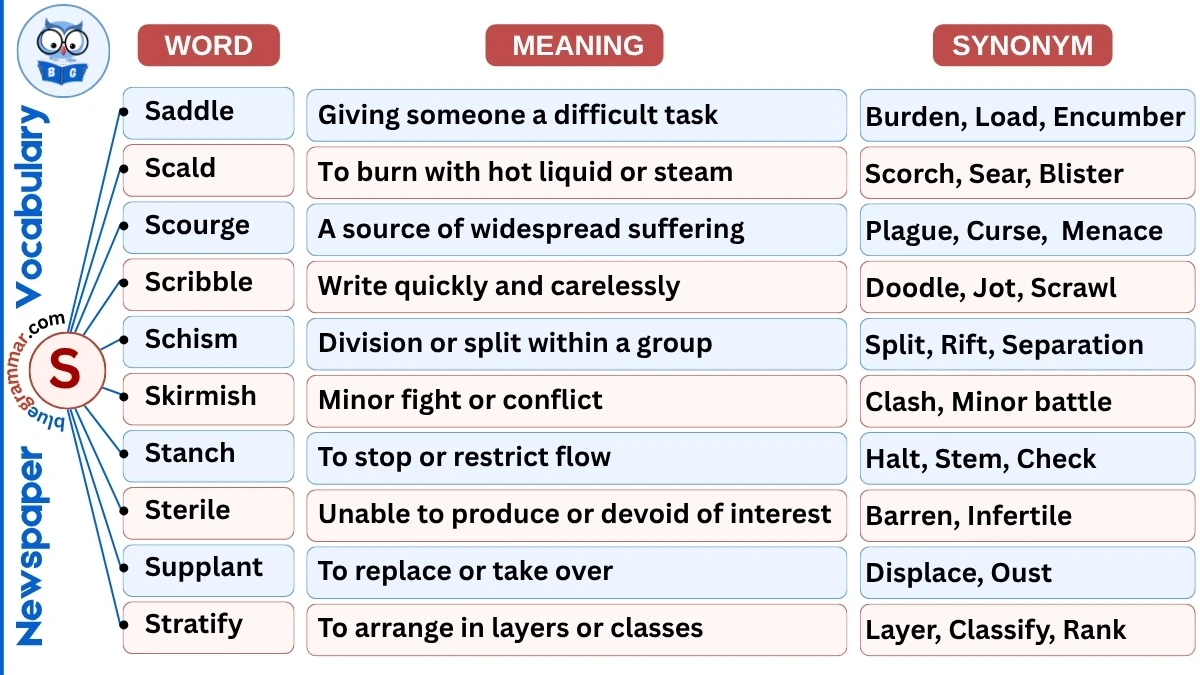
Newspaper Vocabulary | Words Starting with S
Welcome to our comprehensive guide on newspaper vocabulary starting with the letter S. Mastering these formal, precise, and analytical terms will greatly enhance your reading comprehension of news articles, opinion pieces, and editorial columns, as well as elevate your written English.
1. Saddle
Part of Speech: Verb, Noun
Meaning: To burden or assign responsibility.
Explanation: Saddle is used in political, social, and business reporting. It describes giving someone a task, often a difficult one.
Example: The new manager was saddled with reorganizing the entire department.
2. Scald
Part of Speech: Verb, Noun
Meaning: To burn with hot liquid or steam.
Explanation: Scald is used in health, accident, and disaster reporting. It can describe both literal and metaphorical harm.
Example: The worker was scalded in a chemical plant accident.
3. Scorching
Part of Speech: Adjective
Meaning: Extremely hot or intense.
Explanation: Scorching is used in environmental, political, and social reporting. It describes heat, criticism, or intense activity.
Example: The scorching summer led to water shortages in the city.
4. Scourge
Part of Speech: Noun, Verb
Meaning: A source of widespread suffering or trouble.
Explanation: Scourge is commonly used in social, health, and political reporting. It emphasizes widespread damage or hardship.
Example: Malaria continues to be a scourge in many tropical countries.
5. Scribble
Part of Speech: Verb, Noun
Meaning: Write quickly and carelessly.
Explanation: Scribble is used in human-interest, education, and investigative reporting. It often implies informal or careless writing.
Example: The suspect scribbled notes in a hurry during interrogation.
6. Schism
Part of Speech: Noun
Meaning: Division or split within a group.
Explanation: Schism is used in political, religious, and organizational reporting. It describes internal conflict or separation.
Example: The party faced a schism over policy disagreements.
7. Shambles
Part of Speech: Noun (plural)
Meaning: Mess or disorder.
Explanation: Shambles is used in political, social, and economic reporting. It describes chaotic or disorganized situations.
Example: The city’s public transport system was in shambles after the strike.
8. Skirmish
Part of Speech: Noun, Verb
Meaning: Minor fight or conflict.
Explanation: Skirmish is used in military, political, and social reporting. It refers to small-scale confrontations or disputes.
Example: Soldiers engaged in a skirmish along the border.
9. Spawn
Part of Speech: Verb, Noun
Meaning: To produce or generate.
Explanation: Spawn is used in political, economic, and social reporting. It describes creating new events, issues, or consequences.
Example: The new policy spawned debates across the country.
10. Spendthrift
Part of Speech: Noun, Adjective
Meaning: Person who spends money recklessly.
Explanation: Spendthrift is used in financial, social, and human-interest reporting. It emphasizes imprudent or excessive spending.
Example: The billionaire was criticized for being a spendthrift despite economic hardship.
11. Spruce
Part of Speech: Verb, Adjective
Meaning: Neat or stylish in appearance.
Explanation: Spruce is used in lifestyle, cultural, and human-interest reporting. It describes tidiness, presentation, or elegance.
Example: The office was spruced up before the inspection.
12. Stanch
Part of Speech: Verb
Meaning: To stop or restrict flow.
Explanation: Stanch is used in political, health, or disaster reporting. It often refers to stopping blood, leaks, or metaphorical damage.
Example: Efforts were made to stanch the spread of misinformation.
13. Sterile
Part of Speech: Adjective
Meaning: Unable to produce or devoid of interest.
Explanation: Sterile is used in scientific, political, and social reporting. It can describe lack of fertility, creativity, or effectiveness.
Example: The debate was sterile and failed to reach a conclusion.
14. Stupendous
Part of Speech: Adjective
Meaning: Extremely impressive or large.
Explanation: Stupendous is used in human-interest, political, or social reporting. It emphasizes remarkable size or impact.
Example: The team achieved stupendous success in the elections.
15. Stratify
Part of Speech: Verb
Meaning: To arrange in layers or classes.
Explanation: Stratify is used in social, economic, and academic reporting. It describes hierarchical organization or division.
Example: Wealth stratifies society, creating distinct social classes.
16. Strife
Part of Speech: Noun
Meaning: Conflict or struggle.
Explanation: Strife is used in political, social, and economic reporting. It emphasizes disagreement, tension, or fighting.
Example: Ethnic strife has plagued the region for decades.
17. Substantive
Part of Speech: Adjective
Meaning: Significant or meaningful.
Explanation: Substantive is used in legal, political, and editorial reporting. It emphasizes the importance or weight of an issue.
Example: The committee held substantive discussions on policy reform.
18. Substrate
Part of Speech: Noun
Meaning: Underlying layer or foundation.
Explanation: Substrate is used in scientific, environmental, and economic reporting. It describes the base supporting a system or structure.
Example: Soil acts as a substrate for plant growth.
19. Succor
Part of Speech: Noun, Verb
Meaning: Assistance or relief.
Explanation: Succor is used in humanitarian, disaster, and social reporting. It emphasizes help provided during crises.
Example: NGOs provided succor to flood victims.
20. Suasion
Part of Speech: Noun
Meaning: Persuasion or influence.
Explanation: Suasion is used in political, social, and corporate reporting. It refers to convincing others through reasoning or appeal.
Example: The minister used suasion to gain support for the bill.
21. Supplant
Part of Speech: Verb
Meaning: To replace or take over.
Explanation: Supplant is used in political, business, and technological reporting. It describes replacement of one entity by another.
Example: Digital media has supplanted traditional newspapers in many cities.
22. Sabotage
Part of Speech: Noun, Verb
Meaning: Deliberate damage or obstruction.
Explanation: Sabotage is used in political, corporate, and military reporting. It emphasizes intentional disruption.
Example: Protesters tried to sabotage the factory machinery.
23. Scrutiny
Part of Speech: Noun
Meaning: Close examination or inspection.
Explanation: Scrutiny is used in political, financial, and legal reporting. It highlights detailed observation or investigation.
Example: The government’s new policy faced intense public scrutiny.
24. Seize
Part of Speech: Verb
Meaning: Take hold of suddenly or forcibly.
Explanation: Seize is used in crime, political, and social reporting. It emphasizes control, capture, or urgent action.
Example: Authorities seized the contraband before it could reach the market.
25. Substantiate
Part of Speech: Verb
Meaning: Provide evidence or support.
Explanation: Substantiate is used in investigative, political, and legal reporting. It emphasizes proving claims with facts or evidence.
Example: The journalist was asked to substantiate the allegations with documents.