
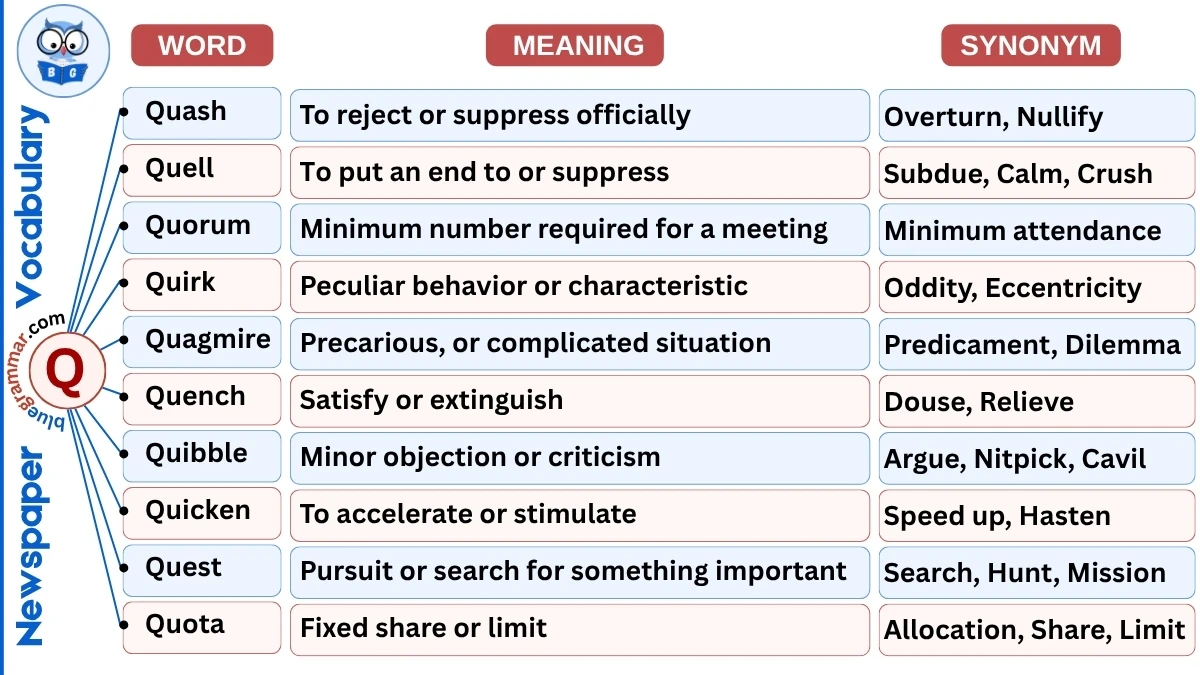
Newspaper Vocabulary | Words Starting with Q
Welcome to our comprehensive guide on newspaper vocabulary starting with the letter Q. Mastering these formal, precise, and analytical terms will greatly enhance your reading comprehension of news articles, opinion pieces, and editorial columns, as well as elevate your written English.
1. Quash
Part of Speech: Verb
Meaning: To reject or suppress officially.
Explanation: Quash is often used in legal, political, or administrative reporting. It describes formally nullifying decisions, laws, or actions.
Example: The court quashed the previous verdict due to procedural errors.
2. Quell
Part of Speech: Verb
Meaning: To put an end to or suppress.
Explanation: Quell is used in political, social, or conflict reporting. It describes stopping unrest, rebellion, or rumors.
Example: Authorities acted quickly to quell the protests.
3. Query
Part of Speech: Noun, Verb
Meaning: Question or doubt.
Explanation: Query is used in investigative, political, and business reporting. It refers to raising inquiries or seeking clarification.
Example: The journalist sent a query to the ministry regarding the policy changes.
4. Quest
Part of Speech: Noun, Verb
Meaning: Pursuit or search for something important.
Explanation: Quest is used in human-interest, political, or cultural reporting. It emphasizes a determined effort to achieve a goal.
Example: The nation embarked on a quest for sustainable energy solutions.
5. Quota
Part of Speech: Noun
Meaning: Fixed share or limit.
Explanation: Quota is used in economic, social, and political reporting. It describes assigned numbers or proportions for compliance or representation.
Example: The government imposed a quota on imported vehicles.
6. Quorum
Part of Speech: Noun
Meaning: Minimum number required for a meeting to be valid.
Explanation: Quorum is used in political, corporate, and organizational reporting. It emphasizes legitimacy of proceedings or decisions.
Example: The meeting was postponed because a quorum was not present.
7. Quarantine
Part of Speech: Noun, Verb
Meaning: Isolation to prevent spread of disease.
Explanation: Quarantine is used in health, political, and social reporting. It highlights public health measures or restrictions.
Example: The authorities imposed a two-week quarantine on travelers from affected regions.
8. Quarrel
Part of Speech: Noun, Verb
Meaning: Disagreement or dispute.
Explanation: Quarrel is used in political, social, and human-interest reporting. It describes conflicts or disputes between parties.
Example: A quarrel between the two ministers delayed the policy announcement.
9. Quicken
Part of Speech: Verb
Meaning: To accelerate or stimulate.
Explanation: Quicken is used in economic, social, or political reporting. It refers to speeding up processes, reactions, or development.
Example: The new policy aims to quicken the pace of infrastructure projects.
10. Quirk
Part of Speech: Noun
Meaning: Peculiar behavior or characteristic.
Explanation: Quirk is used in human-interest, cultural, and social reporting. It describes unusual traits or unexpected situations.
Example: His quirky sense of humor made him a favorite among colleagues.
11. Quintessential
Part of Speech: Adjective
Meaning: Representing the perfect example.
Explanation: Quintessential is used in cultural, political, or social reporting. It emphasizes something as a model or standard.
Example: The Eiffel Tower is the quintessential symbol of Paris.
12. Quagmire
Part of Speech: Noun
Meaning: Difficult, precarious, or complicated situation.
Explanation: Quagmire is used in political, social, or economic reporting. It describes situations that are hard to navigate or resolve.
Example: The country found itself in a quagmire after the economic crisis.
13. Quench
Part of Speech: Verb
Meaning: Satisfy or extinguish.
Explanation: Quench is used in social, political, and environmental reporting. It describes suppressing desires, unrest, or fires.
Example: Authorities tried to quench the unrest through dialogue.
14. Quibble
Part of Speech: Verb, Noun
Meaning: Minor objection or criticism.
Explanation: Quibble is used in legal, political, and social reporting. It refers to focusing on small details rather than the main issue.
Example: The lawyer quibbled over minor points in the contract.
15. Qualitative
Part of Speech: Adjective
Meaning: Relating to qualities rather than quantities.
Explanation: Qualitative is used in research, policy, and social reporting. It emphasizes descriptive aspects or characteristics rather than numbers.
Example: The study provided qualitative insights into voter behavior.