
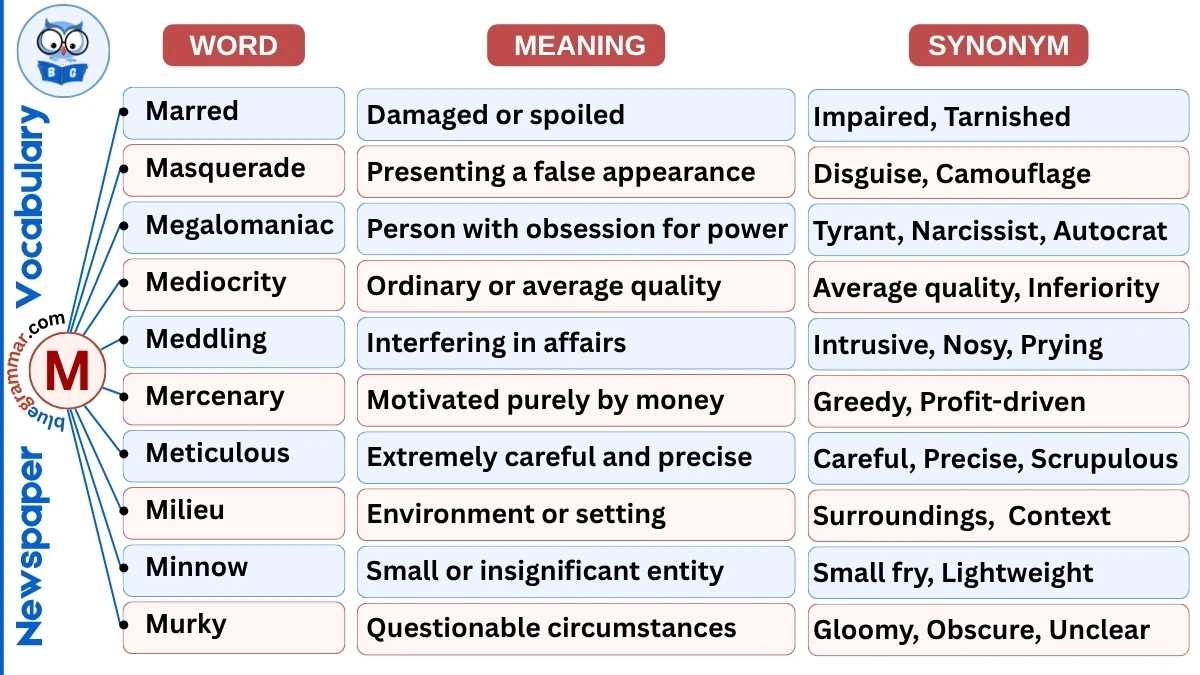
Newspaper Vocabulary | Words Starting with M
Welcome to our comprehensive guide on newspaper vocabulary starting with the letter M. Mastering these formal, precise, and analytical terms will greatly enhance your reading comprehension of news articles, opinion pieces, and editorial columns, as well as elevate your written English.
1. Mantle
Part of Speech: Noun
Meaning: Responsibility or role.
Explanation: Mantle is often used metaphorically in news to describe taking over duties or leadership. It emphasizes authority or responsibility passed on.
Example: The new prime minister assumed the mantle of leadership during the crisis.
2. Manifest
Part of Speech: Adjective, Verb
Meaning: Clear or obvious.
Explanation: Manifest is used in political, social, and economic reporting to describe evidence or outcomes that are apparent. It emphasizes clarity or visibility of a situation.
Example: The benefits of the policy were manifest in improved public services.
3. Marginalise
Part of Speech: Verb
Meaning: To push to the edges or reduce influence.
Explanation: This word is often used in social, political, and economic contexts. It describes groups or individuals being sidelined or ignored.
Example: Minorities are often marginalised in political decision-making.
4. Marred
Part of Speech: Adjective, Verb (past participle)
Meaning: Damaged or spoiled.
Explanation: Marred is used to describe situations, reputations, or events that have been negatively affected. It emphasizes imperfection or harm.
Example: The event was marred by unexpected protests.
5. Masquerade
Part of Speech: Noun, Verb
Meaning: Pretend or disguise.
Explanation: Masquerade is commonly used in investigative journalism or social commentary. It describes people or organizations presenting a false appearance.
Example: The company’s charity work was a masquerade to improve its image.
6. Megalomaniac
Part of Speech: Noun, Adjective
Meaning: Person with obsession for power.
Explanation: This word is often used in political analysis and editorial reporting. It highlights extreme self-centered ambition or authoritarian behavior.
Example: The dictator acted like a megalomaniac, ignoring the needs of his people.
7. Mediocrity
Part of Speech: Noun
Meaning: Ordinary or average quality.
Explanation: Mediocrity is used in commentary and critique, often to highlight substandard performance or lack of excellence.
Example: Critics condemned the movie for its mediocrity.
8. Meddling
Part of Speech: Noun, Adjective
Meaning: Interfering in affairs.
Explanation: Meddling is commonly used in political and international news. It describes unwanted interference in decisions or policies.
Example: The report accused foreign powers of meddling in domestic elections.
9. Mercenary
Part of Speech: Adjective, Noun
Meaning: Motivated purely by money.
Explanation: This word is used in business, politics, and military contexts. It emphasizes self-interest over ethics or loyalty.
Example: The mercenary approach of some contractors raised public concern.
10. Meticulous
Part of Speech: Adjective
Meaning: Extremely careful and precise.
Explanation: Meticulous is used to describe planning, reporting, or research. It emphasizes attention to detail and thoroughness.
Example: The journalist conducted a meticulous investigation before publishing the story.
11. Milieu
Part of Speech: Noun
Meaning: Environment or setting.
Explanation: Milieu is often used in social and cultural reporting. It describes the social, political, or cultural context influencing events.
Example: The artist thrived in a creative milieu that encouraged experimentation.
12. Minnow
Part of Speech: Noun
Meaning: Small or insignificant entity.
Explanation: Minnow is used in business, politics, and economics to describe small players with limited influence.
Example: Startups often struggle against industry giants, while the minnows survive with niche markets.
13. Modicum
Part of Speech: Noun
Meaning: Small amount.
Explanation: Modicum is commonly used in editorial and news writing to describe limited quantities of resources, evidence, or support.
Example: The plan lacked even a modicum of transparency.
14. Moot
Part of Speech: Adjective, Verb
Meaning: Subject to debate; irrelevant.
Explanation: Moot is used in legal, academic, and policy discussions. It describes issues that are arguable or no longer relevant.
Example: The question of funding became moot after the policy was rejected.
15. Murky
Part of Speech: Adjective
Meaning: Dark, unclear, or suspicious.
Explanation: Murky is used in investigative, political, and business reporting. It emphasizes opacity or questionable circumstances.
Example: The company’s finances remained murky despite repeated audits.
16. Myriad
Part of Speech: Noun, Adjective
Meaning: Countless or numerous.
Explanation: Myriad is used in descriptive reporting to emphasize a large number of items, issues, or factors.
Example: The report highlighted a myriad of social challenges facing the city.
17. Magnitude
Part of Speech: Noun
Meaning: Size, importance, or impact.
Explanation: Magnitude is often used in disaster, economic, or political news to describe scale or significance.
Example: The magnitude of the earthquake caused widespread panic.
18. Malicious
Part of Speech: Adjective
Meaning: Intended to harm.
Explanation: Malicious is used in crime, political, and legal reporting. It highlights harmful intent behind actions or statements.
Example: The hacker launched a malicious attack on the government website.
19. Mandate
Part of Speech: Noun, Verb
Meaning: Official order or authority.
Explanation: Mandate is commonly used in politics, governance, and organizational reporting. It describes formal approval or authorization.
Example: The new government received a strong mandate from voters.
20. Maneuver
Part of Speech: Noun, Verb
Meaning: Strategic movement or action.
Explanation: Maneuver is used in politics, military, and corporate news. It refers to careful planning or tactical moves.
Example: The party maneuvered skillfully to secure parliamentary support.
21. Marginal
Part of Speech: Adjective
Meaning: Minor or insignificant.
Explanation: Marginal is used in economic, political, or social reporting. It refers to limited impact or influence.
Example: The policy had only a marginal effect on unemployment.
22. Mediate
Part of Speech: Verb
Meaning: Intervene to resolve disputes.
Explanation: Mediate is commonly used in diplomatic, social, and business contexts. It involves facilitating negotiation or reconciliation between parties.
Example: The UN helped mediate the conflict between the two nations.
23. Militant
Part of Speech: Adjective, Noun
Meaning: Aggressively active or combative.
Explanation: Militant is used in political, social, or military reporting. It describes individuals or groups taking assertive action, often confrontational.
Example: Militant activists protested against government policies.
24. Mitigate
Part of Speech: Verb
Meaning: Make less severe.
Explanation: Mitigate is used in policy, disaster, and legal news. It refers to reducing the negative impact of an event or action.
Example: Authorities introduced measures to mitigate the effects of flooding.
25. Mobilize
Part of Speech: Verb
Meaning: Organize or prepare for action.
Explanation: Mobilize is commonly used in military, political, or social reporting. It emphasizes coordinated action or movement of resources.
Example: The government mobilized emergency services after the hurricane warning.