
Newspaper Vocabulary | Words Starting with B
Welcome to our comprehensive guide on newspaper vocabulary starting with the letter B. Mastering these formal, precise, and analytical words will greatly enhance your reading comprehension of news articles, opinion pieces, and editorial columns, as well as elevate your written English.
1. Bawl
Part of Speech: Verb, Noun
Meaning: To shout or cry loudly.
Explanation: In news, this word is often used to describe emotional outbursts or loud protests. It can refer to people expressing anger, frustration, or grief in public situations. It is commonly seen in reports about demonstrations or disputes.
Example: Protesters bawled slogans outside the parliament.
2. Beacon
Part of Speech: Noun
Meaning: A signal or symbol of hope.
Explanation: “Beacon” is often used metaphorically in newspapers to describe something that guides or inspires people. It may refer to a leader, policy, or country seen as a positive example.
Example: The reform became a beacon of hope for the nation.
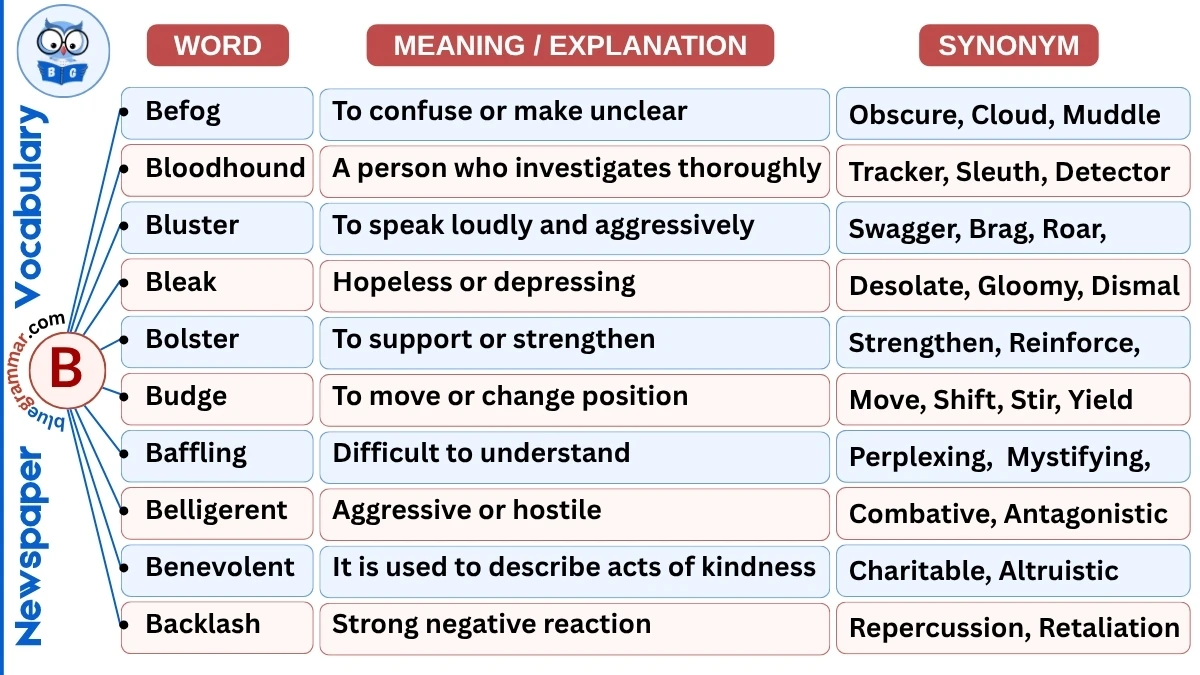
3. Befog
Part of Speech: Verb
Meaning: To confuse or make unclear.
Explanation: This word is used when information or arguments become unclear or misleading. In news, it may describe complex statements or attempts to hide the truth.
Example: The issue was befogged by contradictory statements.
4. Bid
Part of Speech: Verb, Noun
Meaning: An attempt or effort.
Explanation: “Bid” is frequently used in political and business news. It refers to an attempt to achieve something, such as winning an election or acquiring a company.
Example: He made a bid for the presidency.
5. Bloodhound
Part of Speech: Noun
Meaning: A person who investigates thoroughly.
Explanation: In journalism, this word can describe a determined investigator or reporter. It highlights persistence in uncovering facts or truth.
Example: The journalist acted like a bloodhound in exposing corruption.
6. Bluster
Part of Speech: Verb, Noun
Meaning: To speak loudly and aggressively.
Explanation: This word is used for strong, often empty threats or bold statements. It is common in political news where leaders make dramatic claims.
Example: The leader blustered about taking strict action.
7. Bleak
Part of Speech: Adjective
Meaning: Hopeless or depressing.
Explanation: “Bleak” is often used to describe negative situations, such as economic crises or harsh conditions. It conveys a sense of difficulty and uncertainty.
Example: The report painted a bleak picture of the economy.
8. Bolster
Part of Speech: Verb
Meaning: To support or strengthen.
Explanation: This word is commonly used in news about policies, economies, or arguments. It indicates efforts to improve or reinforce something.
Example: The government introduced measures to bolster the economy.
9. Brawl
Part of Speech: Noun, Verb
Meaning: A noisy fight.
Explanation: “Brawl” is used in crime or social news to describe physical fights, often involving groups. It suggests chaos and disorder.
Example: A brawl broke out during the protest.
10. Brethren
Part of Speech: Noun
Meaning: Members of the same group.
Explanation: This word is often used in religious or formal contexts. In news, it can refer to people belonging to the same community or organization.
Example: He addressed his brethren during the gathering.
11. Budge
Part of Speech: Verb
Meaning: To move or change position.
Explanation: In news, “budge” is often used figuratively. It describes someone refusing to change their opinion or stance.
Example: The officials refused to budge on the issue.
12. Bulge
Part of Speech: Verb, Noun
Meaning: To swell or increase.
Explanation: This word is used in economic and population reports. It describes a noticeable rise in numbers or size.
Example: There was a bulge in youth population statistics.
13. Baton
Part of Speech: Noun
Meaning: A stick carried by police.
Explanation: “Baton” is commonly seen in law enforcement news. It is often mentioned in reports of protests or crowd control.
Example: Police used batons to disperse the crowd.
14. Belligerent
Part of Speech: Adjective, Noun
Meaning: Aggressive or hostile.
Explanation: This word is used in political and international news. It describes countries or individuals showing hostility or readiness to fight.
Example: The country adopted a belligerent stance.
15. Benevolent
Part of Speech: Adjective
Meaning: Kind and helpful.
Explanation: “Benevolent” is used to describe acts of kindness, especially by organizations or leaders. It often appears in positive or humanitarian news.
Example: The organization played a benevolent role in relief efforts.
16. Bias
Part of Speech: Noun, Verb
Meaning: Unfair preference.
Explanation: This word is very common in media discussions. It refers to a lack of neutrality or fairness in reporting or decision-making.
Example: The report was criticized for political bias.
17. Bilateral
Part of Speech: Adjective
Meaning: Involving two sides or countries.
Explanation: “Bilateral” is frequently used in international relations. It describes agreements or discussions between two nations.
Example: The countries held bilateral talks.
18. Bureaucracy
Part of Speech: Noun
Meaning: A system of government administration.
Explanation: This word refers to official procedures and government departments. It is often used negatively to describe delays and complexity.
Example: The project was delayed due to bureaucracy.
19. Burgeon
Part of Speech: Verb
Meaning: To grow rapidly.
Explanation: “Burgeon” is used in reports about growth, especially in business, technology, or population. It suggests quick expansion.
Example: The tech industry is burgeoning rapidly.
20. Bypass
Part of Speech: Verb, Noun
Meaning: To avoid or go around.
Explanation: In news, this word is used when rules, systems, or processes are avoided. It can also refer to physical routes like roads.
Example: The company bypassed regulations.
21. Backlash
Part of Speech: Noun
Meaning: Strong negative reaction.
Explanation: “Backlash” is commonly used in political and social news. It refers to public anger or criticism after a decision or event.
Example: The policy sparked a public backlash.
22. Baffling
Part of Speech: Adjective
Meaning: Confusing or puzzling.
Explanation: This word is used to describe situations that are difficult to understand. It often appears in reports about mysterious events.
Example: The case remains baffling for investigators.
23. Breach
Part of Speech: Noun, Verb
Meaning: A violation or breaking of rules.
Explanation: “Breach” is widely used in legal and cybersecurity news. It refers to breaking laws, agreements, or security systems.
Example: The company faced a data breach.
24. Brutality
Part of Speech: Noun
Meaning: Extreme violence.
Explanation: This word is used in serious news reports, especially about crime or police actions. It highlights harsh and inhumane behavior.
Example: The incident raised concerns about police brutality.
25. Blueprint
Part of Speech: Noun
Meaning: A detailed plan.
Explanation: “Blueprint” is often used metaphorically in news. It refers to a clear plan for future action or development.
Example: The government unveiled a blueprint for reforms.