
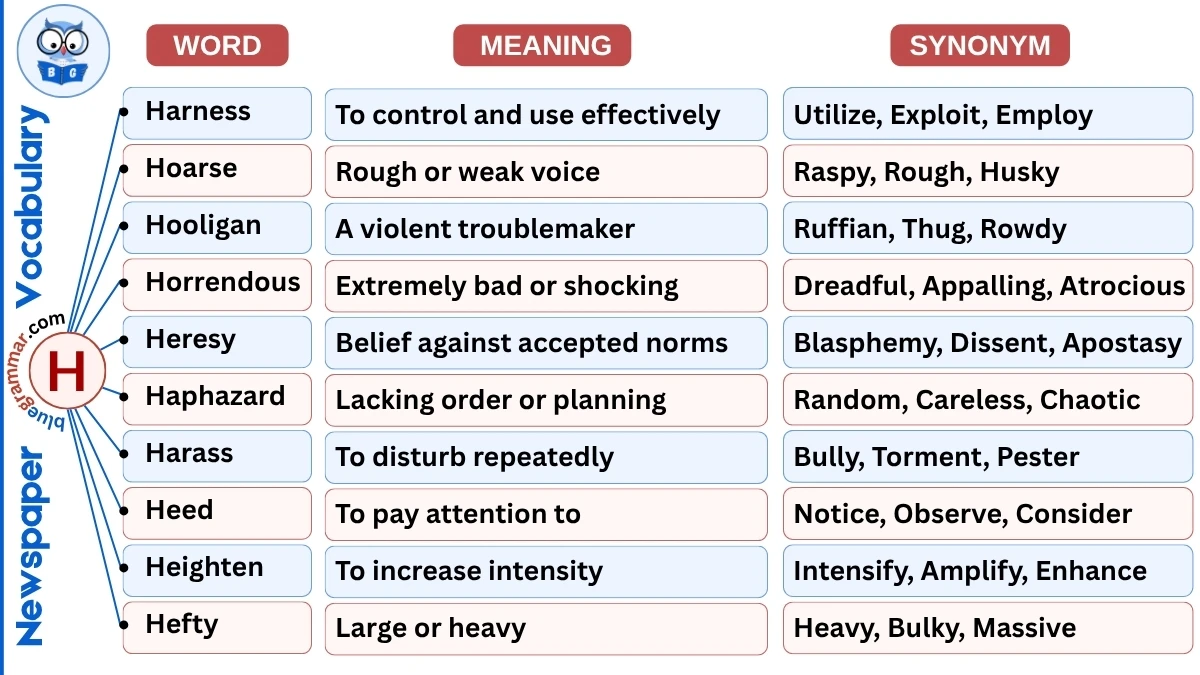
Newspaper Vocabulary | Words Starting with H
Welcome to our comprehensive guide on newspaper vocabulary starting with the letter H. Mastering these formal, precise, and analytical terms will greatly enhance your reading comprehension of news articles, opinion pieces, and editorial columns, as well as elevate your written English.
1. Harness
Part of Speech: Verb, Noun
Meaning: To control and use.
Explanation: This word is used in development and policy news. It refers to using resources or energy effectively for a purpose.
Example: The country aims to harness renewable energy.
2. Heed
Part of Speech: Verb, Noun
Meaning: To pay attention to.
Explanation: This word is used in warnings and advice. It emphasizes the importance of listening carefully.
Example: Citizens were urged to heed safety warnings.
3. Hedonistic
Part of Speech: Adjective
Meaning: Focused on pleasure.
Explanation: This word is used in cultural or social analysis. It may describe lifestyles centered on enjoyment rather than responsibility.
Example: Critics called the trend hedonistic.
4. Heresy
Part of Speech: Noun
Meaning: Belief against accepted norms.
Explanation: This word is used in religious or ideological contexts. It can also describe ideas that challenge established beliefs.
Example: His views were considered heresy.
5. Hegemony
Part of Speech: Noun
Meaning: Dominance over others.
Explanation: This word is widely used in international relations. It describes political or economic control by one country over others.
Example: The nation sought regional hegemony.
6. Herald
Part of Speech: Verb, Noun
Meaning: To signal or announce.
Explanation: This word is used when something indicates the beginning of an event or change.
Example: The agreement heralded a new era of cooperation.
7. Hoarse
Part of Speech: Adjective
Meaning: Rough or weak voice.
Explanation: This word is used in human-interest stories. It describes voices affected by shouting or illness.
Example: Protesters shouted until their voices were hoarse.
8. Hooligan
Part of Speech: Noun
Meaning: A violent troublemaker.
Explanation: This word is used in crime and sports news. It refers to people involved in disorderly behavior.
Example: Police arrested several hooligans.
9. Horrendous
Part of Speech: Adjective
Meaning: Extremely bad or shocking.
Explanation: This word is used in disaster and crime reporting. It emphasizes severity and horror.
Example: The accident was described as horrendous.
10. Hamper
Part of Speech: Verb
Meaning: To hinder or obstruct.
Explanation: This word is used in reports about delays or difficulties. It refers to actions that slow progress.
Example: Bad weather hampered rescue efforts.
11. Haphazard
Part of Speech: Adjective
Meaning: Lacking order or planning.
Explanation: This word is used to criticize poorly organized actions. It often appears in reports about mismanagement.
Example: The response was haphazard.
12. Harass
Part of Speech: Verb
Meaning: To disturb repeatedly.
Explanation: This word is used in legal and social news. It refers to ongoing unwanted behavior.
Example: The worker accused his boss of harassment.
13. Hasten
Part of Speech: Verb
Meaning: To speed up.
Explanation: This word is used when actions are taken quickly. It often appears in urgent situations.
Example: Officials hastened relief efforts.
14. Hesitant
Part of Speech: Adjective
Meaning: Uncertain or unsure.
Explanation: This word is used in decision-making contexts. It describes lack of confidence or delay in action.
Example: Investors remained hesitant.
15. Hindrance
Part of Speech: Noun
Meaning: An obstacle.
Explanation: This word is used in development and policy news. It refers to something that blocks progress.
Example: Lack of funds is a major hindrance.
16. Hostility
Part of Speech: Noun
Meaning: Anger or aggression.
Explanation: This word is used in conflict and international news. It describes tension between groups or nations.
Example: Hostility between the countries increased.
17. Hypocrisy
Part of Speech: Noun
Meaning: False appearance of virtue.
Explanation: This word is used in political criticism. It refers to acting differently from what one claims.
Example: The leader was accused of hypocrisy.
18. Hypothetical
Part of Speech: Adjective
Meaning: Based on assumption.
Explanation: This word is used in analysis and discussions. It refers to imagined situations.
Example: The question was purely hypothetical.
19. Hinder
Part of Speech: Verb
Meaning: To create difficulty.
Explanation: This word is similar to “hamper.” It describes actions that slow or block progress.
Example: Bureaucracy hindered development.
20. Highlight
Part of Speech: Verb, Noun
Meaning: To emphasize.
Explanation: This word is widely used in news. It refers to drawing attention to important points.
Example: The report highlighted key issues.
21. Humanitarian
Part of Speech: Adjective, Noun
Meaning: Concerned with human welfare.
Explanation: This word is used in global and crisis reporting. It refers to aid and efforts to help people.
Example: Humanitarian aid was sent to victims.
22. Hefty
Part of Speech: Adjective
Meaning: Large or heavy.
Explanation: This word is used in financial and general contexts. It often refers to large amounts or strong impact.
Example: The company faced a hefty fine.
23. Heighten
Part of Speech: Verb
Meaning: To increase intensity.
Explanation: This word is used in emotional and political contexts. It describes rising tension or awareness.
Example: The incident heightened tensions.
24. Halt
Part of Speech: Verb, Noun
Meaning: To stop.
Explanation: This word is used in policy and action news. It refers to stopping processes or activities.
Example: The project was halted due to issues.
25. Hardship
Part of Speech: Noun
Meaning: Difficult conditions.
Explanation: This word is used in social and economic news. It refers to suffering due to poverty or crisis.
Example: Many families faced hardship.