
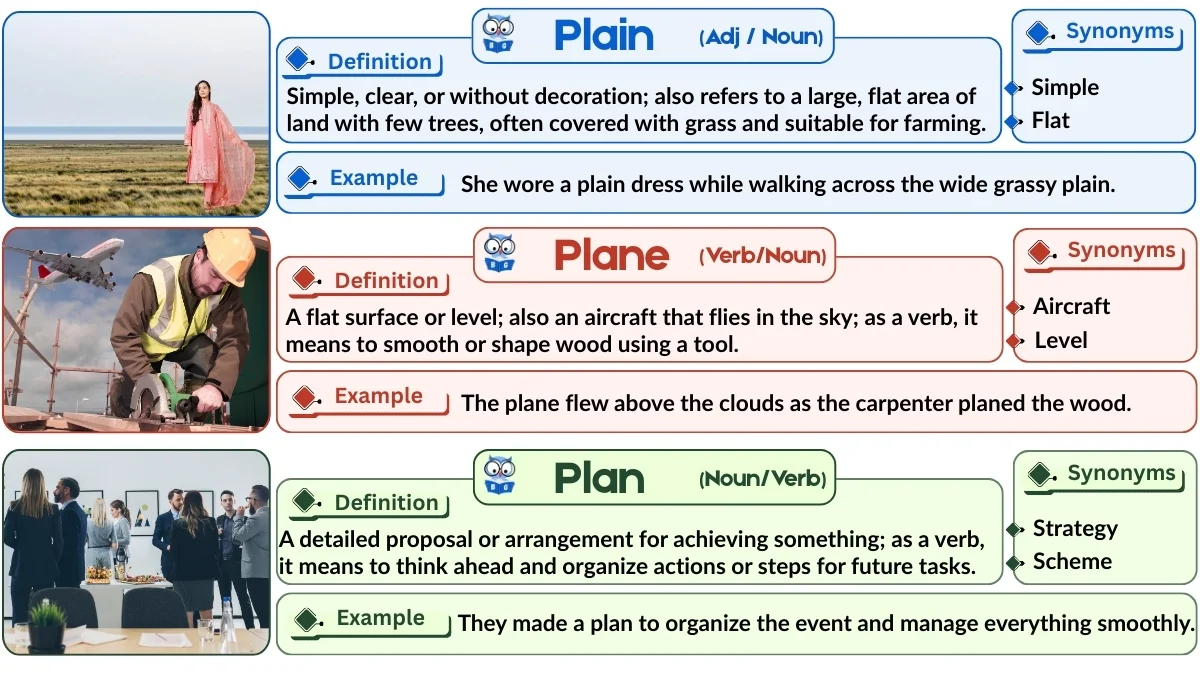
Plain vs. Plane vs. Plan: Difference and Examples
English learners often get confused between plain, plane, and plan because they sound similar but have different meanings and uses. These words belong to different parts of speech and are used in completely different contexts. Understanding their meanings clearly can improve both your writing and speaking skills. While "plain" is often used to describe simplicity, "plane" usually refers to a surface or an aircraft. On the other hand, "plan" is about thinking ahead or organizing something. Let’s explore each word in detail with examples and explanations.
1. Plain
Meaning & Part of Speech: Adjective & Noun — Simple, clear, or unadorned; or a large, flat area of land with few trees.
Explanation: "Plain" is commonly used as an adjective, but it can also function as a noun. As an adjective, it describes something simple, clear, or without decoration. It can also mean something obvious or easy to understand. As a noun, it refers to a large area of flat land with few trees. This word is often used in everyday conversation to describe appearance, food, or landscapes.
Example: She chose a plain outfit for the meeting to look professional.
Explanation: In this sentence, plain means simple and not flashy, showing that the outfit is modest and suitable for a formal setting.
More Examples:
- The instructions were plain and easy to follow.
- He prefers plain rice with vegetables.
- The house had a plain design but looked elegant.
- They traveled across a vast plain during their journey.
Related Words: Simple, Basic, Clear, Ordinary, Unadorned, Prairie
2. Plane
Meaning & Part of Speech: Noun — An airplane/aircraft; a flat two-dimensional surface in geometry; or a woodworking tool for smoothing wood.
Explanation: "Plane" is a noun with multiple meanings depending on the context. It can refer to an aircraft that flies in the sky. In geometry or general use, it refers to a flat or level surface. Additionally, in woodworking, a "plane" is a tool used to smooth surfaces. This word is widely used in both technical and general contexts.
Example: The plane flew above the clouds during the long journey.
Explanation: Here, plane refers to an aircraft, describing its movement high in the sky during travel.
More Examples:
- The picture hangs on a horizontal plane.
- The carpenter used a plane to smooth the wood.
- Birds were flying near the plane.
- The surface must be on the same plane for accuracy.
Related Words: Aircraft, Airplane, Surface, Level, Woodworking tool
3. Plan
Meaning & Part of Speech: Noun & Verb — A detailed proposal or scheme for achieving an objective; or to arrange and organize something in advance.
Explanation: "Plan" can be used both as a noun and a verb. As a noun, it refers to a detailed idea or arrangement for achieving something. As a verb, it means to think about and organize something in advance. Note that "plan" has a short vowel sound (/plæn/), unlike the long vowel in "plain" and "plane" (/pleɪn/). It is commonly used in daily life, business, education, and travel.
Example: They plan to expand their business by opening a new branch.
Explanation: In this sentence, plan is used as a verb, meaning they have decided and arranged to grow their business in the future.
More Examples:
- She made a study plan for her exams.
- We plan our trips carefully every year.
- His plan worked better than expected.
- The team discussed a new marketing plan.
Related Words: Strategy, Scheme, Idea, Arrange, Prepare, Schedule
Common Mistakes to Avoid
-
Writing Plain Instead of Plane for Airplanes
Incorrect: We boarded the plain to London.
Correct: We boarded the plane to London.
Explanation: The vehicle used for air travel ends with an 'e' (plane), whereas plain describes something basic or flat terrain. -
Confusing Plan with Plane in Future Preparation
Incorrect: What is your plane for tomorrow?
Correct: What is your plan for tomorrow?
Explanation: Arranging or scheduling future activities requires the short-vowel word plan.
Summary
Although plain, plane, and plan look and sound similar, their usages are distinct:
- Plain – Simple, basic, clear, or flat land (think of plain as simple and available to identify).
- Plane – An airplane, a flat geometric surface, or a woodworking tool.
- Plan – A strategy or intention to organize something in advance (shorter pronunciation /plæn/).
A simple memory tip: An airplane flies through the sky with wings on each side, a plain description is always instantly simple, and a plan is something you do anhead of time.
Practice Exercise: Fill in the Blanks Using Plain / Plane / Plan
Choose the correct word (plain, plane, or plan) to complete each sentence:
- The __________ landed safely after a long flight.
- She wore a __________ dress to the event.
- We need a clear __________ before starting the project.
- The farmers worked on a large __________.
- They __________ to visit their relatives next week.