
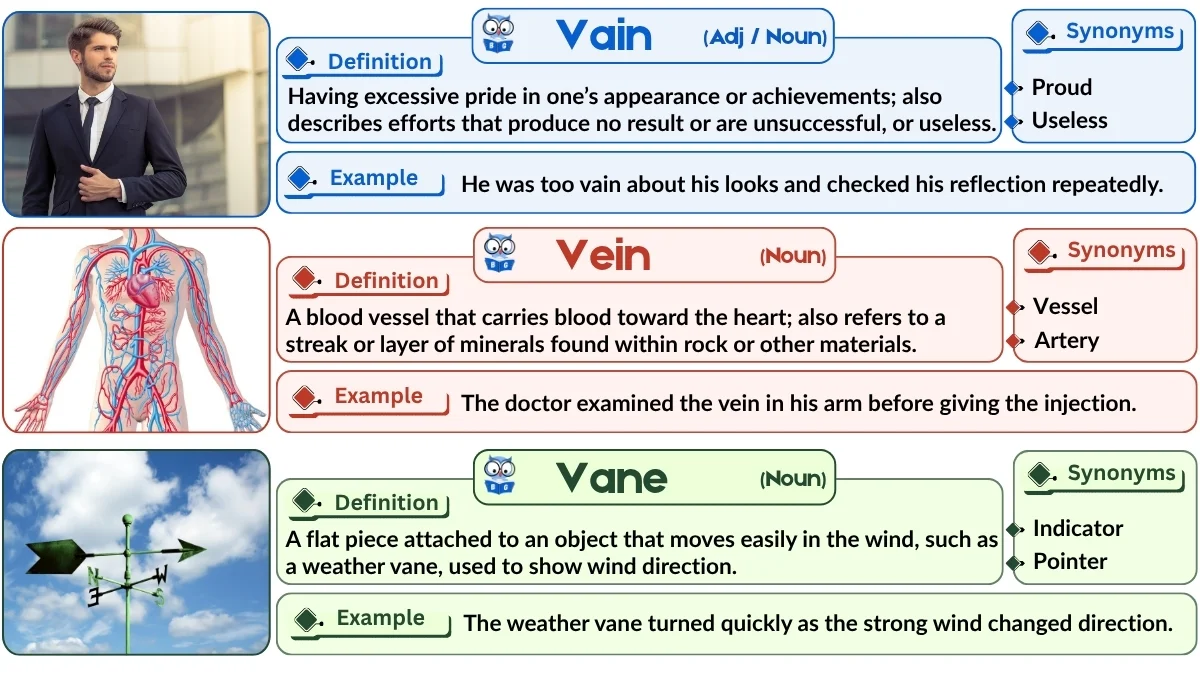
Vain vs. Vane vs. Vein: Difference and Examples
English learners often confuse vain, vane, and vein because they sound alike but have very different meanings. These words belong to different contexts, including personality traits, objects, and parts of the body. A small spelling mistake can completely change the meaning of a sentence. "Vain" is often related to pride or useless effort, while "vane" refers to a device that shows direction. On the other hand, "vein" is connected to the body or patterns. Let’s explore each word in detail to understand their correct usage.
1. Vain
Meaning & Part of Speech: Adjective — Having or showing an excessively high opinion of one's appearance, abilities, or worth; or producing no result; useless.
Explanation: "Vain" is an adjective used to describe someone who is overly proud of their appearance or achievements. It can also mean something done without success or result (e.g., "in vain"). This word is commonly used in both personal and general contexts and often carries a negative meaning when describing a person’s attitude.
Example: He is too vain to admit his mistakes.
Explanation: In this sentence, vain describes a person who is overly proud and unwilling to accept faults.
More Examples:
- She spent hours in front of the mirror, feeling vain about her looks.
- All their efforts were in vain when the plan failed.
- He made a vain attempt to fix the broken machine.
- Being vain can sometimes harm relationships.
Related Words: Proud, Conceited, Useless, Unsuccessful, Futile
2. Vane
Meaning & Part of Speech: Noun — A broad, flat blade or plate attached to a central axis to be moved by wind or water, such as a weather vane or turbine blade.
Explanation: "Vane" is a noun that refers to a flat object that moves with the wind to show its direction. It is commonly seen on rooftops as a weather vane. The word is mostly used in scientific, mechanical, or environmental contexts. Though less common in daily conversation, it is important for understanding weather-related terms.
Example: The weather vane on the roof showed the direction of the wind.
Explanation: Here, vane refers to a device that rotates to indicate wind direction.
More Examples:
- The vane turned quickly during the storm.
- Farmers used a vane to check wind direction.
- The weather vane pointed north.
- A vane helps in predicting weather changes.
Related Words: Indicator, Pointer, Wind tool, Direction, Blade
3. Vein
Meaning & Part of Speech: Noun — A blood vessel that carries blood toward the heart; a distinct streak or line in rock, marble, or leaf tissue; or a style/manner.
Explanation: "Vein" is a noun with multiple meanings. It commonly refers to blood vessels in the body that carry blood toward the heart. It can also describe a distinct line or pattern in materials like leaves or marble. Additionally, it can be used figuratively to describe a particular quality, tone, or mood (e.g., "in a similar vein").
Example: The doctor checked the patient’s vein before giving the injection.
Explanation: In this sentence, vein refers to a blood vessel in the body.
More Examples:
- Blue veins were visible on his hands.
- The leaf has a strong central vein.
- There was a vein of humor in his speech.
- The marble had beautiful white veins.
Related Words: Vessel, Artery, Line, Pattern, Streak, Manner
Common Mistakes to Avoid
-
Writing Vain Instead of Vein for Blood Vessels or Mineral Streaks
Incorrect: The nurse tried to locate a vain for the blood test.
Correct: The nurse tried to locate a vein for the blood test.
Explanation: Anatomical blood vessels use the spelling vein (with 'ei'), whereas vain describes vanity or futility. -
Confusing Vane with Vain in Weather Descriptions
Incorrect: The rooster weather vain pointed north.
Correct: The rooster weather vane pointed north.
Explanation: The device mounted on roofs to show wind direction is spelled vane (ending with 'e').
Summary
Although vain, vane, and vein sound identical, their meanings and applications are completely distinct:
- Vain – Overly proud of appearance or having no success/futility (contains 'ai' like airhead or infectious pride).
- Vane – A weather instrument or blade that points in the wind (ends in 'ane' like wane or plane).
- Vein – A blood vessel, leaf structure, or mineral streak (contains 'ei' like veins carrying energy).
A simple memory tip: You are vain about your appearance, a weather vane moves in the wind, and a blood vein flows through your entire body.
Practice Exercise: Fill in the Blanks Using Vain / Vane / Vein
Choose the correct word (vain, vane, or vein) to complete each sentence:
- The weather __________ showed the wind direction.
- His efforts were in __________ after the failure.
- The nurse found a __________ to draw blood.
- She is too __________ about her appearance.
- The leaf has a visible __________ in the center.