Lose vs. Loss vs. Lost: Difference and Examples
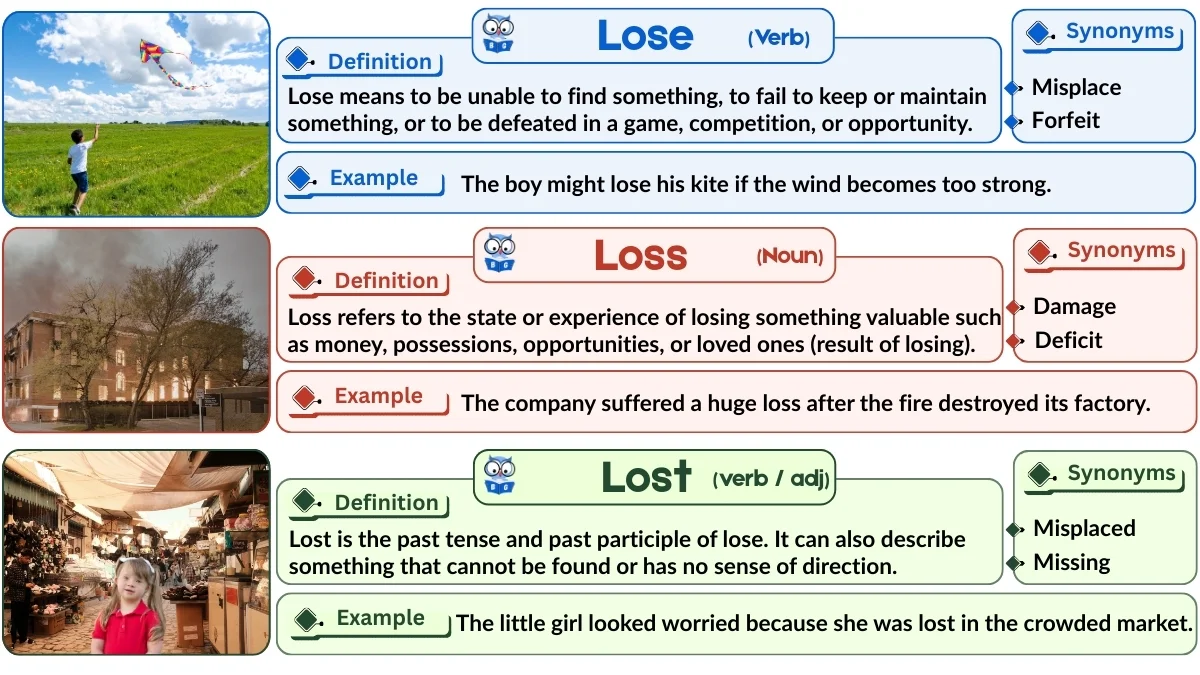
Many English learners confuse lose, loss, and lost because these words come from the same root but serve different grammatical roles. Understanding the difference between them helps you avoid common mistakes in writing and speaking. In simple terms: Lose is a verb (an action), Loss is a noun (a thing or concept), and Lost is the past tense and past participle of "lose." Let’s understand each word with examples and explanations.
1. Lose
Meaning & Part of Speech: Verb — To fail to keep something, to misplace, to be defeated, or to no longer possess something.
Explanation: Lose (verb) means to fail to keep something, to be defeated, or to no longer have something. It describes an action in the present, future, or general sense.
Example: She does not want to lose her keys again.
Explanation: In this sentence, lose describes the action of misplacing or no longer having the keys. It shows something that may happen if she is not careful.
More Examples:
- Try not to lose your phone at the airport.
- If we play carelessly, we may lose the match.
- I do not want to lose this opportunity.
- Be careful not to lose the important documents.
Important Note: Lose is often confused with loose, but they are different: Lose = to misplace or fail to win; Loose = not tight (e.g., "Do not lose your bag" vs. "The screw is loose").
Related Words: Misplace, Drop, Forfeit, Suffer defeat, Fail
2. Loss
Meaning & Part of Speech: Noun — The state of losing something, or the damage, reduction, or absence caused by losing.
Explanation: Loss (noun) refers to the state of losing something or the damage or absence caused by losing. It names a situation, event, or result.
Example: The company suffered a huge loss after the storm damaged the warehouse.
Explanation: Here, loss refers to the financial setback or damage the company experienced due to the storm.
More Examples:
- The team faced a disappointing loss in the final match.
- The fire caused a major loss of property.
- His sudden departure was a great loss to the organization.
- Farmers reported heavy crop loss after the flood.
Important Note: Because loss is a noun, it often appears after words like a, the, great, heavy, or financial (e.g., a huge loss, a financial loss).
Related Words: Defeat, Setback, Deprivation, Damage, Reduction
3. Lost
Meaning & Part of Speech: Verb (Past / Past Participle) & Adjective — The past action of losing, or the state of being misplaced or unable to find one's way.
Explanation: Lost is the past tense and past participle form of lose. It describes an action that has already happened in the past. It can also act as an adjective meaning missing or unable to find one's way.
Example: She lost her wallet while traveling.
Explanation: The action of losing the wallet already happened in the past, so the past form lost is used.
More Examples:
- They lost the game by two points.
- I lost my sunglasses at the beach.
- He lost his balance and fell.
- We lost contact with our old friends.
Lost As an Adjective:
- The child looked lost in the crowded market.
- I felt completely lost during the complicated lecture.
Related Words: Mislaid, Missing, Disappeared, Gone, Stranded
Common Mistakes to Avoid
-
Using Loss Instead of Lost for Past Action
Incorrect: I loss my keys yesterday.
Correct: I lost my keys yesterday.
Explanation: The sentence describes a past action, so the correct word is lost, not loss. -
Confusing Lose with Loose
Incorrect: Don't loose your wallet.
Correct: Don't lose your wallet.
Explanation: Lose means to misplace; loose means unfastened or not tight.
Summary
Although lose, loss, and lost are related, they play different roles in a sentence:
- Lose – Present action (verb); to misplace or fail to win.
- Lost – Past action (verb/adjective); already misplaced or gone.
- Loss – The result or situation (noun); the state of suffering a defeat or damage.
A simple way to remember the difference is that Lose is an action you do (Verb), Lost is past history (Past Tense), and a Loss is the result or thing you feel (Noun).
Examples using all three in one sentence:
- If you lose your wallet today, you may feel the loss tomorrow because you lost something important.
- If you lose your phone at the park, you may feel a great loss because you lost all your important contacts and photos.
Practice Exercise: Fill in the Blanks Using Lose / Loss / Lost
Choose the correct word (lose, loss, or lost) to complete each sentence:
- Don’t __________ your keys again.
- He suffered a heavy __________ in business.
- She __________ her phone at the mall yesterday.
- Try not to __________ focus during the lecture.
- The team faced a big __________ in the final match.
- I __________ my wallet while traveling.