
Lose vs. Loose vs. Loosen: Difference and Examples
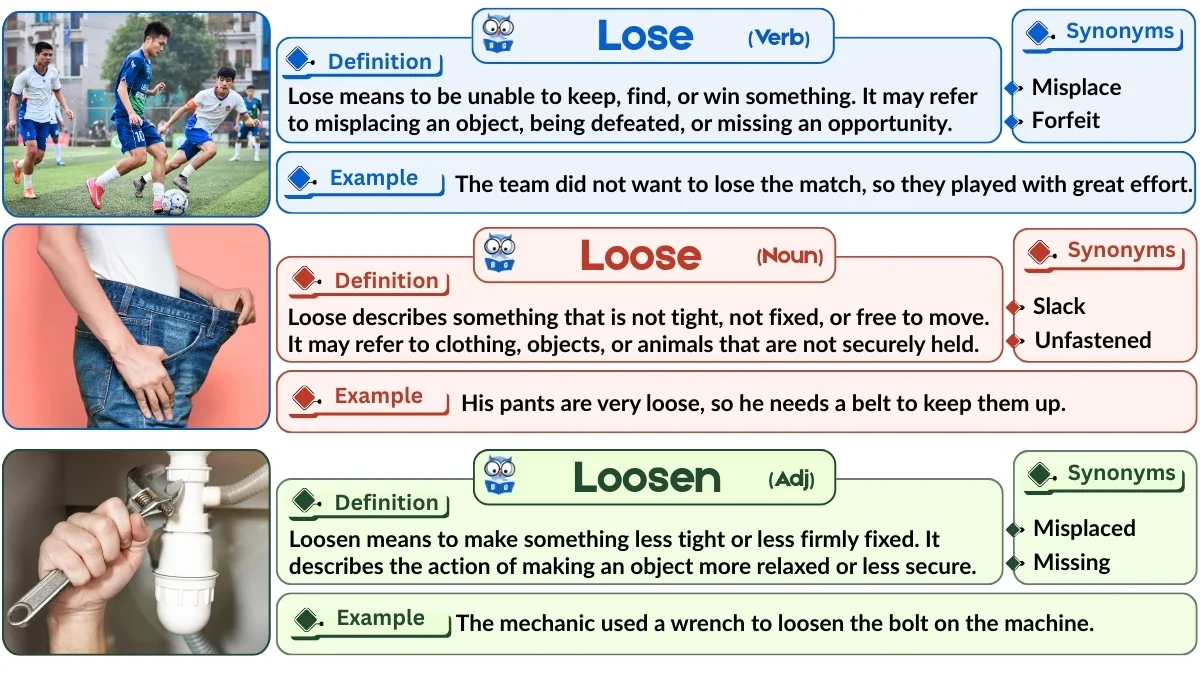
Many English learners confuse lose, loose, and loosen because these words look very similar in spelling and pronunciation. However, their meanings and grammatical roles are different. Understanding the difference between them can help you avoid common mistakes in writing and speaking. In simple terms: Lose is a verb that means to fail to keep something or to be defeated; Loose is usually an adjective that means not tight or not firmly fixed; and Loosen is a verb that means to make something less tight. Let’s examine each word with examples and explanations.
1. Lose
Meaning & Part of Speech: Verb — To fail to keep something, to misplace something, or to be defeated in a competition.
Explanation: Lose (verb) means to fail to keep something, misplace something, or be defeated in a competition. It describes an action.
Example: Be careful not to lose your passport while traveling.
Explanation: In this sentence, lose refers to the action of misplacing or no longer having the passport.
More Examples:
- Try not to lose your keys again.
- Our team might lose the match if we do not practice well.
- I do not want to lose this opportunity.
- She was afraid she might lose her phone in the crowded market.
Important Note: Lose is a verb and does not mean "not tight." Many learners confuse it with loose, which has a completely different meaning.
Related Words: Misplace, Drop, Forfeit, Suffer defeat, Fail
2. Loose
Meaning & Part of Speech: Adjective — Not tight, not fixed firmly in place, or free from constraint.
Explanation: Loose (adjective) describes something that is not tight, not fixed firmly, or free to move. It usually functions as an adjective describing physical conditions such as clothing, screws, or ropes.
Example: The button on my shirt is loose.
Explanation: In this sentence, loose describes the condition of the button. It means the button is not tightly attached.
More Examples:
- The rope is too loose to hold the boat.
- His shoelaces are loose.
- The dog ran away because the collar was loose.
- Wear loose clothing during hot weather.
Important Note: Loose often describes physical items or objects that are unfastened or slack.
Related Words: Slack, Unfastened, Detached, Free, Baggy
3. Loosen
Meaning & Part of Speech: Verb — To make or become less tight, firm, or rigid.
Explanation: Loosen (verb) means to make something less tight or less firm. It is the action verb related to the adjective loose.
Example: Please loosen the lid of the jar.
Explanation: In this sentence, loosen describes the action of making the lid less tight so it can be opened easily.
More Examples:
- He tried to loosen the tight knot in the rope.
- The mechanic will loosen the bolts before removing the wheel.
- She loosened her scarf because it felt too tight.
- Exercise helps loosen stiff muscles.
Related Words: Unfasten, Untie, Slacken, Relax, Release
Common Mistakes to Avoid
-
Using Loose Instead of Lose
Incorrect: I always loose my keys.
Correct: I always lose my keys.
Explanation: The sentence needs an action verb meaning "misplace." The correct word is lose, not loose. -
Using Lose Instead of Loosen
Incorrect: Please lose the rope.
Correct: Please loosen the rope.
Explanation: The sentence means to make the rope less tight, so the correct verb is loosen.
Summary
Although lose, loose, and loosen look very similar, their meanings and grammatical functions are quite different:
- Lose – Action verb; to misplace something or fail to win.
- Loose – Adjective; describes something that is not tight or firmly fixed.
- Loosen – Action verb; the act of making something less tight.
A simple way to remember the difference is that Lose has one 'o' and is an action you do (Verb), Loose has two 'o's like a pair of baggy pants (Adjective), and Loosen adds an 'n' to perform the action of unfastening (Verb).
Examples using all three in one sentence:
- If your shoelaces are loose, you should loosen them further or tie them again so you do not lose your balance.
- If the bicycle chain becomes loose, you may need to loosen the bolts first so you do not lose the proper alignment.
Practice Exercise: Fill in the Blanks Using Lose / Loose / Loosen
Choose the correct word (lose, loose, or loosen) to complete each sentence:
- Be careful not to __________ your grip on the rope.
- These shoes are too __________ for me.
- You should __________ the tight knot carefully.
- If the screws are __________, fix them immediately.
- Don’t __________ your balance while climbing.
- He tried to __________ his tie after the meeting.