
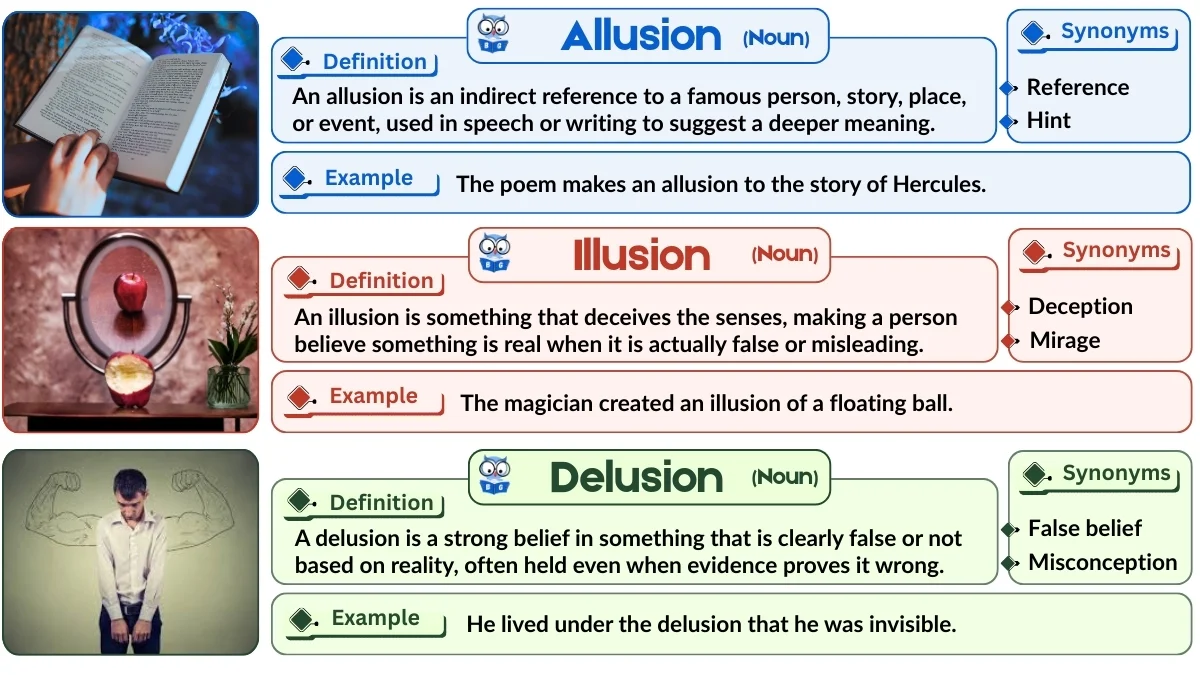
Allusion vs. Illusion vs. Delusion: Difference and Examples
The words allusion, illusion, and delusion look and sound similar, but they have very different meanings. Allusion refers to an indirect reference to something, often in literature, history, or culture. Illusion describes something that appears real but is actually false or deceptive. In contrast, delusion refers to a strong belief in something that is clearly false, often despite evidence to the contrary. Because these words have similar spellings and pronunciations, they are often confused in writing. Understanding the difference helps improve vocabulary and ensures clearer communication.
1. Allusion
Meaning & Part of Speech: Noun — An indirect or subtle reference to a person, event, place, or piece of literature.
Explanation: Allusion is a noun that means an indirect reference to a person, event, place, or piece of literature. Writers and speakers often use allusions to connect their ideas with well-known stories, historical events, or cultural references. The word is commonly used in literature, speeches, and academic writing to add deeper meaning without explaining everything directly. Readers or listeners are expected to recognize the reference and understand its significance. Overall, allusion emphasizes a subtle or indirect mention of something.
Example: The author made an allusion to a famous myth in the novel.
Explanation: In this sentence, allusion refers to an indirect reference to a well-known myth. The author does not fully explain the myth but mentions it in a way that readers who know the story can recognize and understand the deeper meaning.
More Examples:
- The speech included an allusion to a historical event.
- Her poem contains an allusion to a classic novel.
- The movie makes an allusion to ancient legends.
- The teacher explained the allusion to Shakespeare in the text.
- The writer used an allusion to highlight the theme of bravery.
Related Words: Reference, Mention, Hint, Suggestion, Citation
2. Illusion
Meaning & Part of Speech: Noun — Something that appears real or true but is actually false, deceptive, or misleading to the senses.
Explanation: Illusion is a noun that refers to something that appears real or true but is actually false or misleading. It is often used when discussing visual tricks, magic performances, or situations where perception does not match reality. The word may also describe a mistaken belief created by appearances. Illusions are common in art, psychology, and entertainment, especially when something looks different from what it actually is. Overall, illusion emphasizes deception of the senses or a false appearance.
Example: The magician created the illusion that the coin had disappeared.
Explanation: In this sentence, illusion means that the magician made the audience believe the coin vanished, even though it was actually hidden. The word highlights how the trick created a false appearance that fooled the viewers.
More Examples:
- The mirror created an illusion of a larger room.
- The painting gives the illusion of depth.
- The desert heat created the illusion of water in the distance.
- The lights produced an illusion of movement.
- The design uses shadows to create an illusion of space.
Related Words: Deception, Trick, Mirage, False appearance, Misperception
3. Delusion
Meaning & Part of Speech: Noun — A fixed, strong belief in something that is clearly false or mistaken, held despite evidence to the contrary.
Explanation: Delusion is a noun that refers to a strong belief in something that is clearly false, even when evidence proves otherwise. The word is often used in psychology to describe beliefs that do not match reality. It can also appear in everyday language when someone continues to believe something unrealistic or mistaken. Unlike an illusion, which usually involves misleading appearances, a delusion is related to a false belief held in the mind. Overall, delusion emphasizes a deeply mistaken belief.
Example: He was under the delusion that he would win the race without training.
Explanation: In this sentence, delusion describes a false belief that he could win the race even though he had not prepared for it. The word highlights that his belief does not match reality.
More Examples:
- She lived under the delusion that everyone agreed with her.
- His belief that he could never fail was a delusion.
- The plan was based on a dangerous delusion.
- Some people remain in delusion despite clear evidence.
- He realized that his earlier confidence had been a delusion.
Related Words: False belief, Misconception, Fantasy, Mistaken belief, Error
Summary
Although allusion, illusion, and delusion look very similar, their meanings are quite different. Allusion refers to an indirect reference to something, illusion describes something that appears real but is actually deceptive, and delusion refers to a false belief that someone strongly holds despite evidence. A simple way to remember the difference is that allusion relates to a literary link or reference, illusion relates to an image or visual trick, and delusion relates to a deep-seated or dangerous false belief in the mind.
Practice Exercise: Fill in the Blanks Using Allusion / Illusion / Delusion
Choose the correct word (allusion, illusion, or delusion) to complete each sentence:
- The magician created an amazing __________ on stage.
- His speech included an __________ to a famous novel.
- She was under the __________ that she would win easily.
- The desert mirage was just an __________.
- The writer made an __________ to Shakespeare in his poem.
- Believing something false despite evidence is called a __________.