
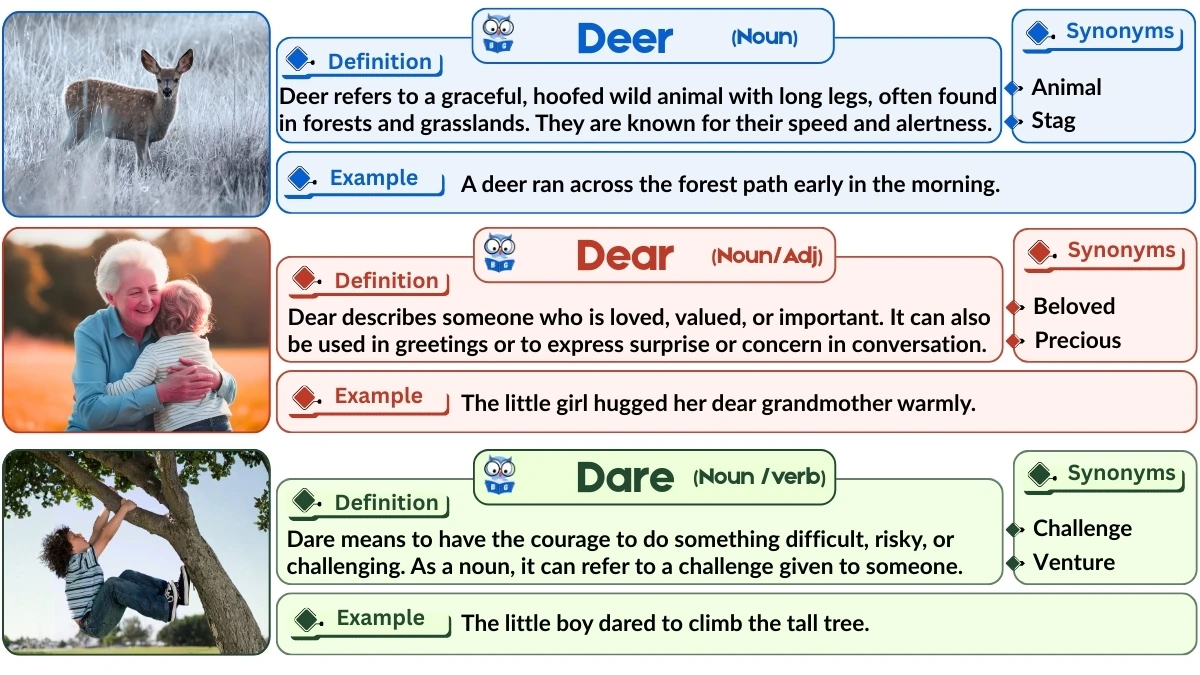
Deer vs. Dear vs. Dare: Difference and Examples
The words deer, dear, and dare may sound similar, but they have very different meanings and uses. These words belong to completely different contexts—animals, emotions, and actions—so it’s important to understand them clearly. Let’s explore each word with simple explanations and examples.
1. Deer
Meaning & Part of Speech: Noun — A hoofed grazing or browsing animal with branched bony antlers that are shed annually (males).
Explanation: "Deer" is a noun that refers to a wild animal with long legs, often found in forests and grasslands. Some deer have antlers, especially males. It is commonly used when talking about wildlife or nature. Note that the plural form of deer is also deer (not deers).
Example: We saw a deer in the forest during our trip.
Explanation: In this sentence, deer refers to a wild animal seen in the forest. It shows the use of the word in a natural setting and highlights how deer is used to describe wildlife.
More Examples:
- A deer ran across the road suddenly.
- The hunter spotted a deer from a distance.
- Deer are gentle and shy animals.
- We watched a group of deer grazing.
Related Words: Animal, Wildlife, Antelope, Mammal, Stag, Fawn
2. Dear
Meaning & Part of Speech: Adjective & Noun — Regarded with deep affection or cherished; used as a polite greeting; or expensive.
Explanation: "Dear" is an adjective and noun used to express affection, love, or importance. It is often used in greetings, such as in letters, and to refer to someone special. In British English and older contexts, it can also mean expensive or costly. This word is very common in daily communication.
Example: She wrote a letter starting with “Dear Ali.”
Explanation: Here, dear is used as a polite and friendly greeting in a letter. It shows respect and warmth toward the person being addressed, which is common in both formal and informal writing.
More Examples:
- He is very dear to me.
- This dress is too dear for my budget.
- Dear friends, welcome to the event.
- She bought a gift for her dear mother.
Related Words: Beloved, Loved, Precious, Cherished, Costly
3. Dare
Meaning & Part of Speech: Verb & Noun — To have the courage to do something; or to challenge someone to do something bold or risky.
Explanation: "Dare" is a verb that means to have the courage to do something or to challenge someone to do something risky. It is often used when talking about bravery or bold actions. It can also be used in questions and negative sentences (e.g., How dare you!). The word is common in both casual and formal speech.
Example: I dare you to climb that tall tree.
Explanation: In this sentence, dare is used as a challenge. It encourages someone to do something that may be difficult or risky, expressing boldness or testing someone’s courage.
More Examples:
- She didn’t dare to speak in front of the crowd.
- How dare you talk to me like that?
- He dared his friend to jump into the river.
- I wouldn’t dare to lie to my teacher.
Related Words: Challenge, Risk, Courage, Venture, Defy
Common Mistakes to Avoid
-
Writing Dear Instead of Deer for the Animal
Incorrect: I saw a dear in the woods yesterday.
Correct: I saw a deer in the woods yesterday.
Explanation: The forest animal is spelled with two 'e's (deer), whereas dear refers to affection or greetings. -
Confusing Dare with Dear in Challenges
Incorrect: Don't you dear touch that!
Correct: Don't you dare touch that!
Explanation: Expressing bold courage or warnings requires the verb dare.
Summary
Even though deer, dear, and dare sound alike, their meanings belong to completely different categories:
- Deer – A forest animal with hooves (remember two 'e's like twin eyes watching in the woods).
- Dear – Loved, valued, expensive, or used as a polite greeting in letters.
- Dare – An action showing courage or challenging someone to be brave.
A simple memory tip: A wild deer runs on double legs (ee) through the trees, a dear friend holds a place in your heart (ea), and a dare requires courage to are-ise to a challenge.
Practice Exercise: Fill in the Blanks Using Deer / Dear / Dare
Choose the correct word (deer, dear, or dare) to complete each sentence:
- We saw a __________ crossing the road at night.
- __________ Sir, I am writing to inform you about the issue.
- I __________ you to try this difficult task.
- The __________ ran quickly into the forest.
- She is very __________ to her family.
- He did not __________ to question the teacher.