
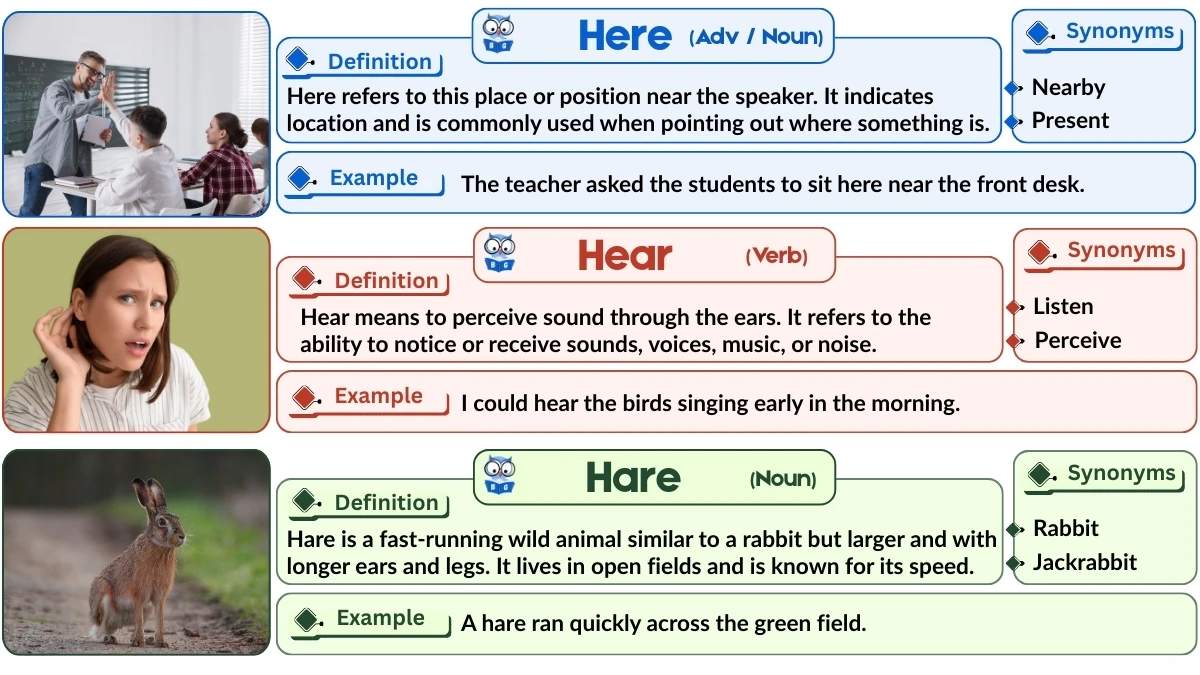
Hear vs. Here vs. Hare: Difference and Examples
The words hear, here, and hare sound the same but have completely different meanings and spellings. These are common homophones in English that can easily confuse learners. Understanding their correct usage will help you avoid mistakes in writing and speaking. Let’s look at each word in detail.
1. Hear
Meaning & Part of Speech: Verb — To perceive or become aware of sound through the ear, or to receive information or news.
Explanation: "Hear" is a verb that means to perceive sound using your ears. It is used when you listen to or become aware of sounds. This word is commonly used in everyday conversations. It can also mean to receive information or news.
Example: I can hear music coming from the next room.
Explanation: In this sentence, hear refers to the ability to detect sound. The person is noticing music through their sense of hearing. It shows how the word is used for listening or becoming aware of sounds.
More Examples:
- Did you hear that loud noise?
- I heard someone calling my name.
- She cannot hear properly.
- We heard the news yesterday.
Related Words: Listen, Sound, Perceive, Notice, Auditory
2. Here
Meaning & Part of Speech: Adverb & Noun — In, at, or to this place or position; present at this moment.
Explanation: "Here" is an adverb that refers to a place or position. It is used to indicate location or presence near the speaker. This word is very common in both spoken and written English. It can also be used to draw attention to something.
Example: Please come here and sit beside me.
Explanation: In this sentence, here refers to a specific place near the speaker. It shows where the person is being asked to come. The word is used to indicate location or position clearly.
More Examples:
- I am standing right here.
- Put the bag here on the table.
- Here is your book.
- We live here now.
Related Words: Place, Location, Position, Nearby, Present
3. Hare
Meaning & Part of Speech: Noun — A fast-running, long-eared mammal related to the rabbit, typically larger with longer legs.
Explanation: "Hare" is a noun that refers to a fast-running animal similar to a rabbit but usually larger. It is known for its long ears, long hind legs, and high speed. This word is often used in stories, folklore, and nature contexts. Hares are commonly found in fields and open areas.
Example: The hare ran quickly across the field.
Explanation: In this sentence, hare refers to a fast animal similar to a rabbit. It highlights the speed and movement of the animal. The word is used in the context of wildlife or storytelling.
More Examples:
- The hare escaped from the hunter.
- A hare can run very fast.
- The story of the tortoise and the hare is famous.
- We spotted a hare in the grassland.
Related Words: Rabbit, Animal, Wildlife, Mammal, Lagomorph
Common Mistakes to Avoid
-
Writing Here Instead of Hear for Listening or Sounds
Incorrect: Speak up so I can here you.
Correct: Speak up so I can hear you.
Explanation: Listening with your ear requires the spelling hear (which contains the word ear). -
Confusing Hear with Here for Locations
Incorrect: Please bring the papers over hear.
Correct: Please bring the papers over here.
Explanation: Present locations or nearby places use here (spelled with 'e-r-e' like there and where).
Summary
Although hear, here, and hare sound identical, their roles and spelling patterns are completely distinct:
- Hear – To perceive sound (contains ear like hearing with your ear).
- Here – This current place or location (rhymes with and shares spelling with there and where).
- Hare – A fast-running animal related to a rabbit (ends in 'are' like a wild area).
A simple memory tip: You hear sound with your ear, you stay here or go there, and a fast hare runs in open air!
Practice Exercise: Fill in the Blanks Using Hear / Here / Hare
Choose the correct word (hear, here, or hare) to complete each sentence:
- I can __________ someone knocking at the door.
- Please sit __________ and wait for your turn.
- The __________ jumped across the field.
- Did you __________ the announcement?
- Come __________ quickly, I need your help.
- The __________ ran faster than the dog.